

1 Mini sentences
Different languages have different word orders that express the same underlying concept, and children have the ability to learn any one of them, as shown in Figure 1.
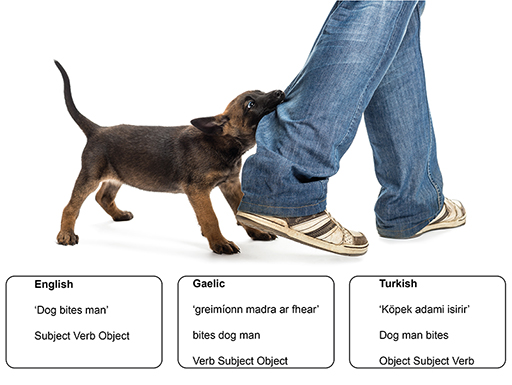
Typically, children start to combine words into mini sentences somewhere between 18 and 24 months old (Nelson, 1973). Let’s take a closer look at the kinds of two-word combinations children first use. Developmental psychologist Melissa Bowerman (1975) compared the early multi-word utterances spoken by children learning English, Finnish, Samoan and Luo. Even though these languages come from very different branches of the language family tree and vary considerably in their phonology, vocabulary and grammar, Bowerman found that children’s first two-word utterances showed remarkable similarity in the types of things they talked about and could be classified according to a small number of constructions types (see Table 1). For example, the utterance types, agent-action and action-object were highly frequent across all languages. Presumably this is because these constructions package a scene common to the experience of all children: someone or something intentionally performing an action and an action having some effect on an object.
| Two-word utterances | English | Finnish | Samoan | Luo |
|---|---|---|---|---|
| Agent-action | Mommy push | Man dances | Goes Va | Car runs |
| Action-object | Bite finger | Drives car | Spank me | Eat medicine |
| Possessor-possessed | Dolly hat | Aunt car | Ball yours | Head mine |
| Demonstrator-object demonstrated | That candy | There cow | Ball there | It clock |
| Adjective-noun | Big bed | Little fish | Children older | Pepper hot |