

4 Rules about sticking parts of words together
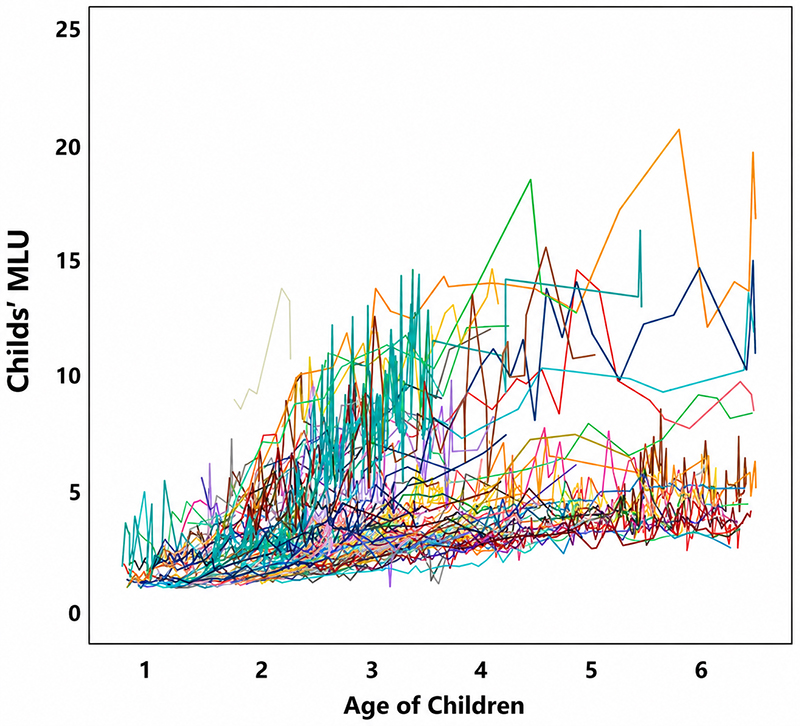
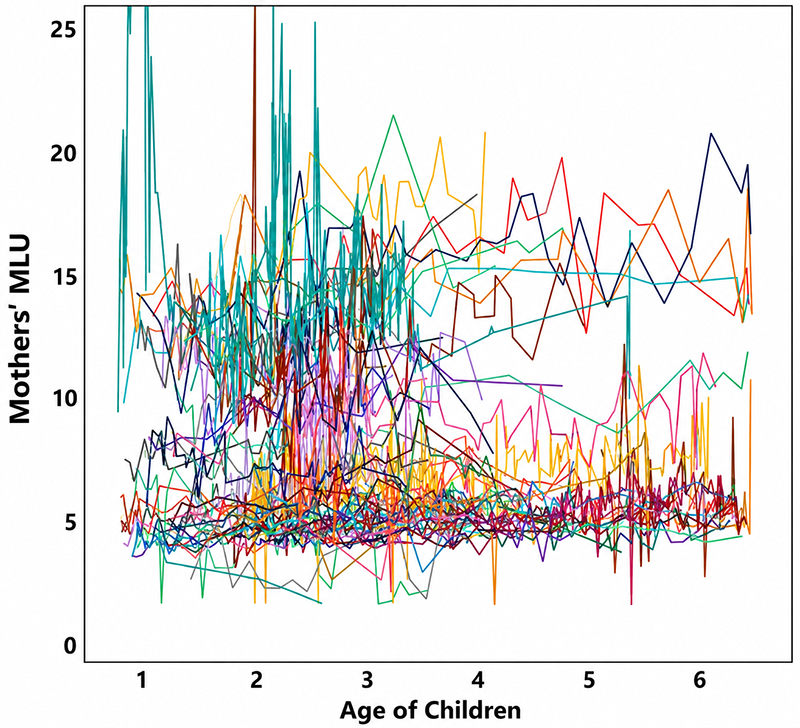
Around 30 months of age, children’s utterances become more complex, as they add additional words, affixes and other grammatical morphemes. Whereas before they may have just said ‘doggie walk’, now they might be able to add morphemes to form ‘walk+ed’, ‘walk+ing’, and ‘walk+s’. The data in Figure X represents 103 mother–child pairs who spoke 3,170,633 utterances and 16,209,659 morphemes, divided across 20 different languages: Afrikaans, Catalan, Cantonese, Danish, Dutch, English, Farsi, French, German, Hebrew, Icelandic, Irish, Italian, Japanese, Mandarin, Norwegian, Portuguese, Spanish, Swedish and Turkish. Ibbotson and Browne (2024) found large variation in the path of early language development, both for children (first image) and their mothers (second image). This variation was best explained by the language children were learning (i.e. children learning the same language had more similar morpheme learning curves) and maternal speech (i.e. mothers with high morpheme use tended to have children with higher morpheme use, regardless of which language they were learning). Interestingly, the rate at which children learned language was attuned to the complexity of their mother tongue, with steeper learning curves for languages with more complex morpheme use. These results demonstrate the relative influence of culture (language) and family (mothers) in shaping the path of language acquisition for different children.
There are more than 7,000 languages in the world that children are capable of learning. But does that mean that they will grow up with 7,000 different ways of thinking? Watch the following video which explores these ideas.

Transcript: Video 1 Do we think differently in different languages?
SPEAKER 1: So do we think differently--
SPEAKER 2: --in different languages.
SPEAKER 1: OK.
SPEAKER 3: [NON-ENGLISH SPEECH] Sorry. It’s like a tongue twister.
[MUSIC PLAYING]
SPEAKER 4: That’s a brilliant question.
[MUSIC PLAYING]
PANOS ATHANASOPOULOS: The Whorfian hypothesis, as it’s known, which is the idea that our language affects our thinking, has been debated for decades, even centuries.
CHRISTOPHER HART: There’s a growing amount of experimental evidence that differences across languages have an influence on the way speakers of those languages conceive of the world. We can see that different languages structure the world in different ways. They carve up the various continua and different types of relations in the world.
SOPHIE SCOTT: The way that different languages chop up the world almost can vary. And that does actually influence how you see that world.
SPEAKER 5: I think language changes everything about the way you think.
SPEAKER 6: I go into a certain mindset. I sound deeper. I don’t know why.
SPEAKER 7: I perceive situations differently, I react differently.
SPEAKER 8: I think I’m more grounded and more in touch with my emotions in German.
SPEAKER 5: Yeah, it makes me feel more assertive when I’m speaking Dutch, because you just get straight to the point.
PANOS ATHANASOPOULOS: It’s not just for talking. Language is for organising an otherwise messy world into identifiable categories. It gives us ready labels.
SPEAKER 9: It’s like LEGO. You add another word to the word, and that makes it more precise.
SPEAKER 5: Language in French is super gendered, so everything has a masculine or feminine, and it just makes everything feel a bit more one or the other.
SOPHIE SCOTT: If you have a word like ‘bridge’, if it’s in a language where it is carrying a masculine gender, then bridges will be described by people slightly differently. So its usefulness or its power might be more associated with the feminine gender, whereas its strength and its size might be more associated with the masculine gender.
CHRISTOPHER HART: The structure of a language forces us to attend to certain aspects of a language that are certain aspects of reality that are relevant for a language at the moment of using that language. It’s known as the thinking for speaking hypothesis. There’s evidence that language involves some kind of image simulation, and that has a consequence for how we perceive of certain events.
SOPHIE SCOTT: Colour is quite a complex property of a visual world. Your brain’s decoding colour in quite a complicated way.
PANOS ATHANASOPOULOS: So you have many languages that have a term to denote both green and blue. And typically, we call this a grue term. You find this in languages like the Himba, for example, in the Namibian Plains. In this experiment, we asked participants to look at the colour tile. And then after 30 seconds, we show them the full array of colours. And we say, now pick the one that you just saw.
And it’s a very difficult task if you’re an English speaker, but a Himba speaker can do it like child’s play, because that colour is central to them. You simply cannot recognise colours that are not easily encoded in your native language.
CHRISTOPHER HART: I think by virtue of being born into a particular culture and the language that goes with that culture, we are almost certainly given to think in a particular way.
SOPHIE SCOTT: The human brain doesn’t work out of the box. You grow up, and you’re growing up learning languages in particular environments. So by the time you’re dealing with an adult, you’re dealing with a brain that has been trained up to be an expert along a number of quite specific dimensions.
PANOS ATHANASOPOULOS: There’s actually another very, very good reason to learn a language, and that’s simply to gain another perspective on the world.
SPEAKER 3: So you can actually say a lot quicker in Uzbek than you can in English, which is quite interesting. They used to be nomadic, which means that the language has to be a lot quicker because you’re speaking to people while moving around, and all this kind of stuff.
CHRISTOPHER HART: But in a sense, language is culture, and culture is language.
SPEAKER 3: Speaking a different language is almost a gateway into a completely different cultural understanding.
[NON-ENGLISH SPEECH]
PANOS ATHANASOPOULOS: Cognitive diversity, I think, is at the core of human nature. It is probably, if you’re looking for universals, diversity is probably the one true universal of humanity.
The Whorfian hypothesis is the idea that the language we speak affects the way we think and even how we see and structure the world around us. While there is no evidence that speaking a particular language makes some thoughts impossible for us to imagine, the language we speak does make some ways of seeing the world more or less obvious.