5 Slot and frames
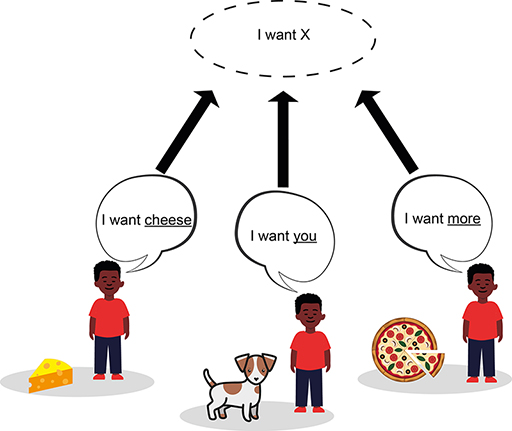
Several theories of language acquisition propose that grammatical knowledge builds up in a piecemeal fashion, and early on in development these are based around specific word-based patterns that become more word-general over time (e.g. Bybee, 2010; Tomasello, 2003). These patterns are likely to emerge where a number of different words occur in a variable slot (X) alongside a relatively frequent and fixed frame, for example, ‘Where’s the X?’, ‘I wanna X’, ‘More X’, ‘It’s a X’, ‘I’m X-ing it’, ‘Put X here’, ‘Mommy’s X-ing it’, ‘Let’s X it’, ‘Throw X’, ‘X gone’, ‘I X-ed it’, ‘Sit on the X’, ‘Open X’, ‘X here’, ‘There’s a X’, ‘X broken’ (e.g. Lieven, Pine and Baldwin, 1997). Figure X shows an example of how this process might work for a ‘I want X’ slot-and-frame pattern where the frame is ‘I want’ and the X is a slot.
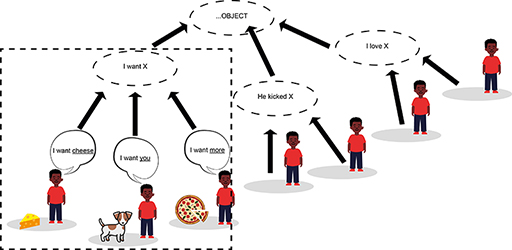
These slot-and-frame patterns are thought to provide initial footholds of reliability for children to ratchet their way into more complex and abstract grammar (Tomasello, 2003). For example, Figure X shows how the hierarchy of the ‘I want X’ schema eventually becomes subsumed into a more complex network that generalises language at an even higher level of abstraction, the grammatical category of ‘Object’. In English the object tends to follow the subject (e.g. ‘JohnSUBJECT likedVERB MaryOBJECT’) the object can become the subject in a passive sentence (‘JohnSUBJECT likedVERB MaryOBJECT’ → ‘MarySUBJECT was likedVERB by JohnOBJECT’) and is marked with a particular case (‘sheNOMINATIVE liked himACCUSITIVE’ not ‘herACCUSITIVE liked heNOMINATIVE’).