

1 Two steps forward, one step back
So far this course has been describing children’s language learning as if it was a smooth progression, with performance always improving. While much of language development does follow this kind of ‘S-shaped’ curve, other aspects show progression and then regression, with performance getting worse before it gets better. This is termed ‘U-’ or ‘N-shaped’ development, depending on which bit of the curve we focus on (see Figure 1).
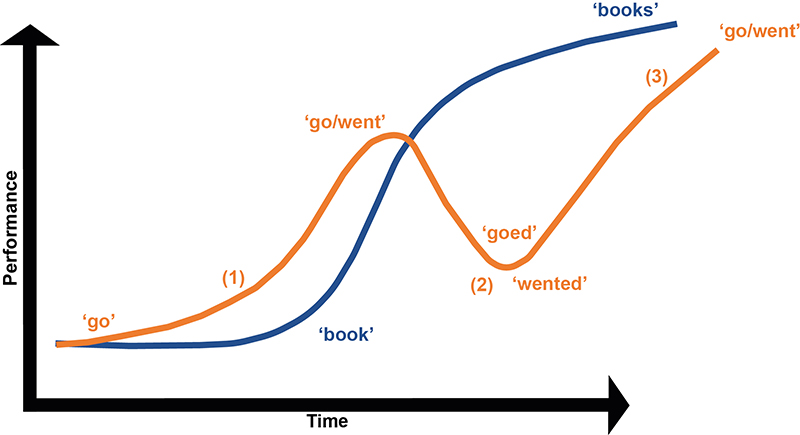
Studying the shape of development is important because it can give us a window into the mechanisms driving acquisition and a test case for theories that predict what pieces of language should be learned when. For example, a U-shaped curve for learning the past tense distinction could reflect a reorganisation of linguistic knowledge taking place in three distinct phases.
- Children begin to memorise the past forms of all the verbs they hear on a verb-by-verb basis, do not deviate far from the language they hear in a conservative learning strategy and so gradually produces correct adult-like forms as they experience examples in Child Directed Speech.
- Children form a general category of ‘past tense’ and make generalisations and sometimes over-generalisations based on this new category. Note that in this phase, incorrect forms such as ‘go-ed’ are sometimes spoken by the same children who at the same time also say the correct form ‘went’.
- A retreat from over-generalisation errors through a combination of linguistic, cognitive and social factors (which will be discussed in Sections 5 and 6).