3 Speech errors
The first thing to note is that speech errors are relatively rare in child speech, with estimates ranging from 2 to 5 per cent depending on what areas of language we focus on and what counts as an error (Pinker, 1989). Given the complexity of language, this level of accuracy is incredibly impressive and underscores what an exquisitely tuned process language acquisition is. Errors do exist though, and they come in two main varieties: errors of commission – saying something you should not – ‘I go-ed to the shops’ vs ‘I went to the shops’ – and errors of omission – not saying something you should – ‘I up now’ vs. ‘I am up now’.
Sometimes these errors can be explained as creative cut-and-pastes of the language children experience around them. For example, how often children make me-for-I errors (e.g. ‘me do it’) is predicted by how often they hear their caregivers use ‘me’ in first person-singular pre-verbal contexts (e.g. ‘let me do it’) (Kirjavainen, Theakston and Lieven, 2009). In this case children appear to cut ‘me do it’ out of the input and paste it in their own utterances. This meets the communicative needs of the moment, albeit in an unconventional way.
A similar process occurs when children learning multiple languages blend elements of different languages together, sometimes within the same phrase. For example, ‘Ein big one wants Tim’ (‘A big one wants Tim’), or ‘Ein yellow spoon hat Tim’ (‘A yellow spoon has Tim’) (Quick, Lieven, Carpenter and Tomasello, 2017). Here the child has inserted English words into a grammatical frame (Object, Verb, Subject[Tim]) much more likely to occur in German than it is in English.
Before you consider how children overcome errors, you’ll look at some examples of how adults and children respond to their own errors. Some researchers of parent–child interactions noted that adults did not seem to explicitly correct children’s errors (example 1) and if they do, children seem resistant to adjusting their response (examples 2 and 3):
(1) Father Where is that big piece of paper I gave you yesterday?
Child Remember? I writed on it.
Father Oh that’s right don’t you have any paper down here buddy?
(2) Father You mean, you want the other spoon.
Child Yes, I want other one spoon, please Daddy.
Father Can you say ‘the other spoon’?
Child Other … one … spoon.
Father Say ‘other’.
Child Other.
Father ‘Spoon’
Child Spoon.
Father ‘Other spoon’.
Child Other … spoon. Now give me other one spoon?
(3) Child My teacher holded the baby rabbits and we patted them.
Adult Did you say your teacher held the baby rabbits?
Child Yes
Adult What did you say she did?
Child She holded the baby rabbits and we patted them.
Adult Did you say she held them tightly?
Child No, she holded them loosely.
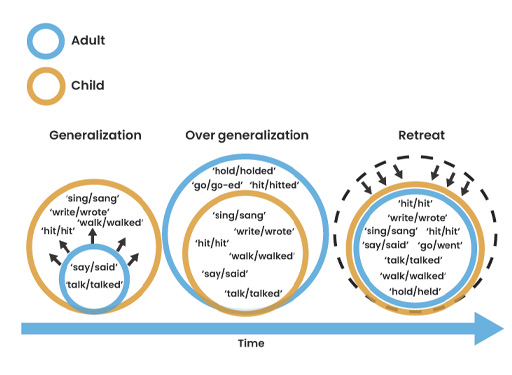
The problem of how words and phrases like ‘writed’, ‘other one spoon’ and ‘holded’ ever come to be regarded as unconventional by children has become a central question in the field of language acquisition research (see Figure 2).