

2 Irony
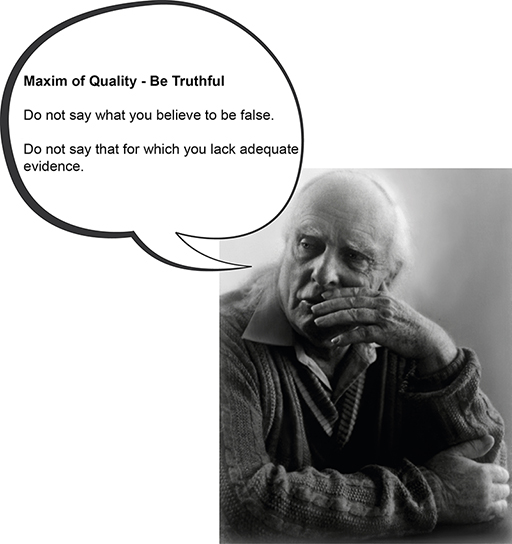
Irony typically involves a speaker juxtaposing a situation which would normally provoke one response with the opposite one, such as ‘I’ve chopped my leg off, how wonderful!’ On the surface then, this might appear like a violation of the maxim Do not say what you believe to be false, because in this example, chopping your leg off is far from wonderful. But with irony, there is usually no intention to deceive (see Figure 2). Ironic language can take many forms, including sarcasm where the intention is usually personal criticism (e.g. ‘You’re so funny’), ironic questions (e.g. ‘Are you insane?’), understatement (e.g. ‘It’s just a minor scratch’), overstatement (e.g. ‘I could eat a horse’), ironic offering (e.g. ‘Would you like another glass to break?’) and ironic thanking (e.g. ‘Thanks for ruining my evening’).

Because of the pragmatic gymnastics involved in ironic language use – integrating speakers’ beliefs, intentions, attitudes, situational context cues and so on – it is not surprising that ironic language production does not become a typical feature of naturalistic speech until late childhood or even early adolescence. There is evidence that ironic comprehension starts much earlier though, with children around 5 to 6 years of age able to recognise that speakers who make ironic remarks do not literally believe what they say, but are unable to articulate exactly what the ironic speakers do believe. Even children as young as 3 to 4 years of age are able to grasp the basic incongruity between the utterance and the context, but fail to comprehend what the ironic language is being used for, for example, deflecting criticism, teasing, or being humorous (Fuchs, 2023). Consequently, young children are more likely to misinterpret ironic use as lying, for example interpreting ‘nice weather’ (when it is raining) as intention to deceive.