

4 Common ground and information structure
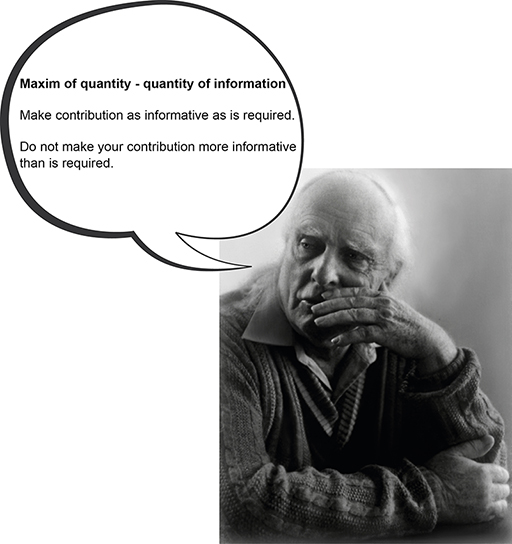
An example of making your contribution as informative as required involves keeping track of what your conversational partner knows. For example, with a stranger, you are unlikely to start the conversation with ‘he was drunk’. Rather, if you play by the cooperative principle, you spend time establishing the common ground between you and your partner such that by the time you get to ‘he was drunk’ you can bet your listener shares enough of your frame of reference to understand who ‘he’ is … ‘you know that guy we saw yesterday … the one with the beard … and the parrot on his shoulder … no, not that guy, his brother … yeah, that’s right, him, well he was drunk’. The psycholinguist Herb Clark has emphasised the importance of this dynamic back-and-forth interactive process in discourse that allows speakers to understand each other’s referential language (Clark, 1996).
In fluent conversation between adults, there is typically only 0.2 seconds between one person finishing a conversational turn and the next person starting. However, it takes about 0.6 seconds to plan and produce the next word (Levison, 2016). This means that adult speakers must be predicting what other people are going to say and planning their response before the other person has finished, a task that requires integrating multiple sources of physical, social and linguistic information that takes years to master.
To examine the roots of common ground, developmental psychologist Nameera Akhtar and her colleagues played with three novel, nameless objects in front of 2 year olds (Akhtar, Carpenter and Tomasello, 1996). The adults then left the room while a fourth nameless and novel object was introduced. On their return to the room the adults displayed excitement and modelled the use of a new word ‘Look, I see a gazzer!’, being sure not to inadvertently cue the children with eye gaze or pointing. The 2 year olds handed over the object that was introduced while the adults were out of the room. This shows that children are not only sensitive to whether elements of a situation are ‘new’ for themselves, but also exhibit awareness of whether an entity is new for their partner.
This new/given distinction is part of a broader set of conventions that govern the information structure in utterances and discourse. The givenness of information typically refers to how easy information is to retrieve from the immediate shared context or from memory. Typically, speakers structure their information such that new information builds upon and refers back to given, established information. A somewhat related idea is that speakers typically follow a topic-comment sequence; that is, they introduce what the utterance is about, before elaborating their attitude towards or comment on the topic.