

5 Relevance
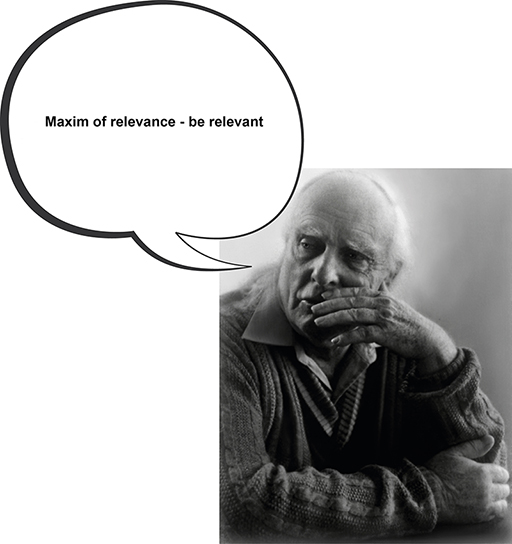
When we talk about people’s inclination to be relevant in conversation, we aren’t just referring to the comically off topic:
Woman ‘How are you today?’
Man ‘An approximation of pi is 3.14’.
We are talking about something much more ordinary and closer to our everyday experience, so much so that it is difficult to comprehend at first why it is irrelevant. To take another example:
Son ‘Can we play?’
Mother ‘I’m tired’
Taken literally, the mother’s response is a non-sequitur about her energy levels. The issue is that non-literal use in this sense is widespread in language. In this instance, the mother hedges her bet that her son can do the inferential footwork and recover the intended meaning of ‘I’m tired’. It is a bet in the sense there are a number of steps in the reasoning, any one of which could cause the son to take a wrong turn and end up at the wrong conclusion. That would mean she would have to spell out her reasoning taking more time and energy.
Understanding communicative intention is fundamental to making language work, which is why you spent time in Session 2 understanding how children develop this kind of understanding through dyadic and triadic interaction, proto-conversations and shared attention, which support more complex understanding of what others perceive, want, know, see, desire and believe.
Note that a decision for the mother in the above example to save some energy not spelling out the inferential steps is a decision for the son to pick up the pragmatic slack (we have all had the feeling in conversation where we have felt the division of labour of inferential work has not been equal). The alternative to saying ‘I’m tired’ is to detail all the inferential steps, and that might violate the rule of do not make your contribution more informative than is required or be brief, unnecessarily burdening your listener with information they already knew or could work out for themselves. The big idea is that speakers are implicitly and constantly involved in a trade-off between being efficient in different contexts and maximising the chances of being successfully understood.