

1 Complexity
By this point you should hopefully agree that understanding of how language works and how children acquire it can be a complicated business. Think for a moment about the vastly different scales you have considered: from the biology of neurons and brain areas, to cognitive, behavioural, social and cultural levels of explanation; from the millisecond-to-millisecond parsing of speech, and the tens-of-years over which a child constructs their language, to the tens-of-thousands of years over which languages evolve. These processes take in the content of 7,000 or so mutually unintelligible cultural forms (not including all the languages that have existed or will exist) and produce an output that is treated as the input to the next generation of learners (see Figure 1).
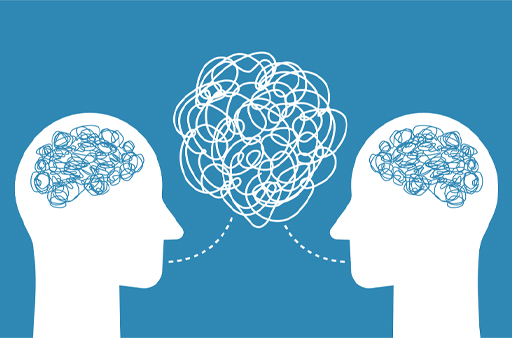
There is another sense in which language is not just complicated, but complex. Tens of thousands of academic papers, monographs and books are published every year on language. As the research accumulates on how individual elements of the linguistic system works, we might expect our knowledge of how the whole system works to also improve incrementally. That is not guaranteed however, because language is a complex adaptive system. That means behaviour we see at a global level (e.g. speech and dialogue) might be difficult, perhaps impossible, to perfectly predict with even a complete understanding of its parts (e.g. phonemes and morphemes). In this sense there is nothing unique about language: emergence has been evoked to explain the behaviour of such different natural systems as crystal growth, flocking birds, weather phenomena, ant colonies and traffic jams.
In these examples, as with language, there is something that is emergent from how the parts interact that is not reducible to the parts themselves. This course has taken a largely descriptive approach to language acquisition. But of course, we want our theories of language acquisition to go beyond that, to predict the unknown and unite what seemed an unrelated set of findings. Both the complicated (e.g. many moving parts) and the complex nature of language (irreducibility and emergence) present an ongoing challenge to constructing a comprehensive and integrated theory of language.