

2 Human nature
They say parents of one child believe in the role of nurture; parents of two believe in the role of nature. The implication behind the aphorism is that parents of multiple offspring often see how differently their children grow up despite sharing a similar environment and appreciate the role that genetics plays in individual differences. Every theory of language acquisition needs to include a role for both genetic and environmental influences, although some may emphasise one influence more than the other. No other animal has communicative abilities comparable to ours, something in our nature sets us apart, the debate has been – and still is – exactly what that is (Figure 2).
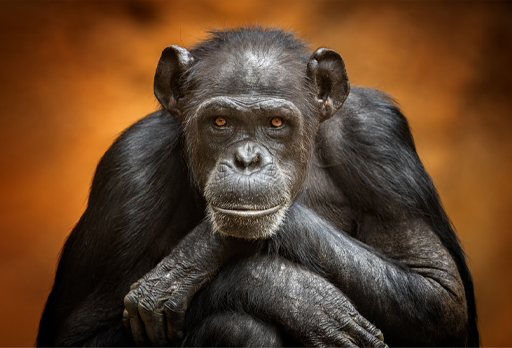
The relationship between genes and environment is profoundly more complex and subtle than we realised, even ten years ago. Humans are of course not born blank slates, with equal motivation or even potential to interact with the world in every way. They are born into this life with biases of physiology, perception and cognition that channel their development from the beginning. This species-typical inheritance is adapted to a species-typical environment, which can regulate which genes are turned on or off at any point, whose expression (or not) affects behaviour, which in turn affects later environment, which genes are expressed and so on. As you can see, this kind of relationship means that either-or thinking about genetics and environment is wholly unsuited to describing how development works. Instead it needs to be both-and. Natural selection has organised humans in advance of experience to expect culture by equipping us with a framework to acquire it. It is this universal framework that allows cultural and linguistic diversity to happen.
So, what is in this framework? One famously influential proposal is a universal grammar (Chomsky, 1965). The basic idea was a set of inherited principles common to all languages that could be triggered by any specific language. The way in which it was triggered and how universal grammar unfolded helped guide children towards successful language acquisition. The major challenge for universal grammar has been defining exactly what goes into it in such a way that helps a child learning any of the 7,000-plus languages. For example, one of the problems has been that any biases written into universal grammar that tend to help acquisition of one language, might inhibit the acquisition of another.
Others have argued we do not need linguistic content as part of the framework at all if we see language as part of a broader adaptation to cultural life in general (e.g. Tomasello, 2008). So yes, humans are unique in their language use, but they are also unique in producing a whole range of cultural artefacts and with cognitive adaptations they are capable of transmitting these from generation to generation. In principle, this view stands a better chance of being universalised across languages because the difference between children’s social cognitive biases (shared-intentionality, imitation, cooperation) are far less than the differences between the languages children need to learn (Navajo vs. Vietnamese vs. Sesutu, for example).