

1 The antibiotic resistance crisis
Start this week by completing the activity below. This will give you a sense of how serious the problem is and an introduction to the factors that drive resistance.
Activity _unit6.1.1 Activity 1 The antibiotic resistance crisis
Timing: Allow about 10 minutes
First, watch the following video.
Download this video clip.Video player: Video 1
Transcript: Video 1 The antibiotic resistance crisis.
TEXT ON SCREEN
Why are antibiotics so important to us? Antibiotics are used extensively in medicine to treat infections and to prevent infection during surgery or cancer treatment. Antibiotics are used extensively in veterinary medicine, dentistry. Antibiotics are used extensively in global food production. ‘Antibiotic resistance is one of the biggest threats to global health, food security, and development today.’ Antibiotics are the largest and best known class of a wider group of drugs called antimicrobials which also includes antiviral drugs and antimalarial drugs. Resistance can develop to all types of antimicrobial making these drugs less effective, but antibiotic resistance poses the greatest threat to global health. Levels of antimicrobial resistance (AMR) and antibiotic resistance (AR) are monitored worldwide.
Every year: 700,000 people die from AMR infection; nearly one third of these deaths are caused by multi-drug resistant TB (review on antimicrobial resistance, 2016). Every year: about two million people in the United States become infected with AR bacteria and at least 23,000 die as a direct result of these infections (Centres for Disease Control and Prevention, 2017). Every year: 25,000 people in Europe die from a drug-resistant infection caused by one of these bacteria: escherochia coli, klebsiella pneumoniae, enteroccus faecium, pseudomonas aeruginosa, methicilin-resistant Staphylococcus aereus (MRSA) (Public Health England, 2017).
Resistant infections lead to higher death rates and are more expensive to treat. In Europe healthcare costs and lost productivity as a result of drug-resistant infections already cost an estimated €1.5 billion per year (Review on antimicrobial resistance, 2016). If not tackled, rising AMR could have a devastating impact.
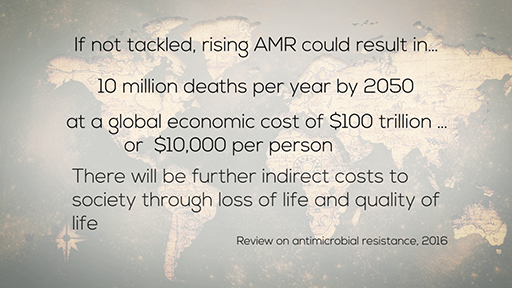
If not tackled, rising AMR could result in: 10 million deaths per year by 2050 at a global economic cost of $100 trillion … or $10,000 per person. There will be further indirect costs to society through loss of life and quality of life (Review on antimicrobial resistance, 2016).
Why are antibiotics so important to us? Every time an antibiotic is used there is the potential for resistance to develop. Poor hygiene and infection control spreads infections and indirectly leads to resistance. Resistance develops more quickly when antibiotics are overused or misused. New drugs are needed to replace antibiotics that are no longer effective. The risk of resistance developing is reduced when clinicians know which antibiotic will be the most effective treatment (Review on antimicrobial resistance, 2016).
The more antibiotics are used the more antibiotic resistance increased ( (Review on antimicrobial resistance, 2016).
Antibiotics only work against bacterial infections. Colds and flu are caused by viruses. Nearly one third of antibiotics prescribed in the United States are to treat non-bacterial infections, meaning around 47 million prescriptoins are unnecessary each year. In the UK, antibiotics are prescribed for 60% of sore throat diagnoses, but 90% of cases are caused by viruses (The King’s Fund, 2016). During food production, antibiotics are used in healthy animals to prevent infection or speed up growth (O’Neill Report, 2015). Animals in the USA consume more than twice as many medically important antibiotics as humans.
Few new antibiotics are being developed. The development of new antibiotics is costly and regulatory approval is difficult. Antimicrobial R&D is not attractive to venture capitalists.
In some countries systems to track infections and AMR are inadequate or non-existant.
What does the future hold? In December 2017, the UK Office of National Statistics (ONS) revised life expectancy down citing ‘fears of the re-emergence of existing diseases and increases in antimicrobial resistance’.
‘… it is entirely possible that we could see a return to a situation where 40 per cent of the population die prematurely from infections we cannot treat’, Professor Dame Sally Davis, UK Chief Medical Officer (The King’s Fund, 2016).
Video _unit6.1.1 Video 1 The antibiotic resistance crisis.
Interactive feature not available in single page view (see it in standard view).
Consider the following statements and decide if they are true or false. Write your answer in the right-hand column.
| Statement | True or false? |
|---|---|
| 1 All antibiotics are antimicrobials but not all antimicrobials are antibiotics. | |
| 2 Drug resistance is only a problem in Europe, the USA and other |
|
| 3 Ten million people each year die from antimicrobial resistance (AMR) infection. | |
| 4 AMR causes significant economic damage. | |
| 5 Using fewer antibiotics will not help reduce antibiotic resistance. | |
| 6 It is acceptable to give antibiotics to healthy animals to promote growth. | |
| 7 Few new antibiotics are being developed to replace those to which bacteria have become resistant. | |
| 8 Antibiotic resistance surveillance data is necessary to inform clinical decision making. |
Interactive feature not available in single page view (see it in standard view).
Answer
- TRUE Antibiotics are just one type of antimicrobial drug. Antivirals, antifungals and antiprotozoans are also antimicrobials.
- FALSE AMR is a global problem.
- FALSE An estimated 700,000 people die every year from AMR infections. This number is expected to rise to 10 million deaths per year by 2050 if resistance is not tackled.
- TRUE For example, the estimated cost to the European Union of AMR infections is €1.5 billion per year.
- FALSE The more antibiotics that are used, the greater the antibiotic resistance.
- FALSE Using antibiotics for reasons other than to treat bacterial infection has been shown to increase antibiotic resistance. You will learn more later about why this happens.
- TRUE Pharmaceutical companies find the cost and regulatory challenge of developing new antibiotics prohibitive.
- TRUE The impact of inadequate AMR surveillance systems on the spread of antibiotic resistance is discussed in Section 6.