Mini Catalogue Entry
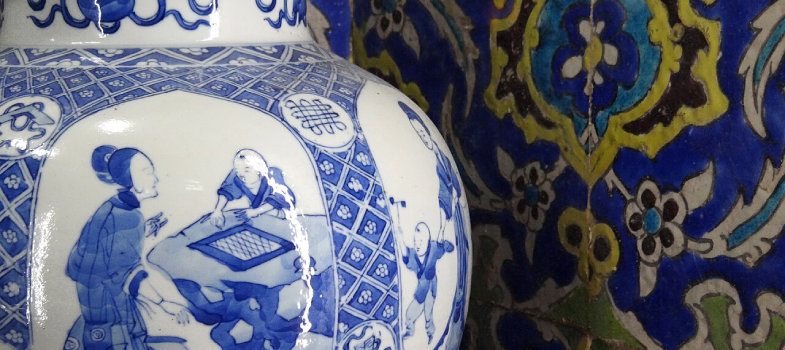
This blue-and-white porcelain bowl exemplifies the elegance and technical refinement of Chinese ceramics. The vessel features a delicate cobalt-blue underglaze decoration painted beneath a clear, glossy glaze. The central motif appears to depict floral scrolls, possibly peonies, symbolizing prosperity and honor in Chinese culture. Around the rim, repeating geometric patterns create a sense of balance and harmony.
The thin walls and smooth curvature suggest skilled craftsmanship and careful kiln control. The rich yet controlled blue tones indicate the use of imported cobalt pigment, which became especially popular during the Yuan and Ming dynasties. The contrast between the white porcelain body and the vibrant blue decoration enhances visual clarity and aesthetic appeal.
Beyond its decorative qualities, this object reflects global trade networks, technological innovation, and cultural symbolism. Blue-and-white porcelain was widely exported, influencing ceramic traditions across Asia, the Middle East, and Europe. As both a functional vessel and a work of art, this bowl demonstrates how Chinese ceramics combined everyday utility with sophisticated artistic expression.
I notice you wrote that the rich yet controlled blue tones indicate the use of imported cobalt pigment, which suggests you are already thinking about material sources and trade connections, not just decoration. That really strengthens your historical interpretation.
One detail I’m curious about is the foot ring and base — what does the finishing there suggest? For example, are there trimming marks, a kiln spur mark, or any unglazed areas that might help us narrow down whether it is Yuan or Ming?
A question to explore next is how the brushwork quality (for example, line thickness or areas where the cobalt slightly ‘bleeds’) might help distinguish between early imported cobalt with high iron content and later, more refined cobalt. Looking closely at these small technical clues could make your dating argument even more precise.
- Jump to: Parent to post 1
- Permalink to post 2