Unit 1 Task 6
In my school, Scots is not currently taught and there are no planned activities or a formal policy relating to Scots language. From discussions with colleagues, there is generally interest in Scots, but it has not been prioritised within the curriculum. There have been conversations about introducing Scots in the senior phase, particularly through the Scots Language Award, but capacity is a significant issue. The success of the languages department meaning that staffing is tight because of the number of classes for German and Spanish, meaning that and there is no space on the timetable to introduce a new course, and there is limited capacity to develop resources or deliver it.
Attitudes towards Scots are broadly positive within the school, but it is often seen as something additional rather than integral to learning. More widely, there is still some scepticism about Scots as a language, which reflects wider societal attitudes. However, the Scottish Languages Act strengthens the case for Scots and gives it a clearer status in education and public life.
I am currently involved in the Curriculum Improvement Cycle for Languages through my secondment at Education Scotland, where we are developing a framework for Scots within the languages technical framework. This has reinforced the need to position Scots more clearly within the curriculum. I can see clear benefits in terms of literacy, identity and engagement, particularly if Scots is embedded more naturally rather than treated as an add-on.
Hi Robbie, thank you for this excellent post. Many teachers who have studied with us come with a similar story from their school or department - capacity and timetabling are often hurdles. With the clear success within the Languages dept in your school thus far in mind, what scope is there to explore delivering the Scots Language Award in partnership with colleagues in perhaps Humanities or English? Discussions we have with Secondary teachers obviously enter the debate around the value of the various qualifications which exist - we find that two most common drivers for offering the Scots Language Award are the number of interested learners and the engagement that comes with that, along with the possible need to offer an Award for learners who have either already completed their Highers and need a further challenge (generally an S6 class) or a group of learners who will struggle to get Highers so an Award is more achievable. If the numbers and the interest from the learners is there then looking at a subject option on a timetable is one route, or, we also find lots of schools deliver the Award within another subject - so the Modern Studies teacher includes the Award within their current timetable class, or the English teacher etc. When that is done then it will regularly work best if other subject teachers also contribute, so a Languages teacher can bring in their expertise. As with so many other things in Scottish Education today, there is no one-best-method of delivery, but whatever the set up, if the learners will benefit, then discussion of possible approaches is definitely worth exploring.
It’s fantastic that you are embracing Scots within your CIC work! Really looking forward to seeing how it develops because as you say, the benefits are widespread and it has certainly been over-looked for far too long. I’m keen to keep discussing with you how we can tackle the long held societal attitudes that have kept Scots from being embedded more naturally and organically as a language which deserves the same respect and status as any other.
This is such a great reflection on the realities of secondary capacity. It must be tough when a successful Modern Languages department means there’s literally no room left on the timetable for a Scots Language Award, even when the staff are really keen.
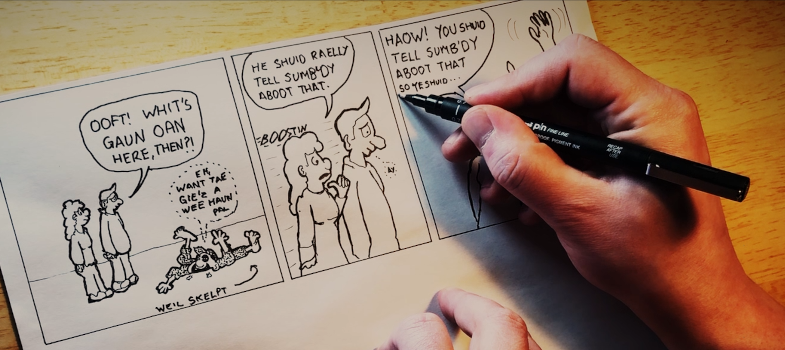
From a primary perspective, we have a bit more flexibility, but that confidence barrier is still very real. Our audit showed that a lot of teachers worry about teaching it because we grew up being told it was "slang" and to stick to standard English. To be honest, I've felt that uncertainty myself! But when you give the kids the right tools, they just fly with it. My class has been using Scots Hoose to make comics during our Term 3 Burns block and seeing how it connects them to their cultural identity is fantastic. I noticed when the children where working on this that it brought them all together, they had a language they could share and learn together with other children who already speak another language other than English. The discussions about how we could learn it together were very engaging and they came up with many ideas together.
Your point about making sure Scots isn't just a tokenistic "add-on" is exactly why your secondment work with Education Scotland is so vital. Honestly, a national framework is exactly what primary teachers like me are crying out for. If we can connect these dots early on, it’ll lay the groundwork so that by the time pupils reach the senior phase, it won't feel like such an unsustainable burden for stretched secondary teams.