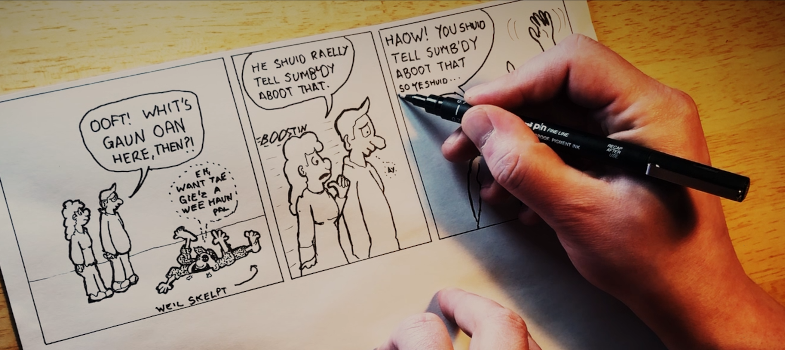
Unit 6 Task Application
Wance agin thi logistics and timins huv goat thi better o mi. Ahve endit up scrievin wit we ur aboot tae dae rathur than reflectin ower oor activity.
Working throught thi unit ah wis initially interestit in Stevenson’s references tae fabric. Hooevir whaun a xplored the hyperlink tae place and ‘Landscape’ a experienced a ‘hook’ similar tae whit Stevenson experienced.
First o aw wis the link tae Inchmahome island and priory, A am very familiar wi this beautiful pairt a Alba huvvin holidayed thaur mony a time on the banks a the Lake of Menteith. It is also linked wi the Cunninghame-Grahams at Gartmore who contributit tae socialist ans Nationalist politcs in Scotland. Ah huv rowed across tae Inchmahome oan maony an occasion and enjoyit the serenity and history o thi place. Thaur is a wee bit ae magic tae walk aroon thi very place the young Mary, Queen o’Scots, played and sought reguge.
Coupled wi this and, the object ae thi hook, wis that, quite seperate fae Scots in thi Classroom activity, ah wis in thi process ae arrangin a wee trip furra group ae students tae a local place ae historic interest.
This students ur young adults, at the younger endo thi spectrum ae Adult Returners. At this stage in thur careers, academic an vocational, they are mair than likely tae pursue a career in Nursing.
A deliver a unit oan Stress Management and, by sheer luck, the Guardian newspaper publishit an airticle oan the benefits ae visitin museums and sic like tae our wellbeing especially oan the effects o agein
Thi local site of historic interest is Provan Hall, a 15th Century building, an wan ae Glega’s best kept secrets. Thaur is a link tae thi ‘Provand’s Lordship in Castle Street Glesga which claims tae be Glesga’s oldest buildin and is a favourite amang tourist. But, Provan Hall, situatit within Easterhouse scheeme an oan thi periphery ae the Fort Shopping Pairk is less frequently visitit. Thaur is also a link tae Inchmahome in that wan o Mary Queen o Scots’ courtiers, William Baillie, lived here.
Ah huv visitit thi site mony a time an enjoytit listenin tae thi stories ae thi folk who run thi site. Mony o them are fae a local social initiative an ur wurkin oan supportin thi local community. They also run activities includin visits fae authors. Thaur is a ‘story telling event in August. Thaur is also a temporary exhibition expolorin witchcraft an witch trials in Scotland.
So, given thi health benefits, the stress bustin escape fae colleg furra coupl o hours and supportin a local initiative a felt that this wis an ideal opportuity that dovetailed neatly intae Unit 6. It also gies me the chaunce tae drive the College Mini-bus; always an adventure!
Bringin it back tae Scots. This shoap actally stocks a credible range ae Scots texts but a wantit tae encourage thi students tae consider links, particularly wi place and names. Provan itself is a family name strongly linked wi thi local area; a nearby scheme is itsel callt ‘Provanhall.’ Meanwhile wantime owners ae thi property wur the Baillie family, mentionit above, an a nearby area is ‘Baillieston.’
Wan o thi key individuals who helpt save this buildin wis Dreda Boyd. Whaun ah fun oot mair aboot her a hauf-ecpectit tae see a poem tae her in Stevenson’s Quines.
Ah quickly pult tigither a wee activity tae supplement oor vist. Thi visit will go ahead oan the 21st o May an ahll poast any student feedback in our forum when a can collect it in..
Ah sould also mention that these students ur no wans studyin Literature 1 wi me, so they’ve no really explorit Scots wi me in class.
Always fine to get oot an aboot Bobby! I took my bairns on a jolly in the minibus as weel. I agree, gettin out is good for your health n wellbeing :)
Hjalta bu Vagaland
Our P67 class are working towards their John Muir award, a large part of this is conservation. The pupils have taken part in a Bee walk and have planted some bee friendly plant in the garden and these plants have Shetland names too. I was aware of Hjalta by Vagaland and found a resource on the Shetland Forwirds page to help me with my lesson. Hjalta is a beautiful poem about the Shetland countryside in Summer. The lesson was in 2 parts, looking at the poem in class to identify flower names and then walking around the ‘banks’ (coast) at Skaw to identify flowers.
Hjalta by Vagaland
Listening and Talking
When I engage with others, I can respond in ways appropriate to my role, show that I value others’ contributions and use these to build on thinking. LIT 2-02a
I can recognise how the features of spoken language can help in communication and I can use what I learn. I can recognise the different features of my own and others’ spoken language. ENG 2-03a
I am developing confidence when engaging with others within and beyond my place of learning. I can communicate in a clear, expressive way and I am learning to select and organise resources independently. LIT 2-10a / LIT 3-10a
Part 1 – Introduced poem and shared copies with the class, played recording to pupils
What does Hjalta mean?
The pupils were really creative with their answers – a place, flower animal. We have a Shetland word of the week challenge every Friday and pupils have really grown in confidence with their guesses, so it was lovely to see them so confident offering their thoughts. Hjalta means Shetland and they made the connection to the Northlink ferry Hjaltland.
For a class with almost all native Shetland spoken pupils, they initially found it quite difficult to understand.
Groups took a verse each to discuss. Pupils managed to translate the basic Shetland words and during class discussions, and a couple of flowers were identified. I told them the number of flowers to find so they enjoyed that challenge and did really well at guessing the flower names.
We looked at the Shetland wildflooer checklist that I made up with a photo, the English and the Shetland names that pupils would be using in the afternoon on the walk.
Part 2 - Walk along the banks at Skaw, an area of Whalsay not familiar for pupils.
We took pupils on a nature walk looking for Shetland names for flowers using the Shetland wildflooer checklist I made up, include species planted from RSPB. Pupils also took photos of plants.
We took the Science teacher with us on the walk, as part of a P7 transition activity and she was able to help pupils identify other species of plants, speak about the birds, how crabs died and so on. Our house names in school are Shetland names for birds - Maalie, Tirrick and Shalder and we saw them too. we found most of the plants including, grice ingans, curly dodies and the commonly known kokkiluries. We could have spent hours along the banks, it was beautiful. Using nature was a lovely way for bairns to learn more about the Shetland language and hopefully appreciate the world around us.
There are so many cross curricular links from this 1 poem, I am vexed that I am not the lass teacher and could run with this for a few weeks.
The class teacher did poetry writing about Whalsay as a follow up with some pupils choosing to write in Shetland, which is very pleasing.
I have attached the Wildflooer checklist, it can be added to or changed.
Additional follow up ideas
Choose a flower and write a Haiku poem in Shetland, include 1 simile
Draw, sketch flowers using photos from the walk, using oil pastels, crayons
Display pictures alongside Vagalands poem
Look for plants on the Bee conservation walks
Find out about the possibility of planting some native plants around the school garden
Art and Design
Inspired by a range of stimuli, I can express and communicate my ideas, thoughts and feelings through activities within art and design. EXA 2 05a
Literacy and English
I can use my notes and other types of writing to help me understand information and ideas, explore problems, make decisions, generate and develop ideas or create new text. I recognise the need to acknowledge my sources and can do this appropriately. LIT 2-25a
Science
I have contributed to the design or conservation of a wildlife area. SCN 2-02a
This is great, Pauline!
I love that so many threads have come together for this lesson. Vagaland’s Hjalta poem, the supporting ForWirds resource, the walk, the plants with Shetland names…da fact it is summer noo an du could winn aroond da banks tae see aa dis wi da bairns!
It’s brilliant to hear about how the pupils have really grown in confidence with their guesses for the word of the week challenge. Goes to show this kind of vocabulary activity is a good choice. Even if the Vagaland poem was initially difficult to understand I still think it was a good choice given how the follow on activities link to it. I’ve just re-read it for the first time in a few years now and it is actually trickier than I remember – quite a few words and phrases that aren’t common any more. But I assume it perfectly set the tone the way you wanted for getting the class ready to head to Skaw.
I hope the Science teacher was happy to tag along for the trip! Haha
One of the great details of this is how much is happening and how much there is for the bairns to engage with: birds, crabs, plants, flowers, language, science, creative writing, photography – and all done as part of outdoor learning! Excellent IDL too.
I can see why you’d love to have done this in more depth with them, and I hope you suggest to other classes that they go and do something similar (and maybe you can go again too!) because it’s clearly a wonderful way to learn and a beautiful experience for a class to have as part of their education.
Bruce
That's such an evocative poem! Good idea Pauline. Will mind Mark aboot Hjalta, he is off oot re.John Muir wi wir P7's dis week anaa :)
Hanks Pauline. Ahve nivur been directly involvit wi John Muir awards but a huv oft seen students and staff returnin clartit in all sairts ae clabber fae John Muir activities-an very happy.
A really enjoyit readin the Shetlan names fur the wildflooers.
Dae ye hink ah cud wangle a wee jolly up tae your neck ae thi woods? Might be a bit o an ask fur oor wee minibus mind ye.
Cheers noo
Well done again, Bobby - you’re always taking these young adult learners on a journey – literally in this instance!
Aabody on da college minibus tae Provan Hall!
Look forward to hearing how the trip went 😊 sounds like there is loads there to learn about and discuss - and a definite way to get away from the desks and the screens and all the stress.
Thanks for information, very interesting - I hadn't heard of Provan hall before. This sounded like a splendid trip out, days like this are always so memorable.
Mhairi belva Shewan Post 9 in reply to 7
• 29 June 2026, 4:51 PM • Edited by the author on 29 June 2026, 4:53 PMMy lesson was to introduce learners to the Scots through the theme of “weel‑kent” Scottish figures either in the world or our community. I used a carousel of interactive activities to build vocabulary, confidence and understanding.
Learners began with a short introduction to key Scots words (e.g. bra, ken, gallus), supported by speaking and listening tasks. They then rotated through three activities: identifying Scots vocabulary in short texts, a “Guess Who” game using descriptions of Scottish icons and known staff, and a Blethergate speaking station where they practised using Scots in conversation. The lesson was supported by a visual grid , which helped learners connect language with familiar figures.
The lesson ended with an independent task where learners created a short profile of a chosen Scottish icon, applying Scots vocabulary in context. Overall, the lesson promoted active learning, collaboration and language use I think – although some enjoyed more than others.
However, the lesson also presented a few challenges. The pace of the carousel meant that some learners did not fully consolidate their understanding before rotating tasks. Those with less prior exposure to Scots required more structured support and modelling I think. While sentence starters were provided, these could have been introduced earlier and revisited more explicitly. In future, I would extend timings to allow for deeper engagement and more purposeful use of vocabulary. Actually I enjoyed this and could get carried away. Using what they know to then gamify the learning and provide an intrinsic motivator.
In terms of next steps, learners need continued opportunities to embed their understanding and develop fluency. This includes moving from supported talk to more independent writing in Scots. To support this, I will encourage incorporating regular, low‑stakes practice such as a “Scots Word of the Day,” short paired discussions, and revisiting familiar games like “Guess Who.” Which I think went down really well. Although the time that this took to set up was a bit of a footer. I think we could extend it. Additionally, using Scots across literacy and other curricular areas will reinforce its relevance as a living language.
fit like Bobby - luved is een. aa aboot fit maks sins in i places wi bide an explore.
Iss is i kin' o lesson at wid be easy ti re-screive n wirk far iver ye wer bidin or gaan aboot. A gweed plan for mony a placey. Thank you!
Shetland Songs Through Creative Arts and Digital Storytelling (CfE Level 2)
Learning Intention:
We are learning to develop our understanding of Scots language, Shetland heritage and identity by interpreting traditional songs through creative and digital forms of expression.
Success Criteria:
I can explain the meaning of Scots/Shaetlan words and phrases in my chosen song.
I can describe how the song reflects Shetland's culture, history or identity.
I can work with others to create a film, animation or performance that communicates the song's meaning.
I can share my work with an audience and reflect on what I have learned.
This project provided learners with opportunities to engage with Scots/Shaetlan language through song, exploring both the linguistic and cultural significance of traditional Shetland music. Working in self-selected groups of two, three or four, pupils chose from a range of familiar Shetland songs, including The Trowie Song, Farewell tae Yell, Da Selkie Wife's Song, Rowin Foula Doon and The Isles o' Gletness.
Through listening to, discussing and interpreting the lyrics, pupils engaged with Scots language in a variety of forms, registers and voices. They explored unfamiliar vocabulary, considered how language conveys meaning, and deepened their understanding of Shetland's cultural heritage and storytelling traditions.
The project deliberately encouraged learners to explore how one art form can inspire and connect with another. Pupils storyboarded the lyrics before selecting a creative medium to communicate their interpretation of the song. Groups used a range of approaches including:
• Live-action film
• Drama and role play
• Stop-motion animation
• Digital animation
• Visual art and illustration
This enabled learners to make connections between literature, song, drama, film and visual arts, reflecting the interdisciplinary approach promoted throughout Stevenson's work.
Place and landscape proved powerful stimuli for creativity. Songs such as Farewell tae Yell, Rowin Foula Doon and The Isles o' Gletness prompted discussion about Shetland's geography, history and island identity, with individuals connections to particular places evident. Learners considered how local places, traditions and stories have inspired artists and musicians and how these continue to shape contemporary understandings of Shetland culture.
The project also encouraged imaginative thinking and interpretation. While all groups worked from the same initial source material, it was suggested by a pupil that they should choose different songs to ‘learn more’, and made a table on the whiteboard to show which group had chosen which song. There seemed to be little issue with this, with greater ownership of the task and good communication with an effective visual aid. Each group then created a unique representation of the song's narrative, demonstrating how creative responses can vary according to perspective, medium and audience.
Sharing the finished films with a wider audience provided an authentic context for learning and demonstrated how Scots/Shaetlan language can be celebrated beyond the literacy classroom. Learners recognised that Scots/Shaetlan is one that lives through music, drama, storytelling, performance and community traditions. It was also discussed that perhaps if the tales had not been shared in song, significant aspects of historical information could have easily been lost as the ability to write may not have been afforded to everyone depending on background - but their experiences no less rich and interesting and certainly worthy of being shared.
Links to Key Learning Points
Through this project learners:
• Engaged with Scots language through song and oral tradition.
• Explored the relationship between music, literature, drama, film and visual art.
• Used place, landscape, local culture and storytelling as inspiration for creative work.
• Developed understanding of how different artistic media can communicate meaning.
• Celebrated Shetland's linguistic and cultural heritage.
• Worked collaboratively to plan, create and present a creative response for an audience.
• Recognised Scots language as a living part of local identity and community culture.
Impact on Learners:
The project fostered a stronger sense of belonging and connection to Shetland's cultural heritage while enabling learners to express their understanding through a medium that matched their interests and strengths. Through choice, collaboration, creativity and digital storytelling, pupils developed a deeper appreciation of how language, culture, place and the arts. As well as using Aifl strategy two stars and a wish to evaluate each contribution, we also considered learner reflection questions What did I learn about Scots language through this project?
• What did I learn about Shetland culture, history or identity?
• How did our chosen medium help us tell the story?
• How effectively did I work with others?
• What skills did I develop?
• What would I do differently next time?
This offered rich and honest discussion with some great ideas for further personal progression from each group. The class loved this activity. As this was very close to the end of term this was where we left it but I can see lots of opportunity for further development. We were lucky to have local contemporary Shaetlan songwriter Claire White visit and share her latest song in Shaetlan regarding the Shetland Bus set in WWII. This was very inspiring, Claire had a great discussion with the class on their favourite Shetland stories and was encouraging them to write them down. A great follow up to this, with more time, would be to have a go at turning their stories into song. We have a really encouraging music teacher who I am sure would be keen to help with this, perhaps something to consider in the new year.