Unit 5 Reflection
As I am currently working outwith a school setting, I have not been able to trial the lesson with learners. My reflection is based on developing the activity, considering the approaches explored throughout the unit and drawing on my experience of teaching Modern Languages and my current involvement in developing the Scots (Learners) Technical Framework.
Reflecting on the choice of text and approach
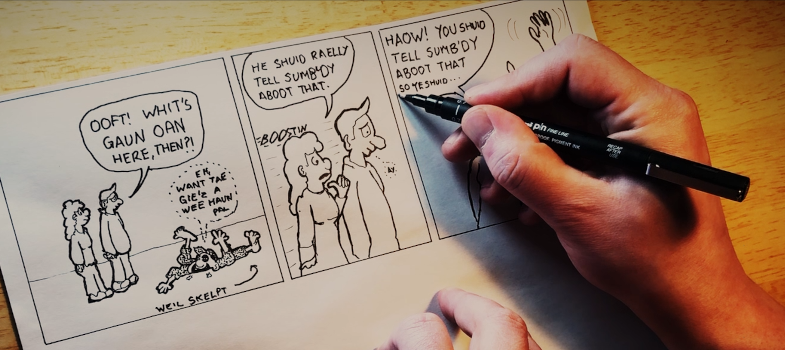
I chose an Oor Wullie comic strip because it provides an accessible way of introducing learners to Scots through a combination of illustrations, humour and authentic dialogue. The visual context offers clues that can help learners work out unfamiliar vocabulary without relying immediately on translation. The exchanges between characters also provide examples of Scots being used to communicate opinions, reactions and everyday experiences.
My initial approach was influenced by my Modern Languages background. I wanted to establish what learners could understand, explore useful vocabulary and language patterns, then provide opportunities to use and adapt that language. This remains a useful starting point, but the unit has encouraged me to think more carefully about the particular contribution that literature and creative writing can make to language learning.
The Scottish Book Trust's Creative writing in Scots resource demonstrates how talking, listening, reading and writing can be brought together through creative activities. The OpenLearn unit has similarly highlighted the relationship between oral storytelling, reading aloud and creative expression. These approaches have encouraged me to consider how a text such as Oor Wullie could provide more than an opportunity to identify unfamiliar words. It could become a starting point for learners to experiment with Scots and develop greater confidence in using it themselves.
Balancing creativity and language learning
One of the main challenges I identified during planning was ensuring that the creative task had a clear language-learning purpose. Asking learners to produce their own comic could be engaging, but an imaginative storyline or an attractive finished product would not necessarily demonstrate progression in Scots.
This is particularly relevant to my work on the Scots (Learners) Technical Framework. The Understand, Know and Do statements encouraged me to think more carefully about what learners should actually gain from the activity and what evidence would demonstrate their learning. In this case, I would be looking for learners to use contextual clues to understand unfamiliar Scots, recognise patterns in the language and adapt familiar expressions to communicate new ideas.
I consequently decided to keep the creative writing task relatively short and structured. Learners would produce a small number of comic panels, drawing on vocabulary and expressions from the original text. The emphasis would be on the language choices they make rather than the complexity of the story they create.
This has reinforced an important distinction for me. Literature and creative writing can make a valuable contribution to Scots (Learners), but they should not automatically become the main curricular focus. More sustained literary analysis and extended creative writing may sit more naturally within Literacy and English, while Scots (Learners) can use these approaches to develop learners' understanding and use of the language.
Recognising learners' different starting points
Another consideration is the range of linguistic knowledge learners may bring to the classroom. Having grown up speaking Scots, I am conscious that much of the language I use or recognise has been acquired through everyday communication rather than formal teaching. Learners may have similar experiences, although their familiarity with Scots will vary considerably.
Some may already speak Scots confidently but have limited experience reading or writing it. Others may recognise particular words or expressions without identifying them as Scots, while some may have had relatively little exposure to the language.
Education Scotland's Keen tae Ken yir Kin resource provides a useful reminder of the diversity of Scots and the importance of recognising regional varieties. I would not want learners to feel that the language used in Oor Wullie represents the only acceptable form of Scots or that their own familiar expressions need to be replaced.
This raises a wider pedagogical question about what progression looks like when learners already possess varying degrees of knowledge of the language. For some, progression might involve acquiring new vocabulary and expressions. For others, it may involve developing greater awareness of spelling conventions, recognising patterns, extending their range of language or becoming more deliberate in the choices they make when communicating.
I think this is an important distinction between teaching Scots as an additional language and approaches which assume that all learners are starting from the same level of linguistic knowledge.
What I would develop further
If I were teaching the lesson, I would place greater emphasis on oral rehearsal before learners begin writing their own dialogue. My original plan included opportunities for paired discussion and reading aloud, but I think these could play a more central role.
Learners could practise short exchanges from the original comic, experiment with changing particular expressions and rehearse their own dialogue before writing it down. This would provide opportunities to explore pronunciation, tone and meaning while reducing the immediate demands of producing a written text.
The relationship between talk and writing is an established area of pedagogical interest, although evidence about the effectiveness of particular approaches is mixed. I would not assume that additional oral rehearsal would automatically improve the quality of learners' writing. Instead, I would want to observe whether it helped learners develop their ideas, make more deliberate language choices and use Scots with greater independence.
I would also build in opportunities for learners to explain how they worked out unfamiliar expressions and why they selected particular words or patterns. This would provide evidence of their developing understanding, rather than relying solely on the finished comic.
Next steps and wider opportunities
If the lesson formed part of a longer sequence, I would develop the activity through digital storytelling. Learners could record their dialogue, listen back to it and consider how pronunciation, expression and language choices affect communication.
This would connect with the digital storytelling approaches explored earlier in the course, including Pauline Turner's work with young Scots speakers. It would also allow learners to develop their spoken language alongside their writing, rather than treating the written comic as the final outcome.
I would be interested in gathering learners' views about the activity, particularly whether they felt more confident using Scots, whether they recognised language they already knew and which aspects they found difficult. This feedback, alongside observations of their language use, would help me judge whether the activities were supporting the intended learning.
Overall reflection
Planning this lesson has helped me reconsider how literature and creative writing can contribute to Scots language learning. The most important learning for me has not been about choosing a creative activity, but about identifying the linguistic purpose behind it and considering how that purpose can be made clear to learners.
The Oor Wullie comic provides a useful context for encountering and experimenting with Scots, but its value as a learning resource would depend on how the activities were structured, the opportunities learners had to use the language and the support provided for different starting points.
More broadly, the activity has reinforced the importance of recognising Scots as a language with its own vocabulary, patterns and variation, while also acknowledging the knowledge learners may already bring from their homes and communities. I would want future lessons to build on that knowledge and provide opportunities for learners to understand, use and reflect on Scots with increasing confidence and independence.