Model Answer Unit 4.4 Activity 3B
This is a model answer. You might have noted down other facts and ideas.
| HISTORICAL FACTORS | CULTURAL FACTORS |
|---|---|
|
6th and 7th century – Anglo Saxons settle in South East Scotland 12th century – Norman nobles settle in Scotland speaking old English influenced by Norse 1100 Inglis spoken and influenced by French and Latin 1300 poem about death of Alexander III – earliest surviving text in Scots Early 1300s Robert (I) the Bruce, Scotland independent, Scottish languages secure Late 1300s Robert (II) – first ruler linked with Scots language in literature 1420s onwards. Acts of Parliament written in Scots not Latin. 1530s North East Scots registered by Aberdeen Council. |
|
| 1542. Scottish Parliament authorises the use of Bible in Scottis. | Mid 16th century – written Scots more influenced by standard English |
| 16th century – printing press introduced. Most publishing in London, so most books printed in English. | |
| 1603 Union of the Crowns. James VI also becomes James I of England. English customs and language favoured. | 1700s English used for formal or intellectual purposes. The big figures of the Enlightenment, David Hume and Adam Smith get people to edit out Scots influences from their papers |
| 1611 King James Bible in English. No Scots version. People had to learn English to read it. | 1774 Robert Ferguson (poet) dies |
| 1690s. Scots speakers 750,000 (70% of population) | 1786 Robert Burns publishes Poems Chiefly in the Scottish Dialect. |
| 1707 Union of the Parliaments. English becomes the language of State. | 1700s. Scots spoken by all ranks of society. But by 1800s the ruling elite shift to English |
| 1792 DORIC named as North East Buchan speech by Alexander Geddes | 1808 Jamieson’s Dictionary of Scots published |
| 1872 Education Act promotes English as standard in Scottish schools. No provision for Gaelic or Scots. | |
| 1993 Scots Language recognised as a minority language of Europe 2001 Scots recognised by UK Government as minority language of the UK. |
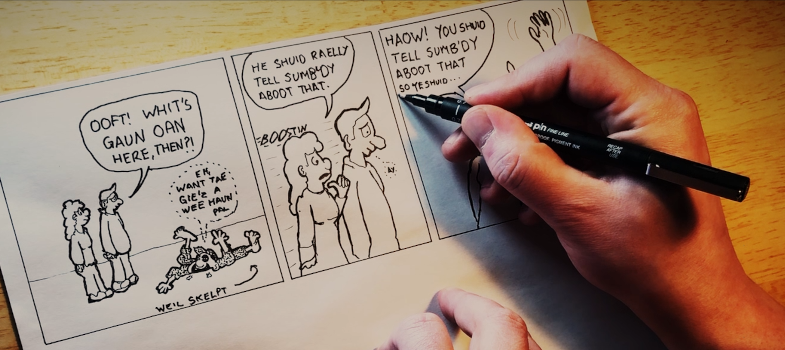
20th century – Hugh MacDiarmid develops SYNTHETIC SCOTS and writes important poems. 1940s Scottish Education Department discourages use of Scots in education Scots often used in entertainment and comedy, football commentaries, popular press, pantomime, comic strips. |
| 2011 Census asks questions about use of affect Scots Scots language. 1.6 million said they used Scots. | Internet and Social Media affect Scots |
| 2014 SQA introduces Scots Language Award in Secondary Schools. | Scottish Parliament records now translated into Scots |
| 2015 Scottish Government launches a Scots Language Policy. | 2017 Matthew Fitt’s translation into Scots of Harry Potter and the Philsopher’s Stane published. |
b) In a lesson, a jumbled version of the above can be colour coded and sorted by historical, cultural, positive and negative factors by learners and then arranged along a desk in a timeline, or on a long poster. The fortunes of Scots can be graphed out. To build on that, pictures and biographies of significant people in the development of the language (positive and negative) can be added in the appropriate position along the timeline to add context. This active learning resource can form the basis of a written piece towards the History and Development Unit of the Scots Language Award. Positive factors include the flowering of Scots literature in the 16th century, the poetry of Fergusson and Burns, the introduction of the SQA Scots language Award. Negative factors include the introduction of English language Bibles, the negative attitude to Scots of the Education Department during WII and the removal of Scots words and phrases from their publications by Scottish Enlightenment figures such as Adam Smith and David Hume.
c) When Scots speaking learners realise that the language they speak has a long pedigree of over 700 years, that words like glaikit are at least 500 years old, it gives them a sense of continuity and status of the language, and gives the way they speak validity. This can provide a boost in self-esteem which can impact their performance across the school.
Return to Unit 4