Stage 1: Meet Nature along Green Routes
By the end of Stage 1, you will have:
-
Learnt more about York’s Green Routes and spaces.
-
Learnt more about York's priority habitats and species, from York's Local Biodiversity Action Plan.
-
Learnt to identify some of the species that you might find on the Green Routes and found how to identify those you don't know yet.
-
Started to record your nature findings.
-
Developed the skills you need to take part in a ‘Citizen Science’ survey of your choice.
Introduction
During this stage you will find out more about the Green Routes and spaces in your local area, and about the priority habitats in York. You will also learn about York’s Local Biodiversity Action Plan; what a Local Biodiversity Action Plan is, and the recommended actions to support the landscapes, habitats and species in York.
We will introduce some of the species that you might find along York's Green Routes and how to identify them. York Bike Belles has a collection of nature calendars which can be used to provide inspiration as to what species you might find in different months of the year.
We will also look at Citizen Science. We will use this as an introduction to recording the nature that you come across, as well as a way of learning to identify more species. You can build your skills in order to be able to find, identify, record and share your findings all year round. This can help to build scientific understanding of different species and habitats.
York’s Local Biodiversity Action Plan
What is a Local Biodiversity Action Plan? These are plans for governments, councils, or companies that work with them, to protect and restore nature. This means looking after the many different types of plants and animals, and the places that they live, particularly those that are rare or under threat. This might be on a local level, or something that is under threat nationally, or internationally.
To find out more, read our summary of York's 2017 Local Biodiversity Action Plan.
If you would like to learn about this in more depth, read the full document.
Things to look for on the Green Routes
There are lots of different species that you will see as you walk and cycle around the Green Routes. Some species will be present all year round, and others change with the seasons. Our Nature Calendars are a great place to start to see what you might find this month. They contain 10 suggestions for each month of the year and are all about the nature that you can find in York's green spaces. Take a look at the Nature Calendars on our website.
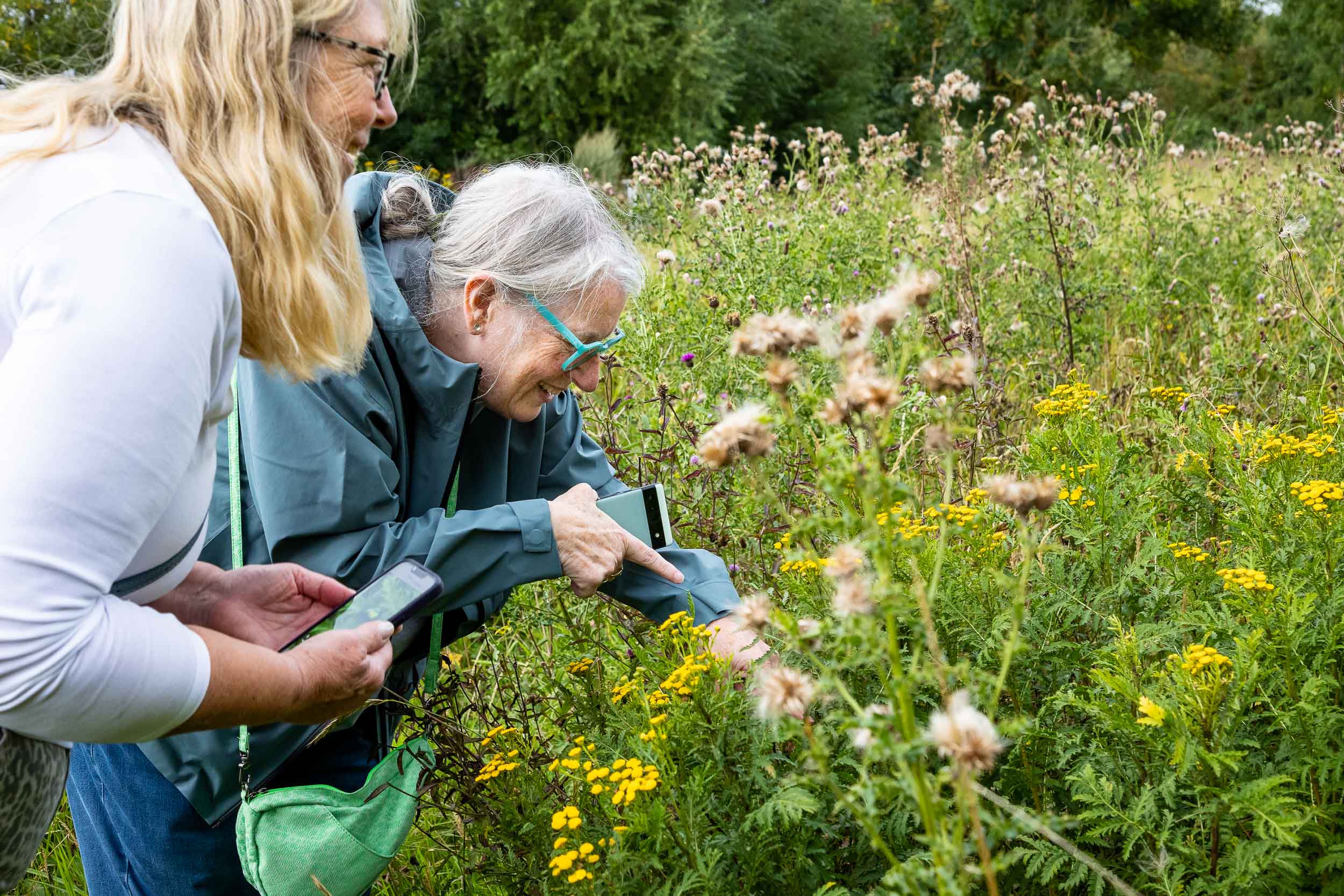
There are many apps that you can use to identify species, from flowers to trees, birdsong to fungi. Whilst these are usually free and easy to use, it is fun to learn to identify some of the more common species without an app.
As well as learning to identify common species, some of the less common ones can also be good to know. An uncommon species, that is special to York, is the Tansy Beetle. This is mentioned in the Local Biodiversity Action Plan for York as it is nationally rare. Being able to identify this York resident is therefore even more important, despite it not being found on all routes.
Now go to our 'Species on York's Green Routes' handout, to learn how to identify two common species, and the not so common but important Tansy Beetle, and its lookalike the Dock Beetle.
If you have a smart phone there are lots of free apps that you can use to identify flowers, trees, grasses and fungi that you come across, and even birdsong. Examples of these are Flora Incognita (flowers, trees, grasses), PictureMushroom (fungi) and Merlin (birdsong). Many nature organisations have online ID tools on their websites (see Resources for a list of these). You can also visit some excellent identification websites on the internet, such as the Tree Guide UK website.
Recording your Findings
You’ll be amazed at what you can find in nature! Start to record your findings and you will have a treasure of memories to both look back on and look forward to. There are many ways to record your findings. You could start a nature journal, notebook, scrapbook or diary to keep a record. You could use photographs, rubbings, sketches or dried specimens if appropriate. If words are more your thing, then you can write what you see, hear or feel about a green space. You could start with something simple like creating a rough map of where you walk, wheel or cycle and add what you find each time you are there. Have a look at our monthly journal, which you can download and has both ideas of what to look for and record each month, and space in which to do it. It is always a good idea when recording to include the date that you saw a species. This means that you know when to look for it the following year, but you can also track any changes in the timing of their appearance over subsequent years.
If you have a smart phone you can record photographs or recordings of your findings on an app. Have a look at the iNaturalist website for information about their popular app. This is an online social network of people sharing biodiversity information to help each other learn about nature, through recording their findings on the iNaturalist app.
Citizen Science
Citizen Science is an amazing way for everyone to contribute to research. It is where members of the public collect data on the natural world, and sometimes even analyse it. It is usually done in collaboration with professional researchers and research institutions, as part of a project. Technology and apps like iNaturalist have made large scale group projects possible and accessible to a wide range of people.
Citizen Science contributes to a huge number of projects, about lots of different species. One of the largest projects in the world is the Great Barrier Reef survey. Thousands of members of the public have collected and analysed photos of the reef since the project started in 2020.
In the UK, you may have heard of the Big Garden Birdwatch which takes place every year in January. This is another example of Citizen Science and has been running since 1979. It has identified long term trends in the bird population in the UK, with a decline in species such as the starling and song thrush, and an increase in species such as the wood pigeon. For more information you can visit the visit the Big Garden Birdwatch website. In July and August every year there is the UK Big Butterfly Count, which is the world's biggest survey of butterflies. For more information, or to take part, take a look at the Butterfly Conservation website.
You can even join an international nature challenge! The City Nature Challenge started as a competition between Los Angeles and California in the USA in 2016. This has grown into an annual friendly competition between cities across the world; to find and record as many different species as possible living within that city in a 4 day window in April, as well as competing to get the most observers and observations. York has participated since 2024. This challenge uses the iNaturalist app and observers needs to sign up beforehand. Visit the City Nature Challenge website for more information.
Have a go at some Citizen Science activities in our activity handout.
Check out this Citizen Science Calendar on the Natural History Museum website. What types of nature would you be most interested in finding and recording?

Activities
Activity 1: Green Corridors, Priority Habitats and Species
Have a look at a map and see which Green Corridor or priority habitat is nearest to where you live. This information can be found in the full Local Biodiversity Action Plan. Are there any priority species identified near you? Find out a little more about 1 or 2 of the priority species. When you are out on a walk or ride can you find one of the priority species or habitats?
Activity 2: Your Green Route - Identification
Choose a walking or cycling route that you can do easily and regularly. This might be from your home, your workplace or part of your commute. It does not have to be far, as you will be amazed at what you can find on a short walk or cycle. Have a look at the Wild York directory website which contains an interactive map of green spaces in York if you need inspiration. Or you could choose one of the York Bike Belle's Take the Green Route! routes, or one of our Nature Time Routes, both of which can be found in the Resources section of the York Bike Belle's website..
Whatever you choose, this route will be 'Your Green Route' for the duration of this course.
On your route can you find a Lime tree or Teasel that you learnt to identify earlier in this stage? Can you find 2 other species that you don't know and use of the free apps or online guides to identify it.
Activity 3: Your Green Route - Recording
Select one of the ways of recording nature on 'Your Green Route' from the 'Recording Your Findings' section. If you can, write about 'Your Green Route' describing where it goes, or sketch a rough map of the route. Record the species on it that you have identified, or record them on an app.
Activity 4: Citizen Science
Look at the Citizen Science Calendar and choose a survey to take part in. Could you make this into an event with your friends and family? Put it in your diary so you don't forget!
Summary
Well done! You have completed Stage 1.
Meeting nature is all about finding the nature that is all around you. In meeting nature you will have learnt about biodiversity in York and some of the priority habitats and species in and around the city. You will have identified the nearest green corridor to where you live. You will have chosen a Green Route to get to know and care for, as part of the the rest of this course. You have learnt to identify some common, and some not so common, species that you might come across. You will have started to use resources to identify species that you don't know and have started to record your findings. You will also have signed up to take part in a piece of Citizen Science.
Next, we will be learning how to get to know nature better, but first take our quiz about this stage to see how much you have learnt already.
Resources:
Biodiversity:
York's Local Biodiversity Action Plan YBB Summary: https://yorkbikebelles.community/wp-content/uploads/2026/01/ybb-overview-york-local-biodiversity-action-plan.docx.pdf
York's Local Biodiversity Action Plan:https://mayhewgroup.wordpress.com/wp-content/uploads/2019/03/city_of_york_lbap_2017-2.pdf
Species Identification:
YBB Nature Calendars: https://yorkbikebelles.community/nature-wellbeing-calendars/
YBB Species on York's Green Routes Identification Handout: https://yorkbikebelles.community/wp-content/uploads/2026/02/species-on-yorks-green-routes-2.pdf
Online ID in nature organisation websites (RSPB, Woodland Trust, Wildlife Trusts, Plantlife):
https://www.rspb.org.uk/birds-and-wildlife/identifying-birds
https://www.woodlandtrust.org.uk/trees-woods-and-wildlife/identify-wildlife/
https://www.wildlifetrusts.org/wildlife/how-identify
Collins ID books:
https://www.nhbs.com/1/series/collins-field-guides
Recording Findings:
YBB Nature Journal: https://yorkbikebelles.community/wp-content/uploads/2026/01/my-nature-journal-template.pdf
inaturalist: https://uk.inaturalist.org/
Citizen Science:
RSPB Big Garden Birdwatch: https://www.rspb.org.uk/whats-happening/big-garden-birdwatch
Butterfly Conservation Big Butterfly Count: https://bigbutterflycount.butterfly-conservation.org/
City Nature Challenge: https://www.citynaturechallenge.org/
Citizen Science Activities Handout: https://yorkbikebelles.community/wp-content/uploads/2026/01/citizen-science-activities-worksheet-v3.docx.pdf
Natural History Museum Citizen Science Calendar: https://www.nhm.ac.uk/take-part/monitor-and-encourage-nature/getting-started-with-wildlife-monitoring/survey-calendar.html
Green Spaces and Routes:
Take the Green Route! Maps: https://www.google.com/maps/d/edit?mid=1NGO-3N-JZHPkKDCxiDaKkGQDrxMxB2w&ll=53.94113728461528%2C-1.080503100000001&z=14
Nature Time Routes: https://yorkbikebelles.community/resources/nature-time-routes/
Wild York Website: https://wildyork.uk/