Stage 3: Care for Nature along Green Routes
By the end of Stage 3, you will have:
-
Learnt about the importance of caring for nature.
-
Learnt about different ways to care for nature.
-
Put some of the ways into practice in your own space, garden, community space or the Take the Green Route! wilder spaces.
Introduction
If you completed stages 1 and 2 then you will have met nature along the Green Routes, and got to know it a little better by spending time building a connection with nature. This stage is about how you can help care for nature, building a deeper connection. Caring for nature will also help to ensure that both you, and others, can enjoy the benefits of nature now, and in the future.
We will start by looking at the importance of caring for nature, and some of the most recent statistics about biodiversity in the UK. We will then explore some of the many ways of caring for nature. This can take many different forms, from choosing nature friendly practices in your own outside space, volunteering in nature, supporting nature organisations or making choices in your life that are more nature friendly.
The Importance of Caring for Nature
Nature is all around us and within us. We are part of nature, and dependent on the rest of nature. We think of nature as beautiful landscapes, diverse wildlife, babbling rivers and shooting stars. It is also the water we drink, the food we eat, the air we breathe. It is the systems in our environment that allow our survival. We rely on nature for medicines, clothes and numerous other goods and 'services'. It underpins our economy, our society and our existence.
Not only does nature provide for us, it is also important to our wellbeing as we explored in the last stage. If there is less nature around us, not only do we lose the balanced ecosystems around us, we also reduce that opportunity to increase our wellbeing.
Whilst nature itself changes and moulds our environment, we are also changing it. And whilst sometimes this is for the better, it can also be for the worse. If you would like to read a comprehensive report on the health of nature in our country, have a look at the State of Nature Report 2023. This is a biannual report produced by the State of Nature Partnership, a collaboration of over 60 UK conservation charities, statutory bodies, research organizations, and recording societies. They found that while the populations of 27% of species in the UK have increased, 38% have decreased, and that 16% of species in Great Britain are threatened with extinction. Their report highlights schemes that have been successful in combating nature loss, using some of the techniques we will introduce in the next sections.
Ways to care for nature
One of the recurring themes in caring for nature is improving biodiversity. Biodiversity is important as different habitats and species provide food and shelter for further species. Some species are very specialised, like the Tansy Beetle, and can only obtain food from a single plant or small number of plants, or they will only lay their eggs or further their lifecycle on a small number of plants. This can be helpful, as the species has found a way to get past that plant's bio-defences, which others might not be able to do, and therefore they have perhaps sole access to the nutrients or shelter that that plant offers. However, it means that if the host plant is lost, so are the species that depend solely on it, or they are more dependant on the other few plants that they use. By increasing biodiversity there are more of a species' host plants or their alternatives available.
There are lots of different ways that you can care for nature. In fact, you have already tried one of the ways earlier in the course. Citizen Science research projects are a way of caring for nature, and some supply data for the State of Nature report that we came across earlier. In this stage we will explore some of the Citizen Science projects further, as well as introducing other ways to care. What you choose to take forward in the activities will depend on your environment, interests and personal circumstances, but there will always be some way that you can help. In addition, our Nature Calendars contain not just ideas of species to find each month and events to celebrate, but also ideas on how to care for nature across the year.
1. Wild Gardening
Wild, or wildlife, gardening is creating an outdoor space that supports native wildlife, by providing food, water and shelter, as well as a haven for you. This can be through the flowers, hedges and trees that you choose to plant, ensuring that they are attractive to pollinators and birds. It can be by thinking about providing a water source like a pond or bucket. It can be through the way that you garden, like leaving seed heads on, not cutting back plants over Winter, or leaving some piles of leaves and logs. If you have a lawn you could consider letting your lawn, or part of your lawn, grow long to allow grasses and other plants to flower. The flowers of grasses provide an important source of pollen and seeds, and long grass is great at protecting all sorts of creatures.
The possibilities are endless, and there are large ideas and small ideas for all sizes of outdoor spaces. Spaces that might be in gardens, verges, allotments, parks, offices and schools. Read Emma's story on how she has transformed a shared space by her flat, inspiring others to join her. There is also lots of information in the Team Wilder Toolkit for Yardens.
The Yorkshire Wildlife Trust's Wildlife Gardening Hub is a great place to look for inspiration. They also run the Team Wilder project, looking to empower communities to make wildlife friendly changes. Check out the Team Wilder section of their website. Their website holds lots of guides and resources on wildlife gardening. There is also the rather fabulous 'Wild About Gardens' website and newsletters, which is a joint venture by the Royal Horticultural Society (RHS) and The Wildlife Trusts.
If you prefer dipping into books there are lots to choose from, such as Dave Goulson's 'Gardening for Bumblebees', and 'The Garden Jungle.'
2. Wildflower planting
Wildflowers are a good way to start increasing the biodiversity in your garden, whether that is in the lawn or in a pot, or in a public or shared space. Cultivated flowers that have been bred for the way that they look may have more petals, which leaves less space for pollen. This makes them less valuable to wildlife than wildflowers. Native flowers and plants, which are those that have always grown in that country, are often more beneficial as native species have evolved to feed or live on them. This is particularly the case for caterpillars, whom are highly dependant on native plants for food.
Wildflowers provide food for pollinators such as bees, butterflies and other insects, as well as being attractive to look at. An increase in pollinators in turn provides more food for species higher in the food chain, like birds and bats. Sadly there is evidence of pollinator loss across the UK, with the State of Nature reporting an 18% decrease in distribution since 1970. If this is something that interests you, then taking part in Citizen Science surveys like the UK Pollinator Monitoring Scheme (PoMS), and the Big Butterfly Count mentioned in Stage 1, can be a good way to help by gathering ongoing data that monitors the situation. More information on PoMS can be found on the PoMS website.
From a window box or pot, to a lawn or border, making the choice to grow wildflowers will help pollinators. The Wild About Gardens campaign have some excellent information on gardening for bees, and butterflies, as does the Butterfly Conservation website. These factsheets also contain bee and butterfly identification sections, to help you see which species your changes have helped to attract. These factsheets also contain bee and butterfly identification sections, to help you see which species your changes have helped to attract.
Wildflowers can be grown from seed and there are many online UK companies that supply them. Alternatively, you could try collecting your own from wildflowers that you find. Under the Wildlife and Countryside Act it is legal to collect seeds for your own use from hedgerows and meadows, provided that you do not remove or uproot the plant. Most wildflowers produce copious amounts of seeds that will not all reach fertile soil for them to germinate in, so gathering seeds is fine as long as you do it in moderation and being mindful not to damage the plant. Wait for a dry day when the flower is ready to drop it's seeds. This is when the seed capsules have turned brown or black and are dry and ripe. Kew Gardens has more in depth information on how to collect and store seeds on their Kew Gardens' website. Planting wildflower seeds is best done in Autumn, but can also be done in Spring.
If you, or a community near you, have a bigger space then you could consider creating a wildflower meadow. There are a number of guides to this on the internet, including one from Team Wilder guide that you can download and also the Royal Horticultural Society on their website.
3. Planting Trees and Hedges
Planting a tree or hedge is a great way to help your area be more nature friendly, as they provide both food and shelter. You may be lucky enough to have space in a garden, or be able to volunteer to plants hedges and trees with a local group that takes care of an area.
When choosing a tree to plant for wildlife think about the space available as well as what the tree offers. Some trees like Rowan, Elder, Hawthorn and Wild Service have both flowers that pollinators like, followed by berries for birds to eat.
For further information The Tree Council have a guide to tree and hedge planting.
4. Feeding Birds
For those without much of an outdoor space feeding the birds, particularly over Winter, can be really helpful and attract different species for you to learn to identify. Not all birds like to eat the same things, or from the same kind of feeder or area, a bit like humans! A wide range of bird food and feeders are available commercially. Some types of leftover food birds will love, other things like salted food, left over cooking fats and porridge are not good for them. You can also make your own suet balls, or feeders from pine cones or sawn up logs. With bought feeders it is important to keep them clean to reduce disease. It can take a while for birds to find a new feeding area and get used to there being a consistent source of food from it so don't give up if you don't have any takers in the first few days. As well as food, birds also need a supply of water, especially through cold spells.
There is more information on the best ways to feed birds from the RSPB website and The Woodland Trust website.
5. Shelter for All
Wild Gardening in itself will often provide shelter for the creatures living in the space. This might simply be by grass left to grow longer, a pile of undisturbed logs, or leaving leaves at the back of a border or behind some pots. It can also be something more creative like building bat boxes, bug hotels or hedgehog houses. There are lots of resources online for these projects, and there are links to some of these in the resources' section at the end of the stage.
Caring for Nature in York's green spaces
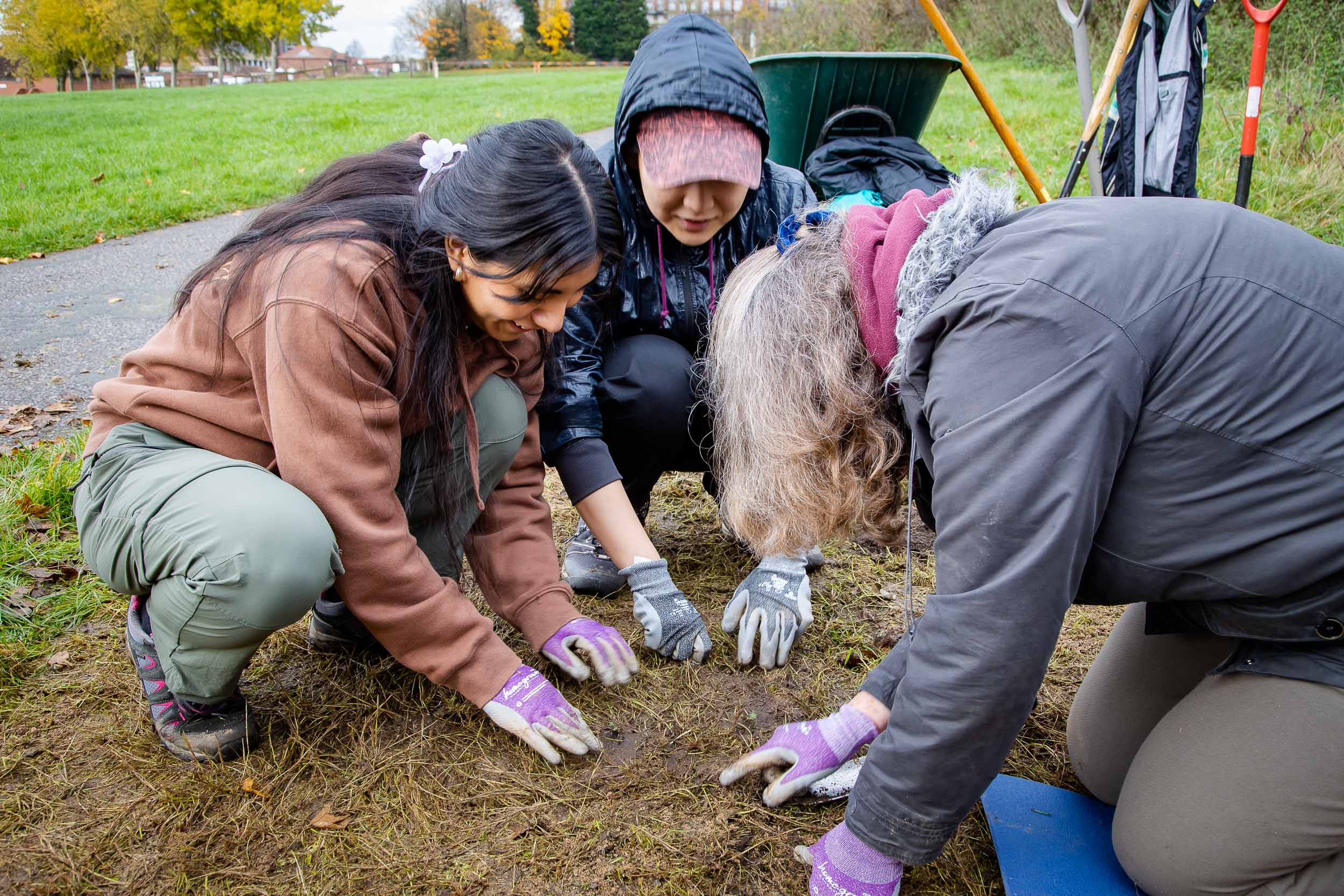
Some green spaces in York are supported by volunteer organisations working to look after that space and improve it's biodiversity. The Wild York directory contains not just a directory of green spaces in York but also many of the green volunteering opportunities in and around the city. As part of the Take the Green Route! project York Bike Belles has cared for 3 green spaces in the south of York. We have increased the biodiversity in those spaces by planting wildflowers and a native hedgerow. If you would like to work with us on these spaces contact us through the website.
A simple way to care for nature in green spaces is by litter picking. A lot of litter lasts a lifetime when it is not discarded properly. Some litter can harm wildlife and pets. Some litter will gradually find its way into the river and then into the sea, affecting both freshwater and marine life. In all cases, the opportunity to recycle the resources found in litter is lost. You could litter pick on your own, as part of one of the groups in the Wild York directory or as part of the annual Great British Spring Clean, organised by Keep Britain Tidy in March each year. For more information on how to litter pick safely please read their Guide to Litter Picking.
Activities
Activity 1: Your Green Spaces
Having reached the end of this stage have a think about how you might like to care more for nature. If you have a garden or yard read some of the additional resources. Reflect on your current gardening practices and what you could do differently. Is there a green space in your community or at work that you could care for, or join with others to care for? Is there a space that you could make green, like a shared gateway or alley?
Activity 2: Your Green Route
In Stage 1 we asked you to choose a Green Route that you use frequently and start to notice the nature on that route. Now we want you to think about how you might care for nature on that route. This could be by:
- Joining a voluntary organisation or group that cares for that space
- Litter picking
- Gathering seeds from the wildflowers and planting them in patches of soil in other places on the route to help them spread further, or in a pot at home (please do read the guidance on gathering seeds).
Summary
Well done! You have completed Stage 3.
Caring for nature is all about finding a way to look after nature in your life. In caring for nature you have learnt about the health of nature in the UK. You have explored some of the different ways that people can care for nature. You will have put some of these into practice.
Next, we will be drawing together your learning to see how you can have a nature friendly lifestyle and community, but first take our quiz to see how much you have learnt already.
Resources:
Nature Overview:
The State of Nature Report 2023: https://stateofnature.org.uk/.
Wild Gardening:
YBB Nature Calendars: https://yorkbikebelles.community/nature-wellbeing-calendars/
Yorkshire Wildlife Trust: https://www.ywt.org.uk/wildlife-gardening-hub
RHS and The Wildlife Trusts' Wild about Gardening:https://www.rhs.org.uk/get-involved/wild-about-gardens
Collecting Seeds;https://growwild.kew.org/championing-nature/wildflowers/how-to-grow-wildflowers/how-to-save-seeds
Creating Wildflower Meadows:
- Team Wilder Guide https://www.hull.gov.uk/downloads/file/4596/yorkshire-wildlife-trust-meadow-creation-and-maintenance
- RHS https://www.rhs.org.uk/lawns/creating-wildflower-meadows
Tree and Hedge Planting: https://treecouncil.org.uk/guidance-resources/tree-and-hedge-planting-a-step-by-step-guide/
Books:
- Gardening for Bumblebees: A Practical Guide to Creating a Paradise for Pollinators Dave Goulson Square Peg 2021
- The Garden Jungle : Or Gardening to Save the Planet Dave Goulson Penguin Random House 2020
Citizen Science:
UK Pollinator Monitoring Scheme: https://ukpoms.org.uk/
Big Butterfly Count: https://bigbutterflycount.butterfly-conservation.org/
Big Garden Birdwatch; https://www.rspb.org.uk/whats-happening/big-garden-birdwatch
Other ways to care:
House Building: https://www.ywt.org.uk/actions
Bird Feeding:
- RSPB https://www.rspb.org.uk/birds-and-wildlife/feeding-birds-near-you
- Woodland Trust https://www.woodlandtrust.org.uk/blog/2025/04/what-to-feed-the-birds/
Litter Picking: https://www.keepbritaintidy.org/
Volunteering in Green Spaces in York:
Wild York Directory of green spaces/ opportunities: https://wildyork.uk/
Search for volunteering opportunities in directory; https://wildyork.uk/volunteer/