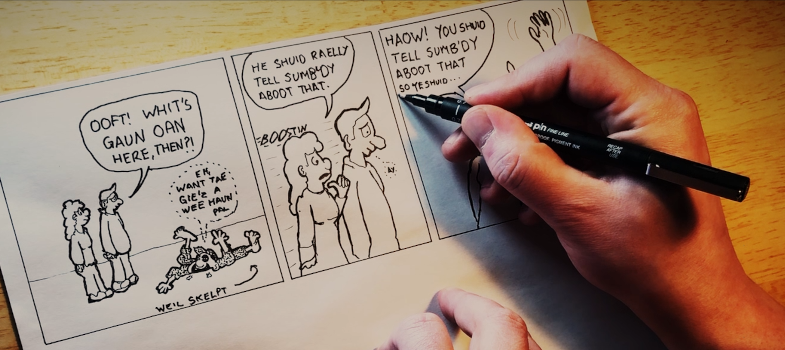
Model Answer Unit 7.3.1, Activity 9
Hou dae A best write sae thit fowk ken hou tae read oot whit it is that A’m writin?
I began by thinking about what role seemingly little things like accent and whether we have the same accent as our peers was important. I started to realise that in the context of creative writing, it can be just as important as any other details we attribute to a character in a book or a person we may meet – whether they are tall or short, fat or thin, clever or silly...their accent and the language they speak in can be essential to understanding a character or person. I used to enjoy reading the novels of Sir Walter Scott and this immediately reminded me of the characters in his books and their “Scottishness”.
For a lesson to explore this, I decided the only way I could get stuck into it with my class was to say from the word go that they will be writing in Scots language. As dialogue will be key to this lesson, I have also decided their texts should be as close to dialogue-only as possible. Whether the class choose a play, a radio transcription, a monologue, or the words for a newsreader / weather reporter will be up to them – but I will emphasize that we are firstly trying to develop our skills in writing Scots, by writing a character or person who speak in Scots, and secondly that the lesson is also about how we present ourselves / how we present information. So the end point is for each learner to write in Scots, be it fictional or a factual piece, where there is a clear message to convey to the reader / audience.
I will take full advantage of the resources in this Unit and share with the class both the Dignity video by Michael, and also the ‘Origins of Scots’ one which is told in Scots. That way we have two good examples of a Scots voice – both of which are real voices and factual texts.
To get the class started we will translate this text (from the Engaging with Spelling resource) from Scots into English:
The Scots language is a tricky hing tae scrieve in, seein as there’s mair that wan way tae spell almaist ivery wurd. Even as ye read this, some ae it will mak perfect sense and some ae it might no. Some ae it seems tae luik like English and some ae it seems tae luik French, or Scandinavian, even. That might hae something tae dae wi the fact that mony ae oor words come fae these places, if ye trace them back hundreds an hundreds ae years.
Ye might hae found yersel disagreein wi some ae the ways yir seein wurds spelt an that’s braw. Language is an iver-changin hing an it’s only in mere recent times that folk hae decided that there’s only wan way tae spell a wurd. This applies in a lot ae places (the English classroom bein wan ae the maist common places tae get telt ye’re spelling hings wrang) but we often use different spellins when we’re textin or messagin. This creativity wi language is a bonnie hing and shouldna be discouraged.
I think that will be a good way to begin as it will get them thinking about different spelling techniques which can be used in Scots. I am confident all the learners in my
class will be able to complete that translation task and use it as notes for their own piece.
For creating their own text, again, I will emphasize this can be fact or fiction. It can be a character saying something which is completely made up, or it could be an experiment for a Scots news or weather piece. It will be their choice if they only write for one voice – or if they choose two or more voices. It could be two characters and their dialogue, or it could be messages/lines where two different people are discussing something in Scots.
Resources I will use are:
-
the tweet sheet from ‘Engaging with spelling...’ Tweet sheet for assessment (education.gov.scot)
-
the Origins of Scots video: The origins of the Scots language - in Scots - YouTube
This is the Literacy for All Benchmark I am aiming to address:
|
Creating texts - considering texts to help create short and extended texts for different purposes |
I can engage and/or influence readers through my use of language, style and tone as appropriate to genre. ENG 3-27a / ENG 4-27a
I can convey information, describe events, explain processes or concepts, and combine ideas in different ways. LIT 3-28a
I can persuade, argue, evaluate, explore issues or express an opinion using a clear line of thought, relevant supporting detail and/or evidence. LIT 3-29a
I can recreate a convincing impression of a personal experience for my reader, sharing my feelings and reactions to the changing circumstances with some attempt at reflection. ENG 3-30a
Having explored the elements which writers use, I can create texts in different genres by:
ENG 3-31a |
as appropriate to genre.
When writing to convey information, describe events, explain processes or concepts, and combine ideas:
of the chosen genre.
a basic structure.
When writing to persuade, argue, evaluate, explore issues or express an opinion:
or evidence.
topic sentences and/or linking phrases.
some attempt to engage the audience.
When writing to convey personal experiences:
When writing imaginatively or creatively:
|
Return to Unit 7