Guess and Match Translation Worksheets & Quizzes
Following every chapter or short lesson, educators can implement translation matching grids containing roughly ten sentences pulled straight from the read content.
It is recommended to pick sentences that form part of a narrative, not just random isolated sentences.
The primary rule when designing these options is that they must never be designed to trick, confuse, or frustrate the student. The instructor's job is to deliberately plant clear hooks, anchors, and obvious clues within the correct option.
This format can be effortlessly adapted to multiple delivery methods:
Quiz Style 1: 3 Options
Each native language sentence is paired alongside three distinct foreign language options.
Quiz Style 2: 1 Option (Jumbled Order Answers)
For each native sentence, one foreign language option is presented. The native language sentences are on one side, the foreign language options on the other side, jumbled, with a different order.
On Printed Worksheets: The native sentences form a clean column on the left side of the page, while the foreign language options sit in a column on the right. Students use colorful pencils to draw lines connecting the correct pairs or circle corresponding blocks in matching colors.
In Digital Formats: The quiz operates as an interactive click-and-select interface on a tablet, computer, or smartphone, providing instant visual feedback.
Example activity sheet:
Left Column: Native Language (English)
- It was an early autumn morning.
- Johnny's alarm clock startled him awake.
- A warm smell of cinnamon muffins drifted in from the kitchen.
- Johnny quickly hid his monster under the bed.
- "Don't make a sound! I'll bring you some cookies later!" Johnny told him.
- The monster nodded, grinned, and curled up under the bed.
- While Johnny was showering, his mother entered the room.
- The monster snored gently.
- She stopped and frowned.
- "What's that strange noise?" she wondered.
Right Column: Foreign Language (Spanish - Scrambled)
- El monstruo asintió, sonrió y se acurrucó debajo de la cama. (Matches #6)
- Era una mañana de principios de otoño. (Matches #1)
- El monstruo roncaba suavemente. (Matches #8)
- El despertador de Johnny lo despertó de golpe. (Matches #2)
- Johnny escondió rápidamente a su monstruo debajo de la cama. (Matches #4)
- Ella se detuvo y frunció el ceño. (Matches #9)
- Un cálido olor a muffins de canela flotaba desde la cocina. (Matches #3)
- "¡No hagas ningún ruido! ¡Te traeré algunas galletas más tarde!", le dijo Johnny. (Matches #5)
- "¿Qué es ese ruido tan extraño?", se preguntó. (Matches #10)
- Mientras Johnny se duchaba, su madre entró en la habitación. (Matches #7)
Example worksheet:
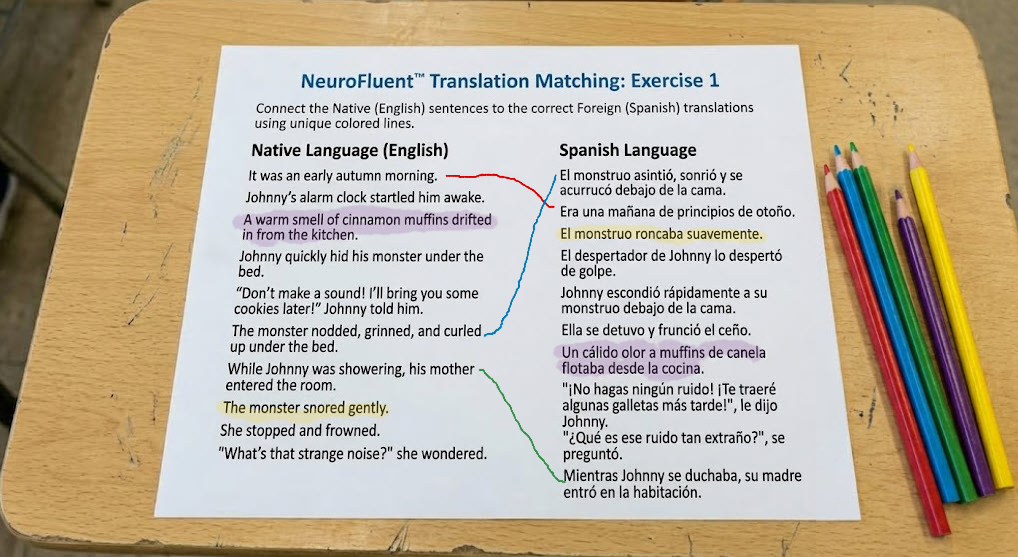
Learners can connect the sentences or color matching sentences.
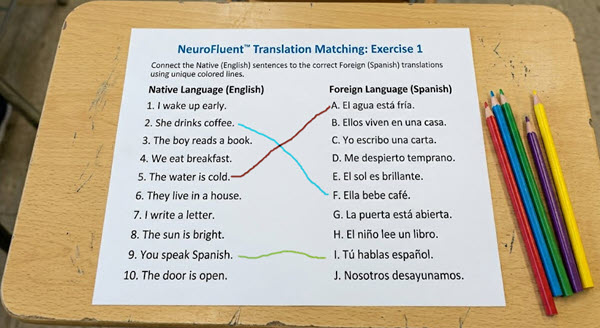
Using segments of stories or narratives is always recommended over picking disconnected, random, dry sentences like:
 |
About the Author Camille Kleinman is the founder of LingoLina™ language learning platform, inventor of NeuroFluent™ and NeuroSwitch™ Immersion Methods, a five-time award-winning writer, bestselling ghostwriter ranked in the top 1% of 18,000,000 freelancers worldwide, linguistic theorist and researcher, instructional designer, and educator. Visit her site LingoLina.com for a growing library of free NeuroFluent™ learning materials, stories, courses, fiction and nonfiction books, audiobooks, podcasts, and games. |