Sentence-to-Image Connectivity Games
Connecting language directly to visual illustrations completely bypasses the need for analytical translation, linking the new language straight to sensory concepts.
This exercises uses the standard language matching activities found in existing methods and worksheets, however the sentences used should come from a story or content piece the learner just engaged with and be presented in both languages to reinforce the new vocabulary. It's best to use sentences that are related and form part of a small narrative.
Beginner Formats
Learners are presented with a paired native-and-foreign sentence block and must match it to the correct visual illustration by clicking an image on a screen or drawing a line on a printed worksheet.
Because beginners are just starting out, this is never treated as a rigorous test of their vocabulary. Both language versions are fully provided because the primary goal is simply to use physical touch, line drawing, or clicking to visually anchor the meaning of the target words directly to a clear, colorful graphic.
Advanced Formats
For Younger Learners: Students are given a sentence written exclusively in the foreign language and must connect it to an image of a specific character or a vivid scene from the story they just read. This keeps their imagination pinned entirely to the narrative world.
For Teens and Adults: Adult learners click on a digital display or match graphics representing realistic historical elements, animals, geographical landmarks, or specific individuals that align perfectly with the advanced foreign language sentence (e.g., matching a foreign-language description of Albert Einstein, ancient Greece, or a dolphin to its corresponding photograph).
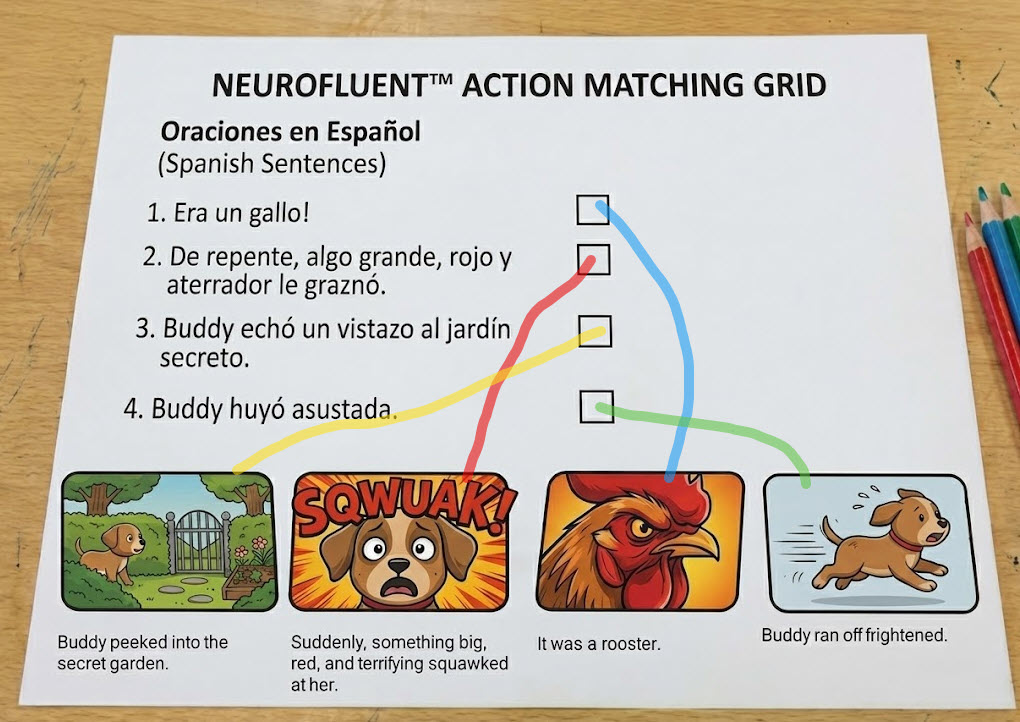
As always, use sentences within context, preferably from a story or content piece they just read. You can abbreviate a long story or scene into a few short simpler sentences, while still sticking to a familiar plot. Think of it as a very short comic strip.
Example of how we can turn an episode from Buddy's Diary into a short activity sheet:
Avoid boring, dry, random sentences like this: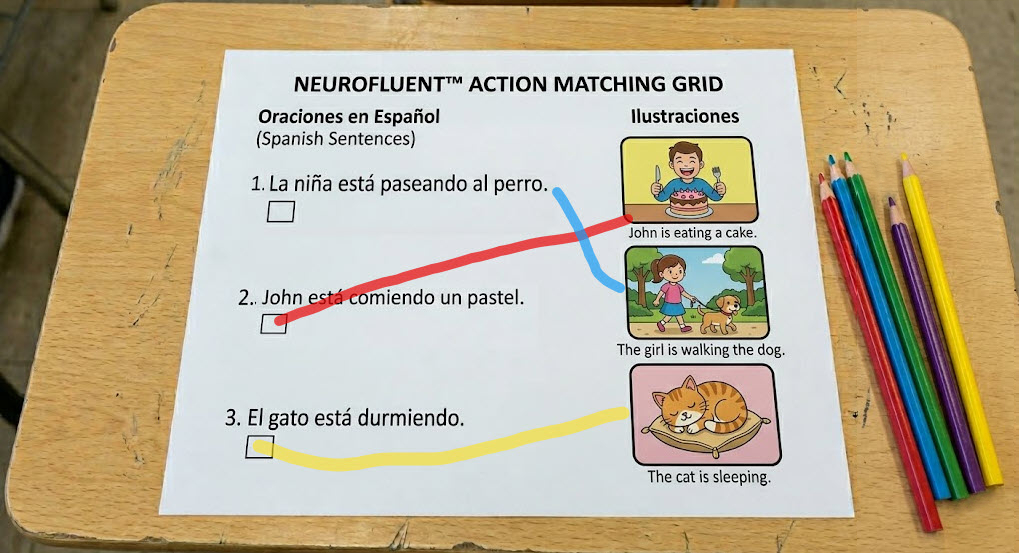
While such content can work, it is boring and that beats the fundamental purpose of NeuroFluent Immersion (content must be engaging to keep learners motivated).
 |
About the Author Camille Kleinman is the founder of LingoLina™ language learning platform, inventor of NeuroFluent™ and NeuroSwitch™ Immersion Methods, a five-time award-winning writer, bestselling ghostwriter ranked in the top 1% of 18,000,000 freelancers worldwide, linguistic theorist and researcher, instructional designer, and educator. Visit her site LingoLina.com for a growing library of free NeuroFluent™ learning materials, stories, courses, fiction and nonfiction books, audiobooks, podcasts, and games. |