
My OpenLearn Profile
Personalise your OpenLearn profile, save your favourite content and get recognition for your learning
History & The Arts
Most popular in History & The Arts
 free course icon
level 1: introductory icon
free course icon
level 1: introductory icon
History & The Arts
Welsh history and its sources
This course is a teaching and learning resource for anyone interested in Welsh history. It contains study materials, links to some of the most important institutions that contribute to our understanding of the history of Wales, and a pool of resources that can help you understand Welsh history and the way it is studied. Included in the material ...
 free course icon
level 2: intermediate icon
free course icon
level 2: intermediate icon
History & The Arts
Discovering Ancient Greek and Latin
The free course, Discovering Ancient Greek and Latin, gives a taste of what it is like to learn two ancient languages. It is for those who have encountered the classical world through translations of Greek and Latin texts and wish to know more about the languages in which these works were composed.
 free course icon
level 1: introductory icon
free course icon
level 1: introductory icon
History & The Arts
Getting started on ancient Greek
This course offers a taster of the ancient Greek world through the study of one of its most distinctive and enduring features: its language.The course approaches the language methodically, starting with the alphabet and effective ways to memorise it, before building up to complete Greek words and sentences. Along the way, you will see numerous ...
Latest in History & The Arts
 free course icon
level 2: intermediate icon
free course icon
level 2: intermediate icon
History & The Arts
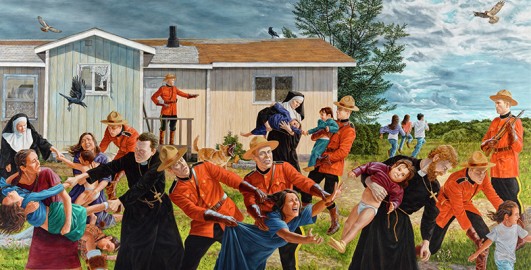
Who gets to be a human? Religion in colonial histories and Indigenous resistance
The global challenge of growing inequalities is intricately linked to the distinction made between those historically regarded as human and those who have not been. The division between ‘civilised’ and ‘non-civilised/primitive’ played a vital role in justifying the colonisation and enslavement of those who were deemed ‘lesser human’, ‘other ...
 article icon
History & The Arts
VE Day
On 8th May 1945, Europe celebrated the end of the Second World War. To mark this, we've put together a variety of resources on this time in history.
 video icon
History & The Arts
Religion as Social Control - Karl Marx
Why did Karl Marx thought religion was like Opium? Had Marx got his way, society would be so happy being revolutionaries, there’d be no need for religion. This 60 second animation explains more.
Hubs in History & The Arts
 collection icon
History & The Arts
Religion, belief and worldviews hub
A place for exploring religion, spirituality and non-religion.
 collection icon
Health, Sports & Psychology
Centre for Open Thanatology Hub
The Open University’s interdisciplinary research centre dedicated to the study and education of death, dying, loss, and grief across the life course and in diverse contexts.