
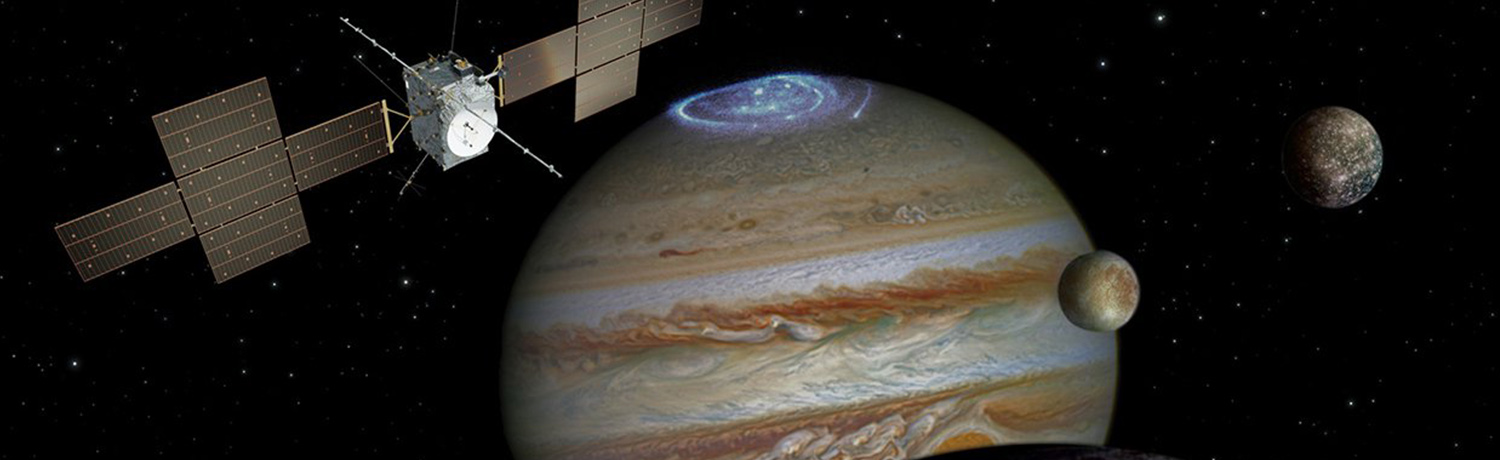
In April 2023, a spacecraft left Earth carrying a camera called JANUS. It is on its way to Jupiter and its icy moons Ganymede, Callisto and Europa, which are thought to hold oceans of liquid water under their frozen surfaces.
Jupiter is one of the worst places you can send a camera. Some of the data JANUS sends back will be of the moons, and some of it will be damage to the camera. In this article you will explore how researchers at The Open University can tell the two apart.
Science communicator Natalie Starkey starts with light itself.
From sunlight to a photograph
One family of radiation heats our homes, carries our phone calls, cooks our popcorn and produces visible light. However, our eyes have evolved to work best in this plentiful light we receive on the Earth’s surface. So, to see the dim light of another planet, we need to use a telescope or send a camera closer.
Why space cameras are built differently
You might have noticed that the same word, radiation, covers both the thing a camera is built to collect (in the form of lower energy visible light) and the thing that damages it (in the form of higher energy light or even particles with higher mass).
Ben Dryer, Space Instrumentation Research Fellow at The Open University, explains what changes when a camera has to work at the edge of the solar system.
Copying space in a laboratory
As Ben showed, a space sensor has about as many pixels as the iPhone 4S sensor beside it, but each pixel is much bigger, so it catches more light. That matters at Jupiter, which gets a twenty-fifth of the sunlight we do on Earth.
The Open University's Centre for Electronic Imaging (CEI) works on sensors like these in collaboration with Teledyne e2v, the UK company behind many of the world's space cameras. Before a sensor can be used for a mission, scientists need to know how it copes with years of vacuum, deep cold and constant radiation. So these conditions are copied.
Reading the damage
Cooling the devices to mimic space matters: at −120 °C the sensor produces far less of the background noise that radiation damage makes worse. The damage still shows though. Bright streaks smear across the dark parts of the picture, and single pixels stick bright or flicker. These effects get worse and worse the longer the camera remains in space.
If you measure how much radiation distorts a picture, you can correct for it in the images a spacecraft sends home.
Taking a camera to jupiter
Space cameras and indeed anything that is sent into space is susceptible to damage. Over time the materials are degraded by the space environment. In terms of radiation, Jupiter is an extreme case. One of the missions The Open University has worked on is the European Space Agency's JUICE, whose camera JANUS uses a Teledyne e2v sensor called the CIS115. Chiaki Crews, another Research Fellow at the CEI, explains what makes Jupiter so challenging.
Why you cannot just add shielding
You can wrap the delicate parts of the sensor in something heavy to block the radiation, like lead or tungsten, and spacecraft do. But every kilogram of shielding is a kilogram you cannot spend on instruments, fuel or power. A camera also needs an opening for light, so there is always a clear path from space into it.
The question, then, is how much damage there will be, and whether the pictures can still be trusted. In the next video Chiaki describes the testing the CEI did for JUICE.
A discovery, or a dead pixel?
Imagine JANUS sends back a picture of Europa with a bright spot nobody expected. It might be a plume of water. It might be one pixel knocked out by a particle of radiation months earlier. Without lab measurements there is no way to tell. With them, many effects can be corrected once the pictures reach Earth, and others taken into account when interpreting the data.
Getting to the launch pad in one piece
Radiation is not the only hazard. Every space sensor Teledyne e2v builds goes through three sets of tests:
Natalie Starkey visits the company in Chelmsford to ask Chief Engineer Jérôme Pratlong how that works.
Where JUICE is now
JUICE launched on 14 April 2023 and is reaching Jupiter via a complicated route designed to minimise the fuel needed. It does this by swinging close past the Earth, Moon, Venus and Mars, and borrowing a little speed each time by using each planet’s gravitational field like a slingshot.
The first swing-by, in August 2024, had never been tried before: the Moon, then Earth about a day later. It gave the teams their first chance to point JANUS at something.
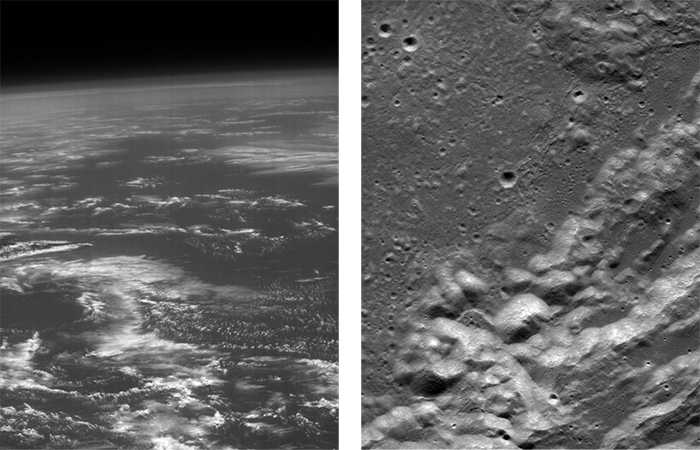 Images taken of the Earth (left) and the Moon (right) by the JANUS camera during JUICE’s flyby in August 2024. Credit ESA/JUICE/JANUS
About four hundred pictures came back. The point was to check the camera against what the lab work predicted, using well-known targets. JUICE passed Venus in August 2025, and has two more swings past Earth to go, before its planned arrival at Jupiter in July 2031. After its first swing-by the international mission team verified that the spacecraft is operational in space, prepared for arrival at Jupiter.
However, getting there is only the start. After eight years in transit, JUICE will then begin the work it was built for: mapping Ganymede, Callisto and Europa, measuring the oceans beneath their ice, and working out whether those oceans could support life. Note that is different from answering whether anything actually lives there, but it is the first step to answering that question.
The damage has already started building up through JUICE’s long journey, much as the video described skin in the sun. The pictures will get worse. However, the team already know roughly by how much, because it was measured in Milton Keynes years before the spacecraft left.
Explore further with OpenLearn...
-
Astronomy with an online telescope
Learn more to access more details of Astronomy with an online telescopeThis free course shows you how to navigate the night sky, and introduces the wide variety of objects it contains. You will develop a hands-on understanding of telescopic observations using the Open University’s own robotic telescope facility COAST sited on the island of Tenerife. Supported by your own measurements we illustrate how stars...

-
Revealing the surface of an asteroid using robotic telescopes
Read now to access more details of Revealing the surface of an asteroid using robotic telescopesHow can studying asteroids allow us to have a better understanding of the formation of our solar system? Samuel Jackson, PhD student in The School of Physical Sciences digs into the research...

-
Science from Early Career Researchers in the School of Physical Sciences
Read now to access more details of Science from Early Career Researchers in the School of Physical SciencesThis collection of articles and videos explores how early career scientists within the School of Physical Sciences carry out research to learn more about the world, and space, we live in.

Rate and Review
Rate this video
Review this video
Log into OpenLearn to leave reviews and join in the conversation.
Video reviews