
In this article, we’ll explore the Celtic roots of Welsh, discover how it branched from the Indo-European family, and trace the journeys of the peoples who shaped its evolution. Along the way, we’ll uncover surprising links between ancient migrations, cultural exchange and the words we use today.
This map shows where Celtic languages are spoken in Europe.
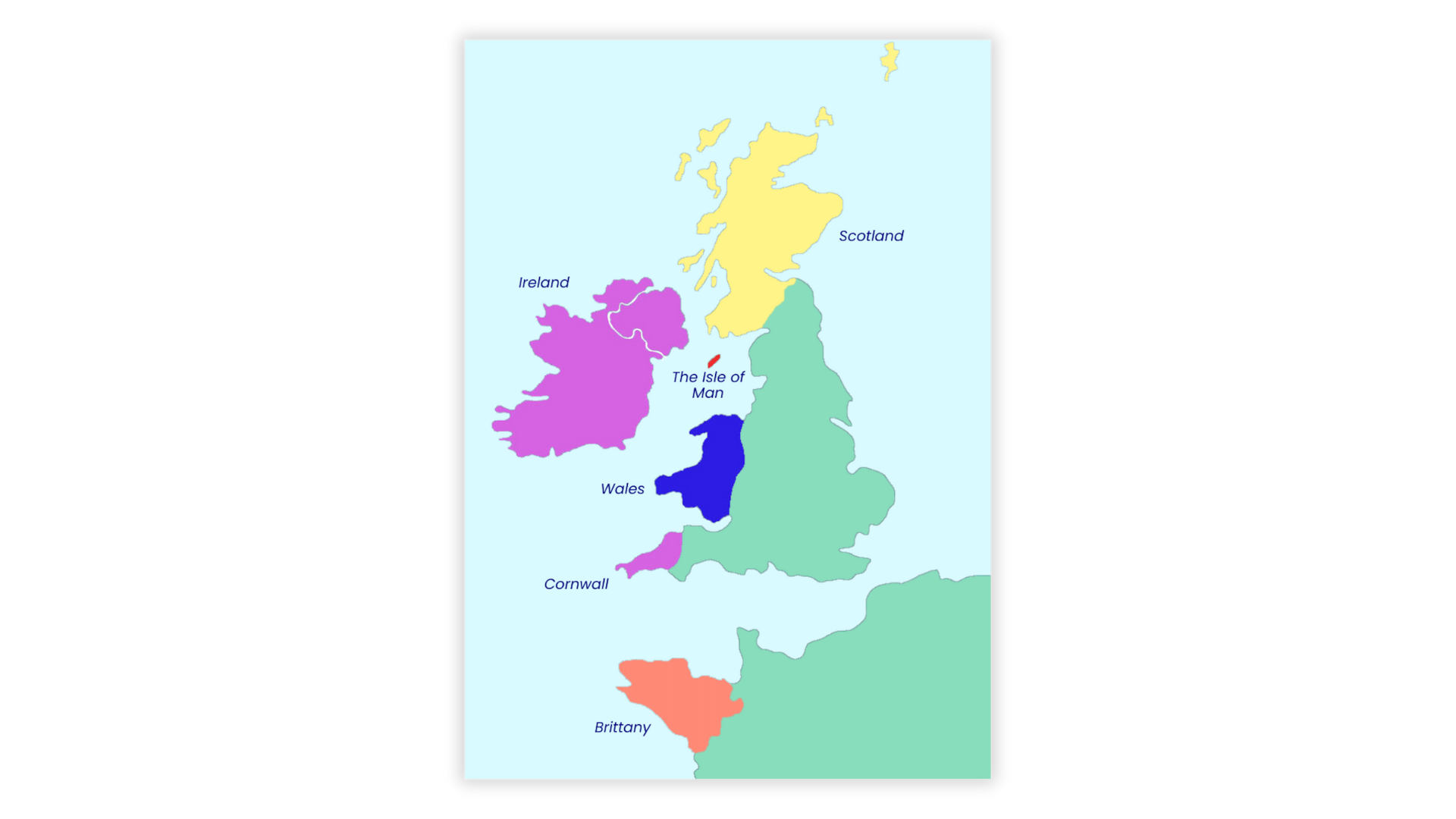
Indo-European roots
The majority of the languages in Europe belong to a family of languages called Indo-European. There are over 400 related languages and varieties belonging to the Indo-European family, and they are divided into six branches, each of which contains a number of languages. For example, English, Dutch and German all belong to the Germanic branch, while French, Spanish and Italian belong to the Italic branch. This means that the Germanic languages all evolved from a common language and the Italic languages from another. Yet both of these had evolved earlier from a much older common language which is now called proto-Indo-European. In the same way, all the Celtic languages evolved from this older language.
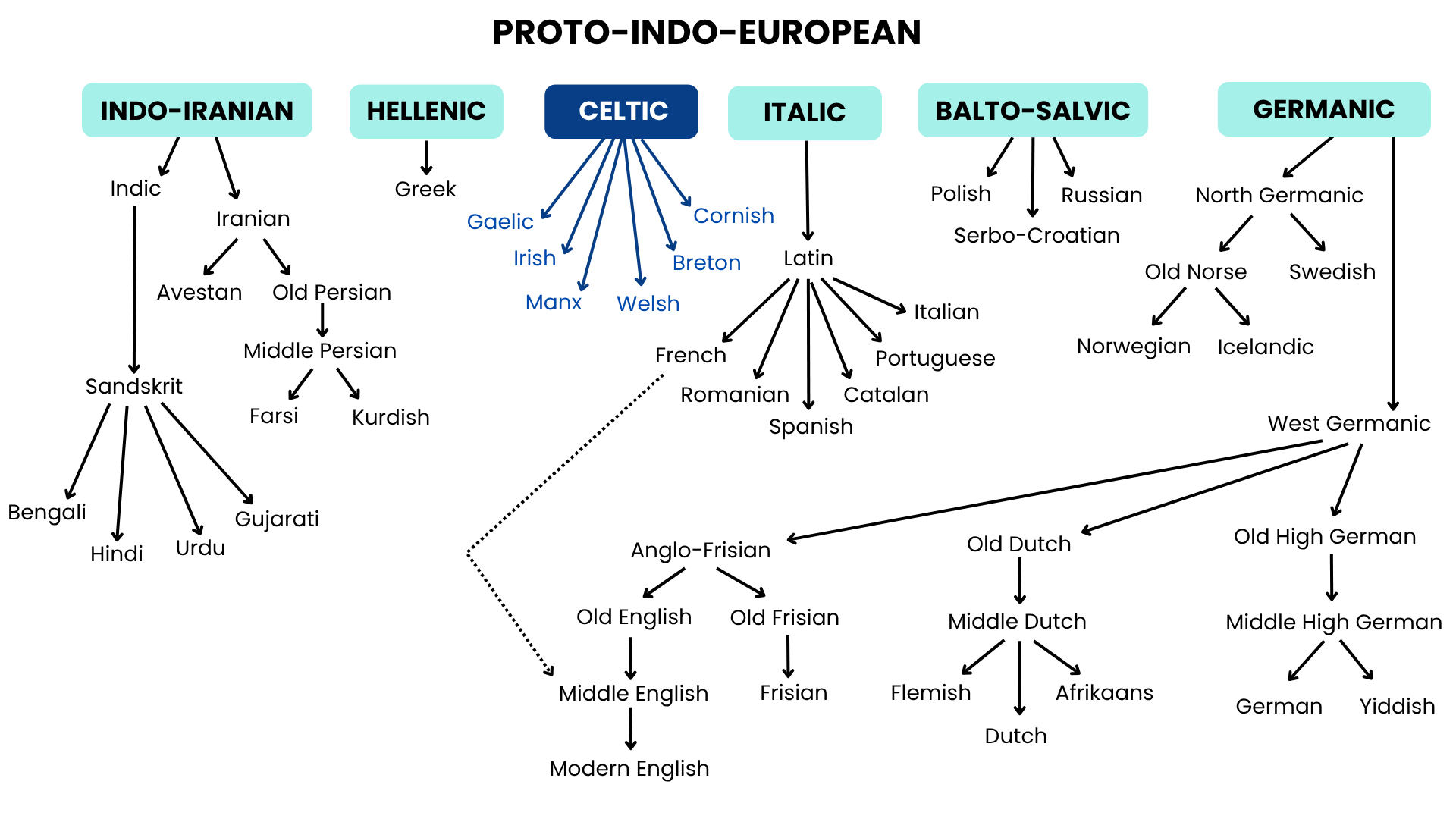
Model of a language tree showing the relationships between (major) languages of the Indo-European family.
The arrival of the Celts
It is thought that the Celts came from central Europe, arriving in the British Isles some time during the fifth century BC. The first wave of Celts to arrive spoke a language which we call Goidelic, and from that language developed Irish, Scottish Gaelic and Manx (spoken on the Isle of Man). Another wave of Celts came shortly afterwards, speaking a language we call Brittonic, from which Welsh, Breton (spoken in northern France) and Cornish developed.
The following table shows some words in Gaelic, Irish, Welsh and Cornish which seem to suggest that they developed from one common Celtic language.
| Scottish Gaelic | Irish Gaelic | Welsh | Cornish | English |
|---|---|---|---|---|
| aimsir | aimsir | amser | - | time, weather |
| anail | anáil | anadl | anall | breath |
| cath | cath | cad | kas | battle |
| caol | caol | cul | cul | slender |
| cnò | cnó | cneuen | know | nut |
| creamh | creamh | craf | - | wild garlic |
| cù | cú | ci | ki | dog, hound |
| làn | lán | llawn | leun | full |
| roth | roth | rhod | ros | wheel |
| taigh | teach | tŷ | ti | house |
| troigh | troigh | troed | troes | foot |
Roman influence
When the Romans arrived in Britain in 43 AD, they called it ‘Britannia’, and their word for the language of those living there gave rise to the term ‘Brittonic’ (also known as Brythonic). At the time, Brittonic was spoken throughout Britain apart from areas of Scotland north of the Firth of Forth. It is almost certain that many of the Britons became bilingual, and Brittonic adopted a number of Latin words. There is no evidence that the Romans tried to discourage or even stamp out the language, but the language of those in power was Latin. The masses continued to speak Brittonic, and following the collapse of Roman rule of Britain, the Brittonic language rose to the fore again.
Impact of migration
Although at the time there were some settlers from Ireland in the west of Britain in what we now call Wales, it was those who were travelling across the North Sea and settling in the eastern parts who changed the linguistic landscape of Britain. From what are now the Netherlands, Denmark and Germany, came the Angles, Saxons and Jutes. It is likely that some came before the Romans left, but after the collapse of the Roman Empire they came more readily to make the most of the rich lands of eastern Britain. By 500 AD they had created kingdoms in which their language, Anglo-Saxon, which eventually evolved into English, was the main means of communication. Over time, they pushed south, west and north, expanding their kingdoms and driving wedges between the speakers of Brittonic.
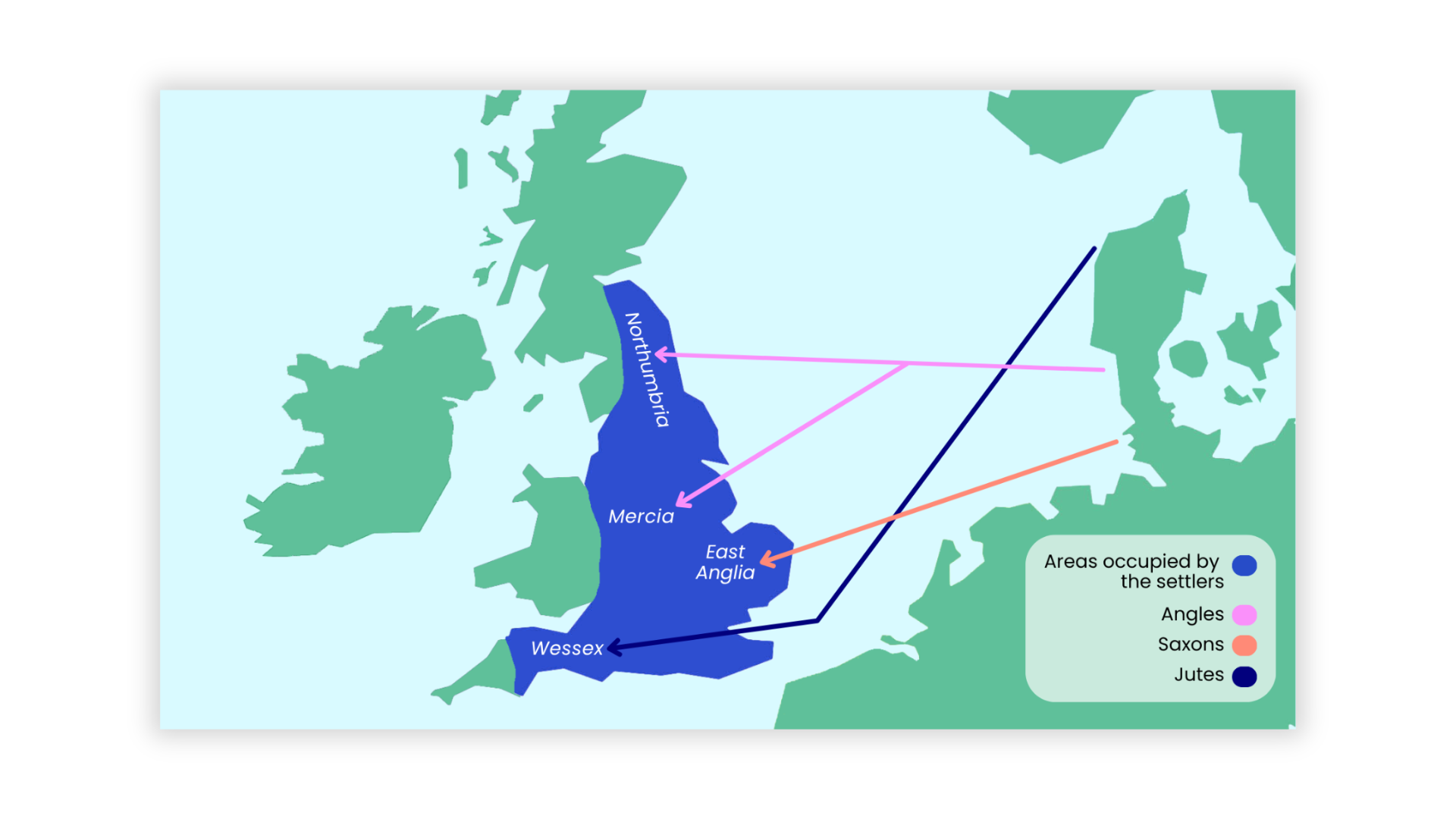
This is a map of north-west Europe, with arrows indicating movement from modern-day northern Germany and Denmark to Northumbria and Mercia (Angles), East Anglia (Saxons) and Wessex (Jutes).
Over the next few centuries the languages of the different groups of Brittonic speakers grew apart from each other, and became Cumbric (a language once spoken in northern England and the lowlands of southern Scotland which died out in the early eleventh century), Cornish and Welsh. Some Brittonic speakers left the British Isles to cross the sea to Brittany, where their language evolved into Breton, which is still spoken today. Of the three surviving Brittonic languages, Welsh is the strongest today, but the Welsh spoken at that time would be unrecognisable to the vast majority of present-day Welsh speakers.
More like this
-
Croeso: Beginners' Welsh
Learn more to access more details of Croeso: Beginners' WelshThis course is taken from Croeso, a beginners' language module that concentrates on Welsh as a tool for communication, but it also provides some insights into Welsh societies and cultures through printed and audio materials. It will be of interest to all those who want to improve their language skills in order to communicate more easily and ...

-
Welsh history and its sources
Learn more to access more details of Welsh history and its sourcesThis course is a teaching and learning resource for anyone interested in Welsh history. It contains study materials, links to some of the most important institutions that contribute to our understanding of the history of Wales, and a pool of resources that can help you understand Welsh history and the way it is studied. Included in the material ...

-
Unlocking the diversity of the past
Read now to access more details of Unlocking the diversity of the pastHistorian Norena Shopland explains why our historical knowledge and perception is lacking when it comes to stories of diversity, and what we can do to change this.

Rate and Review
Rate this article
Review this article
Log into OpenLearn to leave reviews and join in the conversation.
Article reviews