
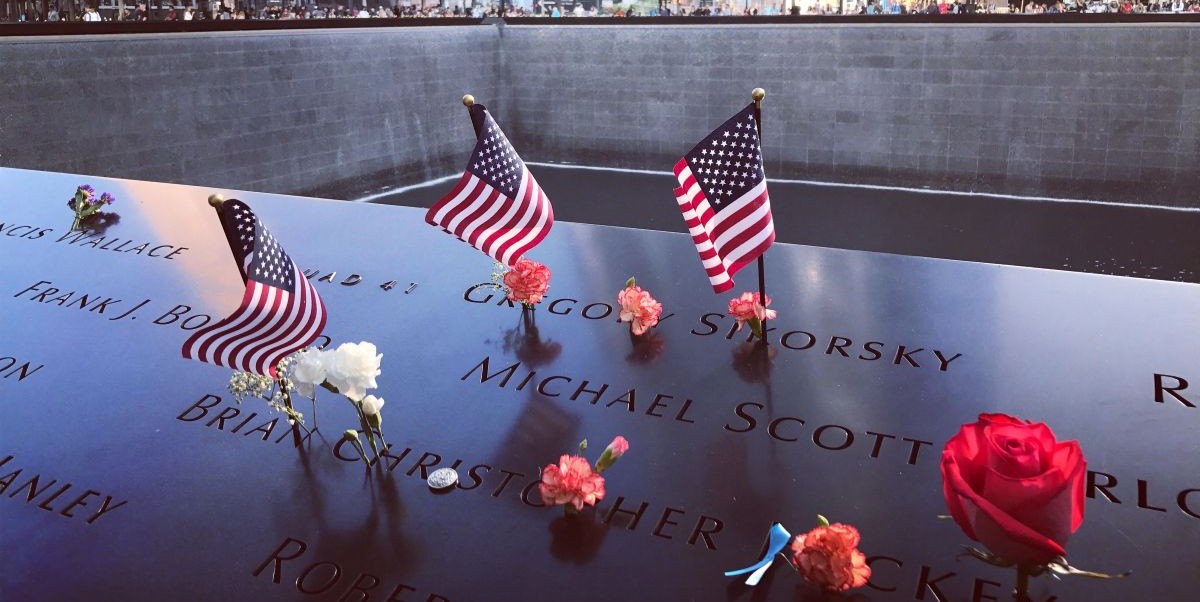
The attacks on the World Trade Center in New York City on September 11th, 2001 have been claimed as ‘world changing’ – with impacts on politics, national and global economies, and travel regulations, and much more. It is also known as a ‘mass death event’ – with nearly 3,000 people dying on or soon after, and at least another 5,000 deaths attributed to ‘9/11 illness’, including deaths of first responders and bystanders who were exposed to dust.
Mass death events can challenge our individual and societal understandings of death and grief. Memorialisation of such events can serve to pay tribute to the people who were impacted, as well as create and sustain social and cultural narratives about the event and legacy. Now that it has been 25 years since that day, how are these deaths – and the people and their lives – being remembered? Here are some examples of social practices of remembrance:
1. Physical Memorial
Opened on the 10th anniversary of 9/11 on the site of the World Trade Center, there are twin reflecting pools created as a memorial. According to the organisation responsible for it, the memorial has been designed as ‘a tribute of remembrance, honoring the 2,977 people killed in the terror attacks of September 11, 2001 at the World Trade Center site, near Shanksville, Pennsylvania, and at the Pentagon, as well as the six people killed in the World Trade Center bombing on February 26, 1993.’ The memorial includes a list of the names of people who died.
2. Museum
Alongside the memorial, there is a museum. This includes information about the building, the history of the attacks (including an earlier bombing in 1993 on the same site), and the aftermath of 9/11. It has a permanent collection of objects and personal testimonies.
3. Moments of Silence
Moments of silence are used in several countries as a gesture of respect and enable an act of collective mourning. As part of the official commemoration ceremony held at the World Trade Center for victims' families, seven moments of silence are held. Six to mark specific timepoints to reflect the pattern of events that day, and a seventh to commemorate those who have died from 9/11-related illness.
4. Reciting the names of people who have died
Reciting the names of those who have died is a practice that seeks to perpetuate a social memory of them as people – who had family, friends, dreams. It is a way to keep them ‘socially alive’ instead of aggregating them into a number or death toll. The time it takes to recite the names creates an effect of slowing down time as part of a ritual.
5. Vigils
A vigil in this context is often an organised public event to bring people together and demonstrate support for those who have been impacted, whether or not those at the vigil have been directly impacted themselves. Vigils may include the use of music, silence, and candlelight – drawing on cultural symbols and practices related to grief and mourning. In the UK, Coventry Cathedral – as a site dedicated to reconciliation and peace holds a vigil and short prayer service, timed to coincide with vigils in New York.
-
Centre for Open Thanatology Hub
Learn more to access more details of Centre for Open Thanatology HubThe Open University’s interdisciplinary research centre dedicated to the study and education of death, dying, loss, and grief across the life course and in diverse contexts.

Try a related free course
-
Death and medicine: postponement and promise
Learn more to access more details of Death and medicine: postponement and promiseThis free course, Death and medicine: postponement and promise, helps you to explore the extent to which death and dying in western societies are medical events and what aspects of death and dying might be neglected as a consequence. The course covers the way that such things as medicine provide the context of the experiences associated with the...

-
An introduction to death, dying and grief
Learn more to access more details of An introduction to death, dying and griefExplore interesting and challenging ideas around death, dying and grief. This free course, An introduction to death, dying and grief, invites you to think more deeply about death and dying and encourages you to think about it in different ways. This course will introduce you to different perspectives on death; ethical issues related to dying and...

-
Caring for adults
Learn more to access more details of Caring for adultsCaring for adults is an introductory course for anyone in a caring role, either paid or unpaid. It builds on what you already know to give you a better understanding of your role as a carer. It also supports your own well-being by giving you some ideas and information about looking after yourself and dealing with stress.

Rate and Review
Rate this article
Review this article
Log into OpenLearn to leave reviews and join in the conversation.
Article reviews