
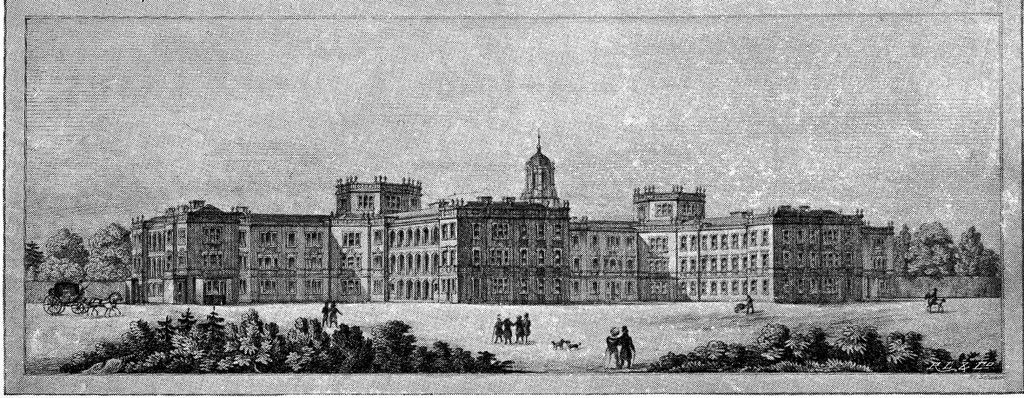
The Crichton Royal Institution, a mental health asylum established during the nineteenth century just outside Dumfries in south-west Scotland, supported a vibrant music life, including concerts, musical plays and, from the mid-nineteenth century, a choir and band. The exceptional records of the Crichton mean it’s a fascinating case study for musical life, and its links with mental wellbeing and therapy during this period.
Please note that this article includes texts describing patients with mental illnesses from the nineteenth century. The terminology used would not be appropriate for use today, but is included in order to illustrate historical ideas.
Superintendent William A.F. Browne’s ideas about music
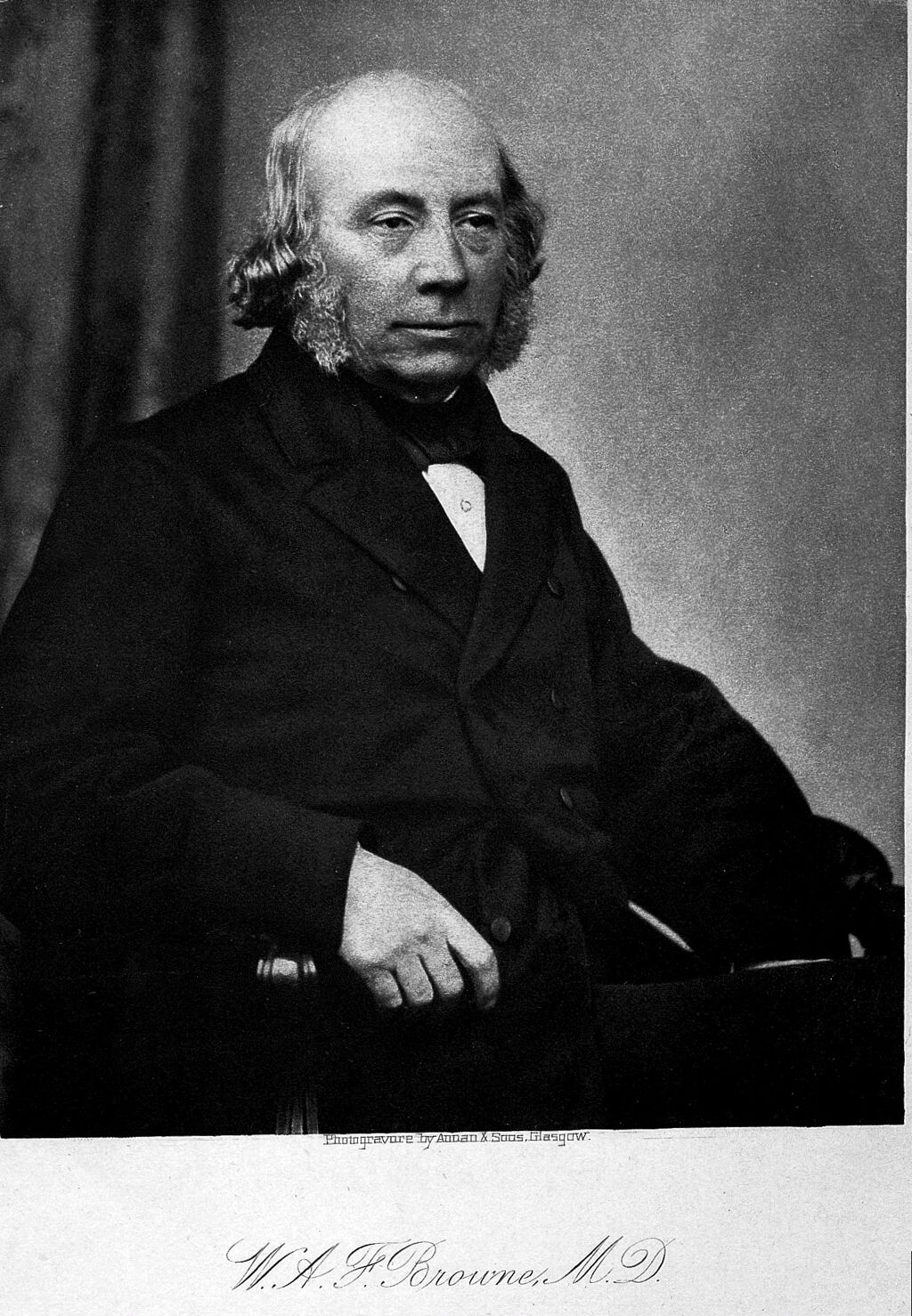
William A.F. Browne, who was Medical Superintendent at the Crichton between 1838 and 1857, wrote extensively about his practice and his views about appropriate treatments for psychiatry. Many of these ideas became influential across Britain through his publications, lectures and personal contacts. Browne describes music as an efficient and effective way of entertaining patients, whose lives at the institution could become monotonous and difficult:
Concerts have, during the past year, taken the place of balls and dancing parties; not because experience had proved the inexpediency of the latter, but because a greater number of Patients could be assembled together to enjoy the music than to share in the dance; and because, by the selection of popular pieces and national airs, a direct appeal could be made to the earliest recollections, and the most delightful feelings of which human nature is capable.
(Second Annual Report, 11 November 1841, p. 23)
In his Annual Reports for the Crichton, Browne includes anecdotes about patients who appeared to be cured or improved due to their musical experiences. In 1841, for example, he recorded the following:
One young lady is at present curing herself of extravagant ideas of her own greatness by copying, and then playing music, at which she is an adept.
(Second Annual Report, 11 November 1841, p. 20)
The 1843 report includes the narrative of a woman who was persuaded to attend a party, and while there was no evidence of her responding to the music at the time, she awoke the next morning having ‘passed suddenly from weakness to strength, from drivelling imbecility to clear, cogent intelligence, from disease to health’ (Fourth Annual Report, 11th November 1843, p. 26).
Similarly, a woman patient attending a concert in 1844 reported an ‘immediate effect, partly of her reunion with her own species, partly of melodies to which she was familiar in other times’ leading to a ‘revival of a taste for music’ (Fifth Annual Report, 11 November 1844, p. 24).
In a later example, dating from 1848, Browne recorded the following:
Music has been re-acquired by a man who had previously sunk into the condition of a partial imbecile, an animal, and a glutton. It had been an innocent passion and pastime, and became a mighty engine of cure.
(Ninth Annual Report, 11 November 1848, p. 32)
Writing much later on, Browne recalled another anecdote specifically linking mental recovery with a patient’s experience of Scottish music:
A lady after hearing Scotch music retired to bed degraded, mute, fatuous; she arose next morning and remained permanently of right and rational mind, quietly remarking to the physician, that “The banks and braes o’ bonny Doon had awakened her.”
(The Moral Treatment of the Insane; A Lecture (London, 1864), p. 26)
In other writings, Browne recognised that music was not a magical remedy for either physical or mental ill-health. Nevertheless, his belief about its ability to influence was strong enough to justify establishing a rich musical life in the early years of the Crichton.
Patient and staff concerts at the Crichton
One of the most important innovations during the early years of the Crichton Institution was its introduction of concerts organised and performed by patients and staff. Performers were drawn from across the asylum, including several of the attendants (male nursing staff), as well as local musicians from Dumfries town.
The first concert given ‘internally’ rather than by external performers was on 26 March 1846, and included piano, flute and violin solos, songs accompanied by piano or guitar, a vocal duet, and the Finale – Auld Lang Syne – sung by all with instrumental accompaniment.
The process of organising the concerts was also an important part of developing community, keeping patients occupied, and giving them a feeling of control. William A. F. Browne’s Annual Report for 1847 includes this description of the ways in which concerts were planned and executed:
By the combined efforts of Patients, Officers, and Attendants, vocal and instrumental concerts can now be provided, after one or two rehearsals, whenever other sources of amusement fail, and whenever a preference is manifested for music. This entertainment can be produced by the cooperation of inmates alone, though to the assistance and instructions of strangers, the Institution, as well as the performers, are deeply indebted. The advantages which flow from the stimulus imparted to every mind, both sane and insane, engaged in this good work, the frequent intercourse of the two classes, are almost equal to the gratification afforded by the performance of well-selected pieces of music of our national melodies, and of songs and glees, which all speak of mirth and old associations and social affections to the stricken and solitary heart. About seven concerts of this kind have taken place. One of them possessed the peculiarity that the words adapted to the airs, in one part, were exclusively the composition of inmates of the Institution. It may be styled a curiosity of literature that some of these songs are now household words, and that festive board or lowly fireside there are sung ballads either written in this Institution, or by those who found it a shelter and home and haven of rest. It must not be conceived that these are impromptu entertainments, suggested by a generous feeling and adopted merely to dispel monotony. They are schemes intended to confer moral advantages, digested with care and consideration, and carried into execution with the same solicitude and discrimination that should attend and regulate all remedial measures. A meeting takes place when the performers are chosen, and the pieces of music are examined, played, and apportioned according to the talents of the singer. Various rehearsals follow in the presence of the Officers; rumour is rife, and expectation pregnant as to the approaching amusement. An evening is appointed, frequently upon the anniversary of some national festival, or the departure of a patient. Lists containing the names of all the patients, arranged according to the galleries which they inhabit, are submitted to the Physician, who examines each, and excludes by affixing a particular mark such as are unable from infirmity to attend, such as might be excited by the scene, and such as have forfeited a right to the enjoyment by improper conduct. The purified lists are then circulated to the respective attendants; and the announcement of the persons invited is followed by refusals to attend, which are admitted, and by petitions for favour, which are considered. Then succeeds a half hour of preparation, of selection of caps, and coats, and ribbons. The mechanical arrangement of the room occupies a considerable period, as every bench and chair has its accustomed and prescriptive place and use. The patients join the assembly, and seat themselves according to an established order; the irritable are separated, the noisy and insubordinate are the companions of the attendants, who are so placed as to command a survey of the whole company, or of those more especially committed to their charge; and are directed to observe and report the deportment of all, to repress agitation, remove the excited or fatigued, and to conduct the dismissal with the same decorum and quietness which attended the commencement. After all have retired to bed the lists are returned, and then indicate those who have been present, so that not only the number, but the individuals attending are known and recorded. A similar course is pursued in the preparation and production of every amusement, and involves the whole theory and practice of reunions of the insane.
(Eighth Annual Report, 11 November 1847, pp. 35–6)
Thus, it wasn’t just performing and listening to music that formed part of the therapeutic activity at the Crichton. All the elements of preparation and decision-making, which gave lots of patients the opportunity to participate in this activity, became important in establishing new ways of creating purpose and community within the institution.
Patient composition and The New Moon
The Crichton is unusual for its record, albeit brief, of compositions by current patients. One edition of The New Moon, published on 2 November 1846, comprises a series of compositions, largely unidentified, but clearly all connected with the asylum in some way. Although we can’t be sure that they were all composed at the asylum, and for some pieces this seems unlikely, the collection forms a rare insight into the kinds of musical repertoire that might have been performed and heard, and composed.
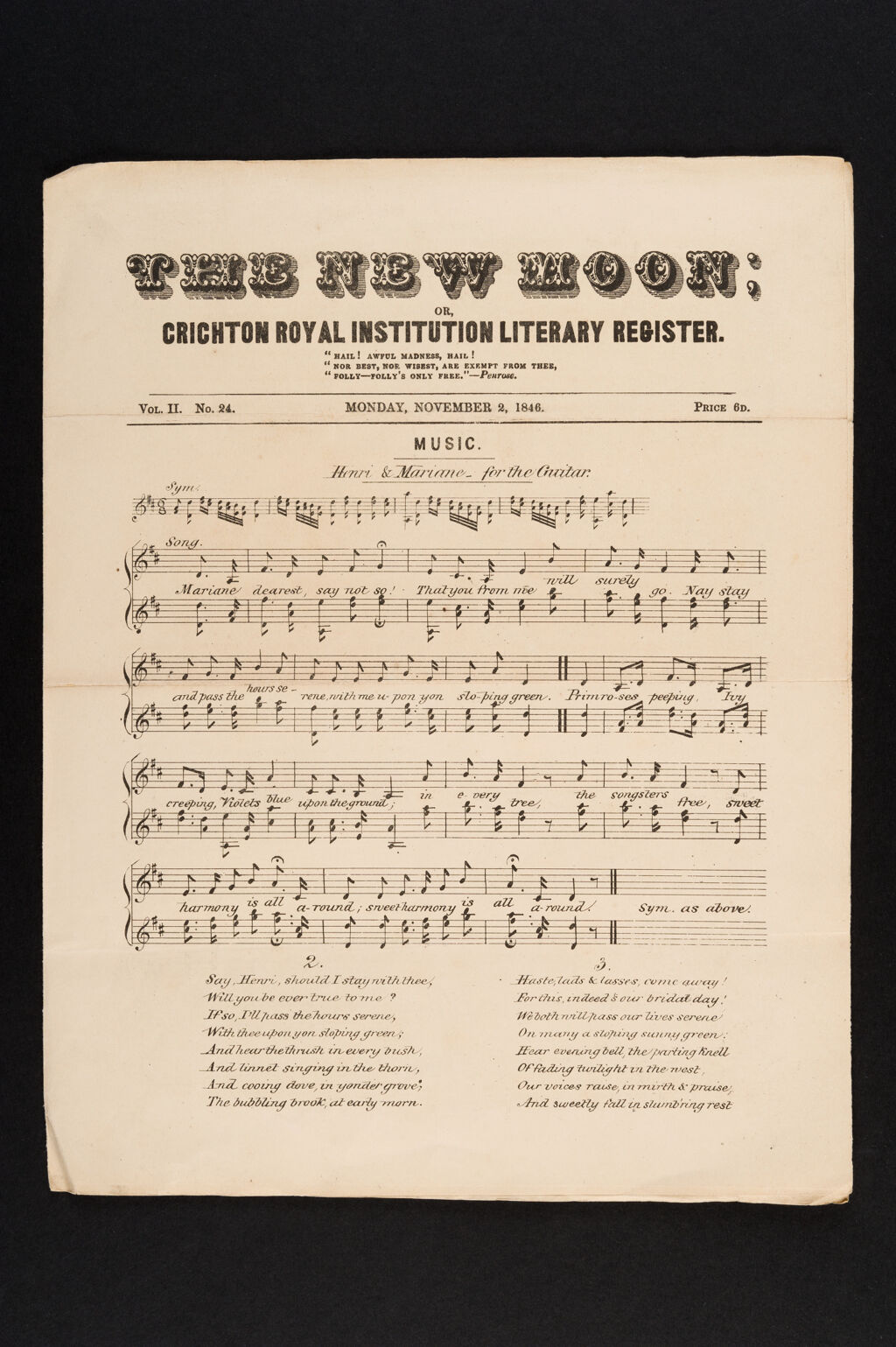 The published music chimes with much of what we know about musical performances at the Crichton. There are two songs: the first, for voice and guitar (‘Henri and Mariane’), outlines a dialogue between the two lovers over three verses separated by short guitar solos. The second (‘By thyself’) is again in three verses but unaccompanied. In both cases the songs draw on the styles of the Scottish folk tradition but are irregular and not straightforward to sing.
In addition, there is one line of melody marked as ‘Crichton, C.M.’ written as a hymn tune. Church music in Scotland was relatively austere in the first two-thirds of the nineteenth century and any singing was restricted to unaccompanied hymns and psalms. However, early records suggest both an organ and a female choir at the Crichton.
The remainder of the music consists of dance tunes and character pieces. Three of these are scored for piano, also two are rather simple, and although they have the character of dance tunes, their irregular rhythm would make them rather tricky for dancing. The rest are probably intended for guitar, fitting with the scoring of the first song for accompaniment. The written records of the Crichton archive include references to guitar accompanying songs, but not to solo guitar playing. Again, however, the pieces are unusual and irregular in their melody and harmony and are most likely composed by amateurs either in the asylum or elsewhere.
Although we don’t know much about how the music was performed, by whom, where, or when, having these snippets of musical material helps bring the sounds of the Crichton a little more to life.
Scottish music at the Crichton
One of the most notable aspects of the musical repertoire at the Crichton – though hardly surprising – is the presence of Scottish songs and dances. As we saw earlier, several of Browne’s writings linked Scottish music, and patient memories of national music, with mental recovery. One particular concert, given on 14 February 1851, had a particular Scottish focus, with several sets of ‘Selections of Scotch Airs’, and a dominance of songs set to texts by Scottish poets. Four out of the eleven songs and ensembles made used of poems by Robert Burns (1759–1796).
While it has been possible to track down the texts of most of the songs performed, musical settings are much harder to pinpoint. Burns wrote most of his songs for pre-existing melodies, largely Scottish traditional or folk tunes, but since then a number of new melodies and settings have been composed specifically, and arrangements of both the traditional and newly-composed tunes made. Some of these processes are explored in the Romantic National Song Project.
The first of these songs, the glee 'Birks of Aberfeldy', was written by Burns in 1787, during a tour of the Highlands, and makes use of a traditional tune 'The Birks Of Abergeldie'. It was arranged as a three-part glee for male or female voices by Harriet Abrams (c.1758–1821), an English composer and Soprano based in London. Abrams studied with the composer Thomas Arne and made her name as a fashionable soloist, performing both in oratorios and private concerts for the aristocracy. She had some considerable success with her compositions, including collections of ballads and sets of English, Italian and Scottish songs. The text reflects the natural imagery that formed an important part of Romantic literature:
Chorus
Bonie lassie, will ye go,
Will ye go, will ye go?
Bonie lassie, will ye go
To the birks of Aberfeldy.
Now Simmer blinks on flow'ry braes,
And o'er the crystal streamlets plays;
Come let us spend the lightsome days
In the birks of Aberfeldy.
Chorus
The little birdies blythely sing,
While o'er their heads the hazels hing;
Or lightly flit on wanton wing
In the birks of Aberfeldy.
Chorus
The braes ascend like lofty wa's,
The foaming stream deep-roaring fa's,
O'er hung wi' fragrant spreading shaws,
The birks of Aberfeldy.
Chorus
The hoary cliffs are crown'd wi' flowers,
White o'er the linns the burnie pours,
And rising, weets wi' misty showers
The birks of Aberfeldy.
Chorus
Let Fortune's gifts at random flee,
They ne'er shall draw a wish frae me;
Supremely blest wi' love and thee
In the birks of Aberfeldy.
Further reading
If you are interested in discovering more about the Crichton and its activities, the documents associated with the institution have been digitised and are available publicly via the Wellcome Collection site.
More information about this research is available in the article ‘Concerts and Cures at the Crichton Royal Institution, 1840–1860’ in Music and Letters (published online November 2024) freely available at Concerts and Cures at the Crichton Royal Institution, 1840–1860 | Music and Letters | Oxford Academic (oup.com)
Like this? Try a FREE course
-
An introduction to music theory
Learn more to access more details of An introduction to music theoryGain an understanding of the basic building blocks of musical theory and notation. This free course, An introduction to music theory, will introduce you to music staves, clefs, rhythmic and pitch values, rhythmic metre and time signatures. This OpenLearn course provides an introduction to music theory pitched at a level equivalent to Grades 1–3 ...

-
Introduction to music theory 2: pitch and notation
Learn more to access more details of Introduction to music theory 2: pitch and notationIn this free course, you will explore the concept of musical pitch by working with examples of folk, popular, and classical music from several world traditions. You will learn how pitch is represented using staff notation and other forms of illustration. You will also practise reading and writing pitch using staff notation, and learn to perform ...

-
Understanding musical scores
Learn more to access more details of Understanding musical scoresThis free course, Understanding musical scores, provides a general introduction to how to understand a musical score, and insights into what professional musicians do with the notation that these contain. You’ll learn how to connect the notation you see with the music you hear, from short familiar melodies to a full orchestral score.

Rate and Review
Rate this article
Review this article
Log into OpenLearn to leave reviews and join in the conversation.
Article reviews