
Find out more about The Open University's Languages courses and qualifications.
As a researcher studying mobile phone communication since the early 2000s, I have witnessed huge technological developments alongside shifts in how people interact with technologies and how technologies are embedded into people’s lives.
Twenty years ago, most mobile phones were chunky, narrow devices with number keys and tiny displays. They did not have touchscreens or QWERTY keyboards and they weren’t connected to the internet – there was no browser, no GPS-enabled map, no social media, no alarm clock. All you could do was call – and text.
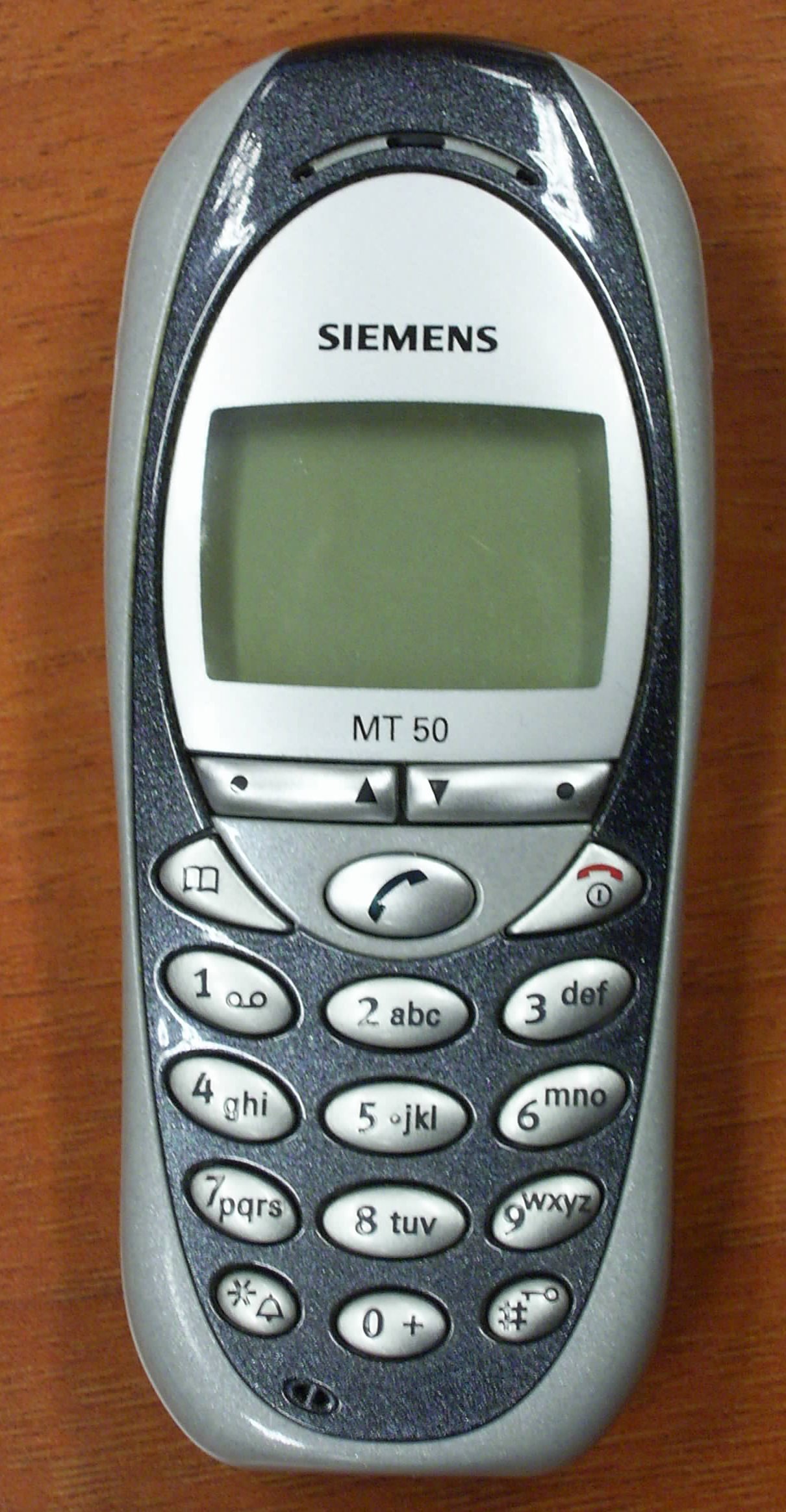 Figure 1: A mobile phone from the early 2000s Siemens MT 50 mobile phone
For the first time, with SMS text messaging, people could communicate directly with friends and family at a distance through written messages in real time and on the move. Admittedly, SMS was a very constrained tool for communication. Messages were limited to 160 characters and senders had to pay per message. Letters of the alphabet were distributed across the number keys and accessed using a ‘multi-tap’ method. With multi-tap, for example, a could be accessed by tapping 2, b by tapping 22 and c 222, while s was 7777.
Textspeak
Although text predictive technology such as T9 were quickly invented and added to phones, these constraints no doubt contributed to the emergence of an abbreviated form of writing known as ‘textspeak’.
In November 2006, for example, I received this SMS text message from a friend:
Hi, been v busy with work, glad wk nearly over, v v tired! Ur wk ok? Re tomo, i finish work at twelve so i'll come back here n join u later, if that's ok. Was wondering whether to train in to uni station n train n taxi back as solves car problem - plus this oldy might flake early as been sleeping badly this wk. Let me know time if plan changes. See u tomo x
Features of textspeak in my friend’s message include the use of grammatical ellipsis, such as the omission of the subject pronoun and verb I have in ‘been v busy’ and ‘been sleeping badly’ and the omission of the (twice) in ‘Let me know time if plan changes’.
However, textspeak was known primarily for its respelling, whereby people deliberately use spellings that deviate from the standard form, rather than making a mistake (or a ‘misspelling’). Respellings in the message above include word shortenings (v, re, tomo, uni), consonant writing (wk) and letter homophones (ur, u, n). These abbreviated forms emerged in response to technological constraints such as the keyboard. For example:
Twenty years later
Since 2006, the technology has changed hugely, through the introduction of internet-enabled smartphones with touch screens, QWERTY keyboards, new interfaces and more sophisticated predictive text-entry methods. Since the advent of smartphones, mobile messaging apps such as WhatsApp now sit alongside web browsers and apps including camera, maps and streaming services, games and social media, and this has increased the fluidity with which people navigate the multiple online and offline spaces in their daily lives.
Here, for example, is an extract from my family WhatsApp group taken from August 2026.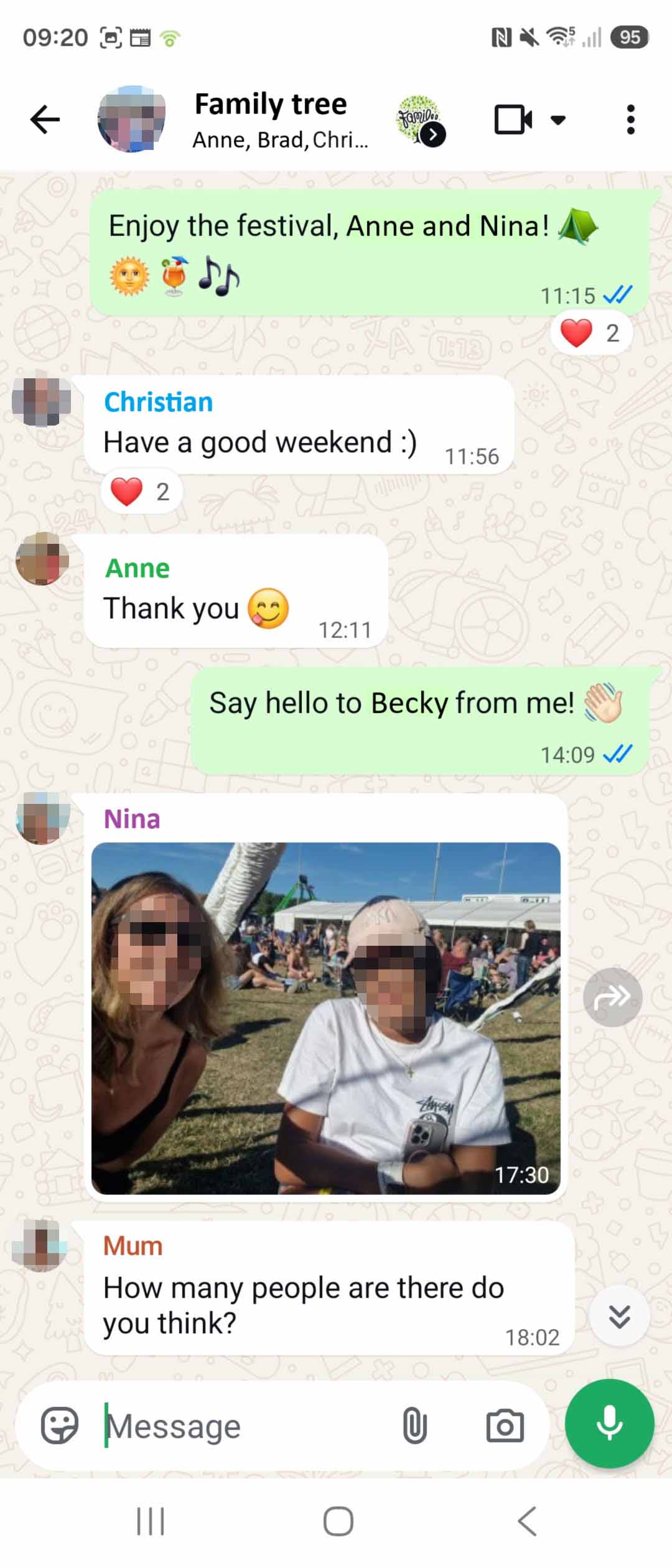 Figure 2: An extract from my family WhatsApp chat (names have been changed) A screenshot of a WhatsApp conversation from the 'Family tree' group. The messages read: Me: Enjoy the festival, Anne and Nina (emojis: tent, sun, cocktail, musical notes) Christian: Have a good weekend :) Anne: Thank you (emoji: smile with tongue sticking out) Me: Say hello to Becky from me (emjoi: wave) Nina: [Selfie photo] Mum: How many people are there do you think?
In the extract, my family do not make use of respelling and instead have access to a greater array of multimodal resources. The verbal messages contain very short formulaic expressions but are animated by a variety of emojis, both embedded into messages and offered as reactions to messages sent by others. The photo – a selfie sent without an accompanying written caption – allows Nina and Anne to convey what they are doing not by telling their family but by showing them. In so doing, they invite their loved ones into the moment to participate in their experience. The photo also serves as a prompt for further conversation, in this case eliciting a question about the number of festival goers, which also demonstrates Mum’s interest and engagement with the shared photo. At the same time, we might argue that the conversation does not require much effort from those involved. They do not need to interrupt what they are doing (such as enjoying the festival) but can send a message at times that suit them.
Understanding technologies and relationships
Over the last twenty years, researchers have moved away from a focus on the technological constraints of new technologies towards understanding the ways in which technologies make possible new ways of connecting, relating and doing things in the world.
The extract from my family group points to a shift in how people build and maintain relationships in the 2020s. Intimacy is nurtured not only through in-person encounters and in-depth conversation but through small everyday gestures – hastily composed messages, emojis, photo-sharing – which signal ongoing interest and involvement but which also enable people to simultaneously carry out busy schedules and competing commitments.
The mobile phone does not determine our relationships, but over the last two decades it has become an increasingly inherent part of how we relate to others.
Explore the other articles in this collection...
-
20 years in… What’s changed?
Read now to access more details of 20 years in… What’s changed?A lot can change in 20 years! From scientific discoveries and technological advances to shifts in society and culture, explore how different subjects have evolved since OpenLearn first launched in 2006.

Level: 1 Introductory
Discover more on OpenLearn
-
A brief history of communication: hieroglyphics to emojis
Learn more to access more details of A brief history of communication: hieroglyphics to emojisThis free course, A brief history of communication: hieroglyphics to emojis, is an introduction to the history of writing, and the key role it plays in human communication. It tracks this history from the invention of writing around 5500 years ago to the mass popularity of emojis today.

-
A short introduction to the English language
Learn more to access more details of A short introduction to the English languageThis free course, A short introduction to the English language, will look at the role language plays in our lives, with a particular focus on the English language. It will examine the history and the future of the language, from the Anglo-Saxons and Shakespeare to social media communication and stand-up comedy.

-
How emoji are changing the shape of everyday English
Read now to access more details of How emoji are changing the shape of everyday EnglishWhat influence are emoji having on the way we communicate? Is the common use of the eggplant or facepalm emoji something to worry about? Philip Seargeant explores this online visual language...

Rate and Review
Rate this article
Review this article
Log into OpenLearn to leave reviews and join in the conversation.
Article reviews