
The Winter Olympics are much more than an inferior sibling to the perceived glamour and wider media coverage of the summer games. They offer something the Summer Olympics cannot always offer, and that is real jeopardy. As all the events are performed either on ice or snow the risk that competitors may come to grief at any point is constant. This increased uncertainly, and the role of luck, contributes to the outcome of events being more unpredictable. This makes for events with added excitement. For example, the skeleton event which is a time trial involving the athletes lying face down on a fibre glass tray as they hurtle down an icy, winding course at great speeds with only body movements to steer them, is known for producing unpredictable outcomes.
Where is it taking place and when?
The 25th Winter Olympic Games start on Friday 6 February in the north of Italy hosted jointly by Milan and Cortina d’Ampezzo. They are referred to as Milano Cortina and will actually be spread across five venues: Milan, Cortina, Valtellina, Val di Fiemme and Verona. Cortina, which is in the Alps, will host skiing, curling, bobsleigh, luge and skeleton, while Milan is home to ice hockey and speed skating as well as the opening ceremony. Across 17 days there will be 116 medals to be won in 16 disciplines. The Paralympics will be held concurrently and run from 6 February to 15 February.
Athletes from 92 Olympic Committees will compete, including Benin, Guinea-Bissau and UAE for the first time, while athletes from Russia and Belarus remain under a ban. There are some Russian and Belarus athletes who are eligible to compete as Individual Neutral Athletes (INA). INA don’t compete under the Olympic or their national flag and don’t march at the opening ceremony. The Paralympics involves athletes from 52 National Paralympic Committees.
There is only one new event for these games and that is ski mountaineering, or SkiMo, where competitors will climb a mountain on skis, or carrying their skis, and then ski back downhill.
What are the chances of medals for Team GB?
UK Sport have been talking up the chances of medals for British athletes, suggesting they may come back with eight medals which would be a significant improvement on their record tally to date of five medals. This medal prediction is based on recent successes of British athletes in World Championships over the last two years.
For me the Winter Olympics is a chance to rekindle my love for Curling. My passion for Curling was reinforced by the medals won by British teams in 2022. The women’s team, with Eve Muirhead as skip, won gold while the men’s team led by Bruce Mouat won silver. Now with Eve Muirhead retired, she is acting as Team GB Chef du Mission, it is up to her teammate Jennifer Dodds and the team nicknamed ‘Jen and the kids’ to match her success. This might be too much to ask for as the teams from Switzerland and Canada are particularly strong. However, Team GB’s men’s team will go into the event as favourites.
The last figure skaters to win a medal were Jayne Torville and Christopher Dean in 1994 at Lillehammer when they took bronze to go alongside their Bolero inspired gold medal from 1984. However, there are high hopes that British pair of Lilah Fear and Lewis Gibson, nicknamed the ‘Disco Brits’, might get onto the podium. This is based on the bronze medal they won at the 2025 World Championships. Another figure skater to look out for is Kristen Spours who featured in BBC OU co-production Freeze: Skating on the edge. It is Kristen’s final appearance before retirement.
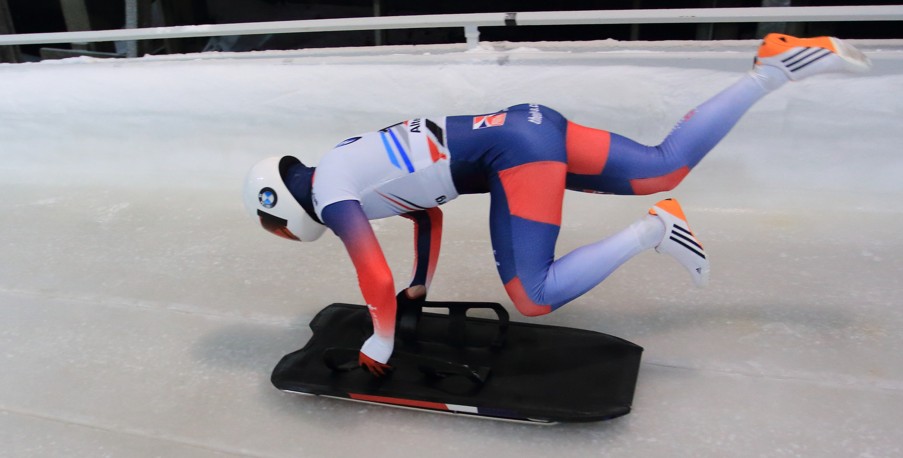
The skeleton events have traditionally been productive for Team GB with Lizzy Yarnold and Amy Williams winning golds between 2010 and 2018. In Cortina the men’s team will be represented by Matt Weston and Marcus Wyatt (pictured below) who were gold and silver medallists respectively at the 2025 World Championships. They are both experienced Olympians and stand a real chance of winning a medal. The women’s team is represented by three athletes: Tabby Stoecker, Amelia Coleman and Freya Tarbitt. All three of these athletes started out in different sports. Stoecker was a gymnast, while Coltman and Tarbitt were long jumpers and they transitioned to skeleton through UK Sport’s Discover your Gold programme.
While the skeleton might be the most frightening sport, the gravity-defying exploits of the freestyle skiers and snowboarders is also thrilling. Freestyle skiing offers real medal chances through Zoe Adkin in the halfpipe event and Kirsty Muir in slopestyle and big air events. They both won golds in the recent X Games, but both athletes have serious competition from Olympic legend Eileen Gu who already has two gold medals to her name.
Two more to look out for
The bobsleigh events are among the most spectacular events as these huge sleds hurtle down the tight turns of the course. Team GB has both two-men and four-men teams led by Brad Hall and including Royal Marine Taylor Lawrence, who played football, cricket and rugby before settling on bobsleigh.
No article about the Winter Olympics is complete without a mention of the Jamaican bobsleigh team who were immortalised through the film Cool Runnings despite not officially finishing. The 2026 Jamaican team includes British bobsledder Joel Fearon, who won a bronze medal with Team GB in 2014.
There is optimism around the British team for these Winter Olympics and whether it works out, it is still an opportunity to enjoy sports we might not usually watch and admire these feats of danger.
Team GB will be looking be build upon recent successes at Winter Olympics, as the 2026 Games in Italy starts this month. You can dig deep into the Winter Olympics with our range of free resources.
Level: 1 Introductory
Discover more about the Winter Olympics
Winter Olympics
Study a free course on Sports and Fitness
-
Supporting female performance in sport and fitness
Learn more to access more details of Supporting female performance in sport and fitnessDo you support women’s performance in sport or fitness as a coach or parent? Are you a female athlete who wants to optimise your performance using recent research insights? If so, then this free course is for you. It addresses the problem of sports science research traditionally being male dominated and the assumption that if it works for men ...

-
The business of football
Learn more to access more details of The business of footballIf you are fascinated by men's and women's football and interested in discovering more about business and management, then this engaging and stimulating course is for you.

-
The football World Cup: where sport and politics collide
Learn more to access more details of The football World Cup: where sport and politics collideOccasionally, controversies arise that remind us of the link between sport and politics. It was once common for leading figures in the sporting world to declare that sport was, effectively, a politics-free zone. Sport was cast as the perpetual innocent party, liable to be corrupted by any connection with politics. However, it has become ...

-
Exploring sport coaching and psychology
Learn more to access more details of Exploring sport coaching and psychologyThis course investigates how scientific and management ideas contribute to success, referencing unique sporting case studies and insights that will change how you view and study sport. You will consider how the mind, the body, the environment and training techniques all contribute to optimum fitness.

-
Learning from sport burnout and overtraining
Learn more to access more details of Learning from sport burnout and overtrainingSport can place high levels of stress on athletes, coaches and others involved. If unable to cope with these stresses they may be vulnerable to developing burnout. This free course, Learning from sport burnout and overtraining, examines burnout in sport from various perspectives including both the coach’s and athlete’s perspective. Drawing on ...

-
Sporting women in the media
Learn more to access more details of Sporting women in the mediaThe mass media (e.g. radio, TV, internet) has become one of the most powerful institutional influences in society. This free course, Sporting women in the media, explores whether gendered inequalities exist in sport by evaluating the media coverage. The media can be highly influential in shaping perceptions about gender in sport and headlines ...

Rate and Review
Rate this article
Review this article
Log into OpenLearn to leave reviews and join in the conversation.
Article reviews