If you are creating a new learner account between 8am on Saturday 6 June - 8am on Monday 8 June, you might experience delays or difficulties in the process. This is due to an upgrade to a system related to new account creation. We apologise for the inconvenience.
Start this free course now. Just create an account and sign in. Enrol and complete the course for a free statement of participation or digital badge if available.
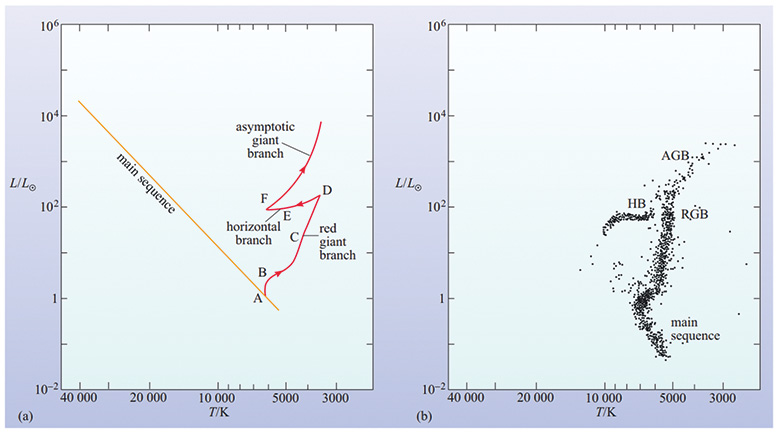
Figure _unit8.2.3 Figure 3 The post main sequence evolution of a star like the Sun. The right-hand diagram shows a sample of stars from a globular cluster such as M13. Because globular clusters are old, the more massive stars have already left the main sequence to become red giants. Only the lower portion of the main sequence, containing stars of similar mass to the Sun and smaller, is still intact. These less massive stars have longer lifetimes so have not yet left the main sequence.