
1 Why does positionality matter?
Understanding your positionality is essential because it helps you become aware of your biases and assumptions about other people and their experiences. These biases can shape your interactions, particularly when working with children and young people from diverse backgrounds. Your positions are the lenses through which you see the world, and this lens can affect how you perceive and relate to those around us. For example, someone from a middle-class background might unconsciously assume that all families have access to certain resources, or someone who has never experienced discrimination might underestimate its impact on others.
Consider this: how you see and describe ourselves and how others see and describe you can profoundly influence your experiences and our worldview. For instance, a person who has experienced racism directed towards them may have a different understanding of it than someone who has only observed it from a distance. Similarly, someone who grew up in care may have insights about the system that someone who had a stable family home might not possess. Examining your positionality can help you better understand these differences.
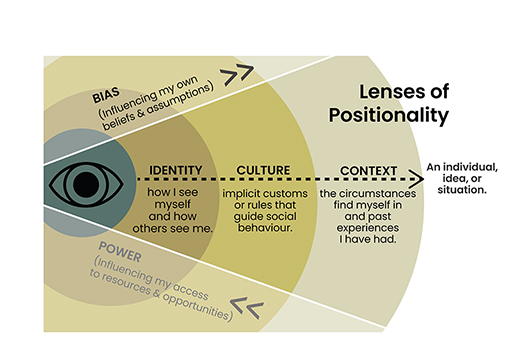
To better understand what shapes your positionality, you’ll look at the different elements that contribute to our individual lens through which you view the world. Figure 2 illustrates the different aspects that contribute to our positionality.
In the following video, you’ll meet the course author and hear her describe her positionality and how she thinks it affects her view of herself and the people she works with.
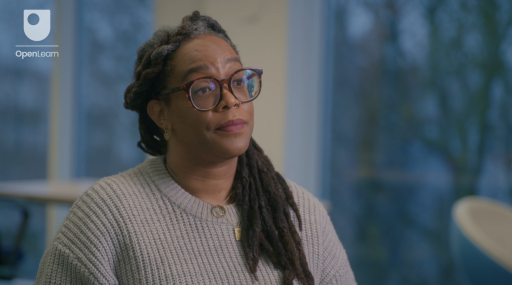
Transcript: Video 1 Mel Green introduces the course.
MEL GREEN
Hello, and welcome to this OpenLearn course called Understanding race and racism when working with children and young people. My name is Mel Green, and I’m a lecturer in education studies at The Open University, where I’ve been teaching since 2017. I’m leading efforts across the University to embed anti-racist practice, pedagogy, and assessment into our work. And these principles are central to the course you’re about to undertake.
I am also a mother of two wonderful boys, who are a big part of why I’m so passionate about this topic. My boys are mixed race. They have a Black British mother, me, and a white British father. This aspect of our family’s identity significantly shaped my worldview, especially when it comes to understanding how race will affect their experiences in education and beyond.
Before becoming a lecturer, I worked as a primary school teacher in various settings-- state schools, specialist provisions, pupil referral units and psychiatric units. During that time, I saw first hand the different experiences that racially minoritised learners face. These experiences have driven me to want to make a difference to help inform educators and practitioners about how to support positive racial identity development in children, particularly those who are often overlooked and misunderstood.
My eldest son is diagnosed as autistic and is non-speaking. This has deeply influenced my work, particularly my interest in special educational needs. Because of this, you’ll find a section in this course dedicated to exploring the intersection of racial identity development and special educational needs. I’m also pursuing a doctorate in education, where my research focuses on how identity affects teaching practice. I’ve had the opportunity to work with participants from various ethnic backgrounds and with different disability needs, exploring how their personal identities influence their professional lives.
In addition to my teaching and research, I’m currently co-writing a book that explores the impact of Blackness on mothers raising autistic children. This book draws on my experiences, my co-author’s experiences, and the experiences of other Black women across the UK. It examines the unique challenges and strengths that come with this intersection of identities, and it serves as another way I am working to bring marginalised voices into crucial conversations.
Throughout this course, I will invite you to reflect on how your life experiences, both personal, professional, shape your practice and values when it comes to working with and understanding race and racism in the context of children and young people. This course is designed not just to inform but to challenge and inspire you to think differently about how we support the racial identity development of all children, including those with additional needs. I thank you for taking part in this course.
Whether you’re a parent, carer, family member, practitioner, or educator, this course is designed with you in mind. My hope is that by the end of this course you will leave with a deeper understanding of how to support positive racial identity development in children, and that you’ll be equipped with practical tools and insights that you can apply in your daily interactions. With this newfound knowledge you’ll be able to create environments that are inclusive, affirming, and truly supportive of every child’s unique identity.
The author’s experiences as a Black woman, a mother, and a carer are integral aspects of her personal identity that have profoundly influenced her professional work and research interests. These identities and lived experiences shape the lens through which she views the world and inform the areas she chooses to focus on in her studies and practice.
Understanding positionality as parents and/or practitioners is crucial for several reasons.
1 Personal and professional awareness
Each person’s identity influences how they perceive and interpret the world around them. By reflecting on your individual positionality, you can become more aware of the biases and assumptions that shape our perspectives. It’s important to recognise that everyone holds biases, often without realising it, and people may also make assumptions about others based on how they perceive their identities. This awareness is essential in your personal and professional lives, as it allows you to approach situations with greater empathy and understanding.
2 Impact on research and practice
Being aware of our individual positionality affects the questions you ask, the methods you use, and the interpretations you make in our research and practice. For example, the author’s research interests in race, gender and education are directly influenced by her experiences as a Black woman and educator. This demonstrates how your lived experiences naturally guide you toward areas where you have personal insight, but it also means you might overlook perspectives or issues that fall outside your own experience. Acknowledging and critically examining your positionality can help you to conduct more ethical and reflective research and develop more inclusive practices that consider diverse perspectives.
3 Promoting equity and inclusivity
Equity means ensuring fairness by recognising that different people may need different types of support to achieve similar outcomes, while inclusivity means creating spaces where everyone feels welcomed, valued and able to participate fully.
Your individual positions are the lenses through which you see the world. These lenses, influenced by your identities, culture, and context, shape your worldview, which is essentially how you see and understand everything around you, including your beliefs, values and attitudes.

Activity 1 What is your lens?
This activity will help you to uncover your own lens and how it shapes your understanding of race and racism.
Think about the following questions and write down your thoughts:
- What are the key aspects of your identity (e.g., race, gender, class, sexuality, ability)?
- How might these aspects influence your perspective on the world? For example:
- a.Do they affect what you notice or pay attention to?
- b.Do they influence what feels ‘normal’ or ‘different’ to you?
- c.Do they shape what you worry about or feel confident about?
- How do you think others might perceive you? What aspects of your identity might others use to describe or define you?
- Can you think of a significant experience that changed the way you view the world or other people? This might be something that happened to you personally, something you witnessed, or even something you learned about.
- Have you experienced, seen, or heard racism? How did these experiences affect your understanding?
Note your responses to these questions in the text box below.
Discussion
When an individual understands their own positionality, they are able to acknowledge how their backgrounds, identities and experiences shape the way they see the world and interact with others. This concept is especially relevant when working with children and young people because it helps us recognise that:
- every child and young person also has their own unique positionality that influences their experiences and perspectives
- your assumptions about what is ‘normal’ or ‘appropriate’ may not reflect a child’s lived reality
- you may unconsciously favour approaches, examples or expectations that align with your own background rather than theirs
- understanding your own lens helps you become more aware of when you need to step back, listen more carefully, and adapt your approach to better meet their individual needs.
In the next section, you’ll explore why positionality matters.