
2.1 Understanding race and ethnicity through positionality
Understanding the concepts of race and ethnicity is deeply intertwined with your positionality and the various worldviews you hold. These concepts are not static; they are influenced by your background, experiences, and the cultural contexts you navigate.
Race is a social construct, meaning it is a concept that society has created based on physical characteristics such as skin colour, hair texture and facial features. There is no scientific basis for racial categorisation – in reality, the human species shares 99.9 per cent of DNA, with the 0.01 per cent difference reflecting variations in our environments and other external factors (Mensah, 2021). However, as you’ve explored, how you understand and engage with race is significantly influenced by your positionality. For example, someone who has experienced racism may have a very different understanding of how race operates in society compared to someone who has rarely had to think about their racial identity. Similarly, someone from a racially diverse community may view race differently than someone who grew up in a more homogeneous environment. Your positionality shapes whether you see race as something that significantly impacts daily life or as something that feels less relevant to your personal experience.
Your experience of race will affect how you come to understand it. For instance, an individual who identifies as a person of colour may have a deeply personal and lived understanding of race that includes experiences of racism and discrimination. Their positionality allows them to see race as a critical aspect of their identity that influences their interactions and opportunities in society. In contrast, a person who has not experienced racial discrimination may hold a position of privilege, where racial issues are less apparent in their daily lives and may view race as a less significant in their personal experience.
It’s important to note that having privilege doesn’t necessarily mean being unaware of systemic inequalities. Many people recognise that racism exists and affects others, even if they haven’t experienced it personally. However, our positionality does shape how immediately visible these issues are to us and how they impact our daily reality. Someone who benefits from racial privilege might need to make a more conscious effort to understand and recognise systemic inequalities, while someone who experiences discrimination encounters these realities as part of their lived experience.
This difference in awareness and experience influences how you approach conversations about race and the importance you place on addressing racial issues in your personal and professional practices.
Activity 2 Perspectives on practice
This activity will help you consider how different positionalities might lead to different interpretations of the same situation.
Read the scenarios below and consider the questions that follow.
Scenario A: During circle time, 8-year-old Amara, who recently moved from Somalia, sits quietly and doesn’t make eye contact when the teacher asks her direct questions. She participates enthusiastically in group activities but seems reluctant to speak up individually.
Scenario B: 15-year-old Malachi, a Black teenager, has been arriving 10 minutes late to your form registration after lunch recently. When his form tutor asks him about it, he gives short answers and seems defensive. His form tutor has noticed Malachi has been spending time with a group of older boys outside the school gates.
Scenario C: 6-year-old Li Wei brings rice and vegetables in a container for lunch every day. Some children have made comments about the ‘strange smell’ of her food, and she’s started asking if she can have sandwiches like the other children instead.
Reflection questions:
- How might different practitioners interpret each situation based on their own cultural background and experiences?
- What assumptions might someone make, and how could these be influenced by their positionality?
- How might your own positionality affect your initial response to each scenario?
- What additional information would help you better understand each child’s experience?
Think about how factors like cultural background, experience with discrimination, family structure and social class might influence how different people view these situations.
Discussion
These scenarios highlight how our positionality can significantly influence our initial interpretations of children’s behaviour and needs.
For Scenario A, someone from a similar cultural background might immediately recognise that in many cultures, direct eye contact with authority figures is considered disrespectful, while someone unfamiliar with this norm might interpret Amara’s behaviour as shyness, defiance or lack of engagement. Additionally, it’s important to consider that Amara may simply need time to build trust and familiarity with new adult figures in her life, something that could affect any child in a new environment, regardless of cultural background.
In Scenario B, an educator who has experienced discrimination might be more attuned to potential external pressures Malachi could be facing, while someone without this experience might focus primarily on rule-breaking or attitude issues without considering broader contextual factors.
For Scenario C, someone who has experienced food-related discrimination might immediately recognise this as a cultural inclusion issue requiring intervention, while others might see it simply as children being ‘fussy’ about different foods.
The key insight is that there’s rarely just one ‘correct’ interpretation of a situation. Your positionality shapes what you notice first, what you prioritise, and what solutions you consider. By acknowledging this, you can:
- ask more questions before making assumptions
- seek input from colleagues with different backgrounds
- consider multiple possible explanations for a child’s behaviour
- develop more culturally responsive approaches.
Understanding your own lens helps you recognise when you might need to look through others’ perspectives to fully support each child.
To confuse matters more, the concept of ‘race’ is often unhelpfully used interchangeably with the term ‘ethnicity’. However, ethnicity actually recognises the distinct cultural practices and beliefs of a particular group of people who share a sense of collective identity. For example, people who belong to the ethnic group defined as ‘White’ may vary widely in physical characteristics and place of birth. Your positionality plays a crucial role in how you perceive and relate to ethnicity. A person from a minority ethnic group might see ethnicity as a core part of their identity, providing them with community and belonging, while also potentially facing challenges related to discrimination or cultural preservation. Conversely, someone from a majority ethnic group may take their ethnic identity for granted, rarely needing to actively think about or defend it.
Additionally, terms like Black and Minority Ethnic (BAME) and Black and Minority Ethnic (BME), which group all non-white people together, can be offensive and frustrating to some. These terms emphasise certain ethnic minority groups (Asian and Black) while excluding others (mixed, other, and white ethnic minority groups) (Gov.UK, 2021). They can also mask disparities between different ethnic groups, creating misleading interpretations of them as a single, homogeneous group. However, some government and educational institutions still use the term BAME or BME because deciding on language to discuss racial inequality and other forms of discrimination can be complex and consensus is often challenging to achieve.
The mixing of terms like race and ethnicity stems from the complex process of racialisation, that is, the way certain physical or cultural characteristics become the basis for creating racial categories. This process can be linked to colonisation and historical power structures (Blakemore, 2019). Omi and Winant (1986) describe racialisation as a political process of assigning ethnic or racial identities to groups that did not initially identify as such. This highlights two important points:
- Without this political process of categorisation, individuals were unlikely to categorise themselves in these ways.
- Racialisation is inherently political.
Since racialisation is a process that places people into racial categories, this course uses the term ‘racially minoritised’ rather than umbrella terms like BAME and BME. This language emphasises that people are made into minorities through social and political processes, rather than suggesting minority status is a natural characteristic.
To better illustrate racialisation, consider how you may have been asked to categorise yourself in official forms. The 2011 Census form below shows how ethnic identity is structured and presented to the public.
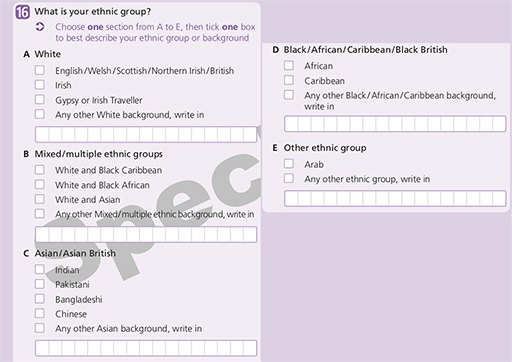
You’ve probably encountered similar forms asking for your ‘ethnic group’. Notice how this census form asks for ethnic group and cultural background but also uses terms like Black and White that hint at racial characteristics. You might also observe that ‘White’ is listed first, and different groups are separated rather than grouped into a single BAME category. This structure reflects the political dimensions of racialisation.
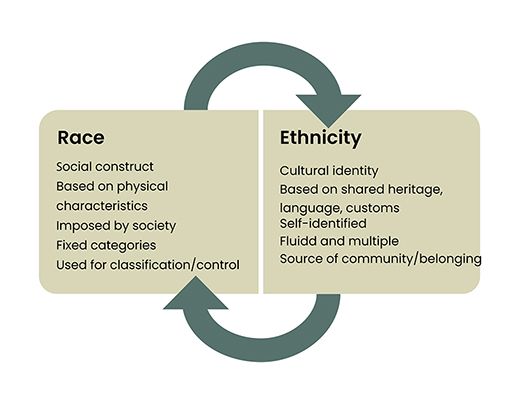
While the census form shows how race and ethnicity are often treated as the same thing, they are actually fundamentally different concepts that shouldn’t be used interchangeably. The diagram below illustrates the key distinctions between these two terms and why it’s important to understand the difference.
Your positionality plays a crucial role in how you perceive and relate to ethnicity. A person from a minority ethnic group might see ethnicity as a core part of their identity, providing them with community and belonging, while also potentially facing challenges related to discrimination or cultural preservation. Conversely, someone from a majority ethnic group may take their ethnic identity for granted, rarely needing to actively think about or defend it.
Understanding our positionality helps us appreciate why ethnicity holds varying degrees of importance for different people and to foster a more inclusive attitude towards cultural diversity and individual experiences.