
1.1 What is racial identity?
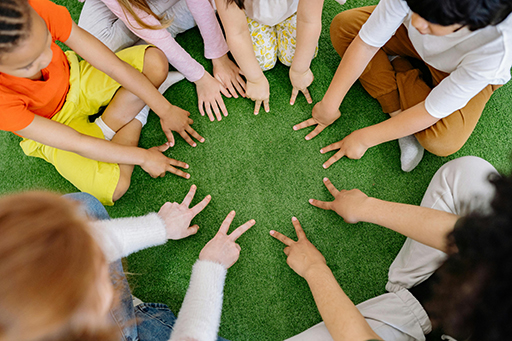
Developing a sense of identity is a crucial part of childhood development. You might recall your own experiences of forming your identity during childhood, which could have been either positive or negative depending on your lived experiences missing from glossary.
Racialisation missing from this session’s glossary so I copied across from Session 1 - is that OK? is the process through which society assigns racial identities to people. Think back to Session 1, where you explored the example of an English Census form. Citizens completing this form are asked to place themselves into racial categories, which is a form of racialisation. This process uses certain characteristics, like skin colour, to categorise people. Children experience racialisation from birth through how others respond to their appearance, even before they understand these categories themselves. As highlighted in Session 1, membership within these categories can lead to assumptions about an individual’s abilities, behaviour or worth. For example, someone might be treated differently simply because of the colour of their skin, regardless of who they are as an individual.
During childhood, children begin to recognise sameness and difference between themselves and those around them, often influenced by the racialisation processes they observe and experience. They may also begin to verbalise how they feel about these differences or similarities. This can be referred to as an awareness of in-group and out-group membership. An in-group is a social group that an individual psychologically identifies as being part of. This might be a racial group, an age group and even a cultural group like being a Star Wars fan. Being a member of a social group (i.e. an in-group) often implies that you are not a member of another social group (i.e. an out-group) (Roth, Steffens and Vignoles, 2018).
Awareness of racial in-groups and out-groups begins as early as three months old, when babies show a preference for looking at and interacting with people who share their race (Kelly et al., 2005). This early inclination suggests that racial awareness is not just a product of socialisation but may also have a biological basis. As children grow, this awareness becomes more pronounced. By early childhood, children often show favouritism towards peers of the same race (Dunham, Baron and Banaji, 2008), choosing playmates who share their racial characteristics and expressing preferences that align with their in-group. By preschool age, these racial preferences become more explicit and consistent, reflecting both their developmental stage and the influence of their environment (MacNevin and Berman, 2017).
As these preferences and social groupings emerge, children begin to form their racial identity, that is, a sense of belonging to a particular racial group. This identity is shaped not only by their interactions and experiences but also by the societal attitudes and cultural practices they are exposed to. A racial identity includes the significance and meaning that individuals attribute to their membership in that group. This meaning can be influenced by personal experiences, community values and family traditions. Racial identity involves the recognition of both shared physical characteristics, and the cultural heritage associated with a racial group. It is a crucial aspect of a person’s overall identity, affecting their self-perception, interactions with others, their worldview and how they navigate the social world.
During the Early Years, children’s developing self-esteem becomes increasingly connected to how they see themselves within racial groups and how others respond to their racial identity.
Reflection prompt
Think about the in-groups you belong to.
Consider factors like your age, gender, race and ethnicity, sports clubs, hobbies, other interests and political affiliations.
Then, reflect on the out-groups you belong to by default because of your in-groups.
How does this sense of belonging – or exclusion – make you feel?