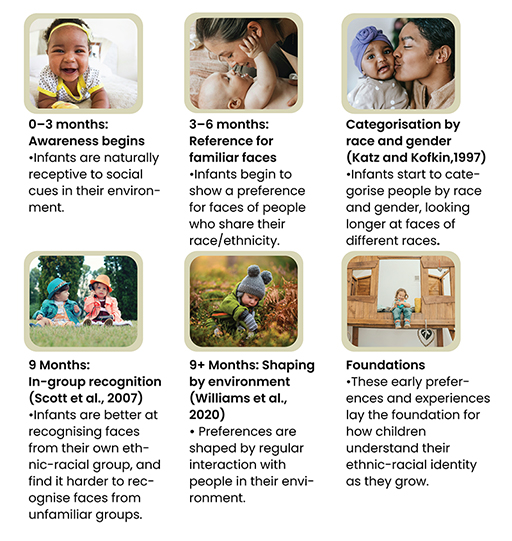
2.1 Infancy and toddlerhood (0–2 years)
While a lot of existing research on racial identity explores older children’s perspectives, there is evidence that racial identity actually starts forming much earlier, even in babies and toddlers. Researchers like Williams et al. (2020) use the term ethnic-racial identity (ERI) missing from glossary to describe this important part of who you are. This includes both race and ethnicity. Their research shows that a child’s ERI starts developing in their first year of life.
Babies aren’t born knowing about racial identity. They are, however, very good at picking up on social signals around them. Between three and nine months old, babies start paying attention to the social and cultural cues they see most often. This includes cues about race and ethnicity (Scott, Shannon and Nelson, 2007).
From three to six months old, babies begin showing preferences for faces of people who look like them. Katz and Kofkin (1997) found that even six-month-old babies can start to categorise people by race and gender. In their study, babies looked much longer at unfamiliar faces from different racial groups than at faces from their own group. As this happens so consistently at six months, it is possible to deduce that awareness of race probably starts even earlier (Katz and Kofkin, 1997).
A baby looking more at certain individuals than others likely comes from seeing certain groups more often, usually family members and close caregivers (Anzures et al., 2013). By nine months, babies are much better at recognising faces from their own ethnic-racial group. They find it harder to tell apart faces from groups they’re less familiar with. However, this is not only linked to a person’s physical appearance, as babies also respond to familiar languages, cultural practices, and sounds they hear regularly.
You explored the concept of in-group membership earlier in this session. Here you can make the connection that babies are already starting to identify with their in-group, i.e. the people they see and interact with most often. These preferences aren’t due to any inherent bias. Instead, they are shaped by the environment and the people they interact with regularly. This phenomenon, known as the Other Race Effect (ORE) missing from glossary, is not fixed (Williams et al., 2020). When infants are regularly exposed to people from different racial groups, they become better at recognising and distinguishing individuals from those groups. This suggests that early exposure to a variety of people plays a crucial role in shaping these preferences.
Think about it: Have you noticed this in your own life or in children you’ve observed? Perhaps you’ve seen how a child becomes more comfortable and responsive to different people as they spend more time with them.
Research also shows that positive associations with one’s own race begin very early. For example, infants show a preference for same-race faces when paired with happy music or learn behaviours more easily from same-race models (Xiao et al., 2018). These early experiences create the foundation for how children understand their ethnic-racial identity as they grow (Williams et al., 2020). They also demonstrate that children are not ‘colour-blind’, instead they are aware of racial differences very soon after birth.
The timeline in Figure 3 summarises the key developmental milestones in racial identity formation during the first year of life, showing how quickly these foundational preferences and awareness develop.