
2.2 Preschool years (3–5 years)
As children move into the preschool years, they develop a much clearer understanding of race and ethnicity. During this time, their awareness of racial categories becomes stronger. This awareness is shaped by the people and environments they interact with, such as family, school, and media (Quintana, 2008; Tatum, 2017). This is an important stage where children not only notice differences in skin colour, language and cultural practices, but they also begin to attach meaning to these differences (Aboud and Levy, 2018).
By age three, many children can identify and label racial differences. They start using these labels when they talk and play with others (Hirschfeld, 2008). For example, they might notice that their friends or family members look different from other people. They often ask questions or make comments about these differences. This is also when children might begin to show preferences or biases based on race. These preferences often reflect the attitudes and messages they pick up from adults and the world around them (Katz, 2003).
At this stage, children are doing two important things at once. They’re forming their own sense of racial identity, and they’re also starting to understand what race means in society. The messages children receive from their parents influence how they understand their racial identity. However, these messages don’t affect all children in the same way. They can have different impacts depending on a child’s gender and even their skin tone (Derlan et al., 2017).
Children learn, sometimes directly, sometimes indirectly, what it means to be part of a particular racial or ethnic group. They also learn what it means to be included in or excluded from certain groups (Brown and Bigler, 2005; Cristol and Gimbert, 2008). This shows us that children aren’t ‘colour blind’. From a young age, they are aware of racial differences and are already learning what these differences mean in their social world.
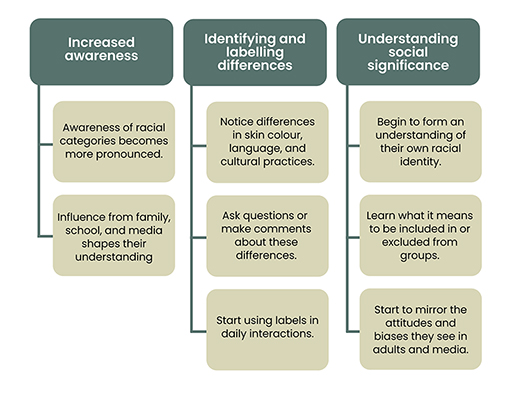
Figure 4 illustrates the three key areas of development during the preschool years. Notice how each area builds on the others – as children become more aware of racial categories, they begin using labels to describe what they observe, which then leads to understanding the social meanings attached to these differences.
Activity 2 Pre-school racial identity quiz
a.
During adolescence
b.
During the preschool years
c.
As early as the first year
d.
Only after starting school
The correct answer is c.
Discussion
Research by Williams et al. (2020) shows that a child’s ethnic-racial identity starts developing in their first year of life, much earlier than previously thought. Babies begin responding to social and cultural cues, including those related to race and ethnicity, from around 3–9 months old.
a.
By imitating speech patterns
b.
By categorising people based on race and gender
c.
By playing with toys
d.
By reacting to different sounds
The correct answer is b.
Discussion
Katz and Kofkin’s research found that six-month-old babies looked longer at unfamiliar faces from different racial groups than at faces from their own group. This shows they can already group people by race and gender at this very early age.
a.
At birth
b.
At around three years old
c.
At six years old
d.
During adolescence
The correct answer is b.
Discussion
By age three, children have developed enough language skills to identify and name the racial differences they’ve been noticing since infancy. This is when they start using racial labels in their conversations and play.
a.
They are too young to notice any differences
b.
They are unaware of social cues related to race
c.
From a young age, they are aware of racial differences and what these differences mean in their social world
d.
They treat everyone the same without understanding differences
The correct answer is c.
Discussion
The research clearly shows that children notice racial differences from infancy and begin understanding their social significance during the preschool years. Rather than being ‘colour blind’, children are actively learning what race means in their social world through observation and interaction.
a.
Infants can recognise faces from all racial groups equally
b.
Infants show a preference for faces of their own ethnic-racial group
c.
Infants have no preferences for any particular faces
d.
Infants recognise faces from unfamiliar racial groups more easily
The correct answer is b.
Discussion
The Other Race Effect shows that babies become better at recognising faces from groups they see most often (usually their own ethnic-racial group) and find it harder to distinguish between faces from less familiar groups. However, this effect can change with more diverse exposure