
2.3 The ‘influencers’ of racial identity development
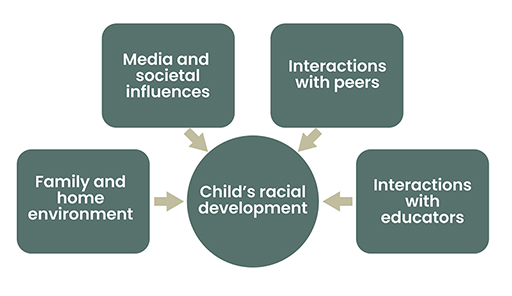
Now that you have explored how racial identity develops during the early years, it’s important to recognise that this development doesn’t happen in isolation. Figure 5 shows the four main influences that shape a child’s racial development during the preschool years and beyond.
Family and home environment
Parents and caregivers are often a child’s ‘first educators’, so the family and home environment are usually the very first place where children start learning about race and ethnicity. Parents and caregivers play a huge role in shaping how a child understands their own racial identity through the things they say and do, both directly and indirectly.
Research shows that how parents talk about race and model their attitudes toward other racial groups can significantly impact how children see race (Hughes et al., 2006). For instance, when parents have open conversations about race and encourage discussions, their children tend to be more aware of and accepting of racial diversity (Pahlke, Bigler and Suizzo, 2012).
However, it’s important to remember that these messages don’t affect every child the same way. Factors like a child’s gender and skin tone can influence how they absorb and interpret these lessons. This makes the family’s role in racial identity development both complex and unique to each child (Derlan et al., 2017).
Media and societal influences
In today’s media-saturated world, children are exposed to many messages about race and ethnicity from a young age. Whether it’s TV shows, books, movies, advertisements or video games, children are constantly picking up messages about race and ethnicity.
Unfortunately, many of these media portrayals rely on stereotypes, which can shape how children perceive different racial and ethnic groups (Anderson and Jennings, 2018). Studies have found that children who frequently watch or read content that reinforces stereotypes are more likely to adopt these biases and bring them into their everyday interactions (Gonzales et al., 2019).
However, positive media representation can make a real difference. When children are exposed to diverse and positive representations of different racial groups, it can help counteract these stereotypes and encourage a more inclusive way of thinking.
Interactions with peers and educators
As children start school, the people they interact with, especially their peers and teachers, begin to play an even bigger role in shaping their racial identity. These social interactions give children a chance to put into practice the racial attitudes and beliefs they’ve learned at home and through the media.
Teachers, in particular, have a significant influence on how children understand race. They’re not just educators; they’re also role models. When teachers promote inclusive practices and create a classroom environment that celebrates diversity, it helps children develop a positive racial identity and greater appreciation for cultural differences (Gay, 2010).
However, if racial and cultural diversity isn’t given attention in the classroom, or if biased attitudes are present, it can reinforce negative stereotypes and make some children feel marginalised. This shows how powerful the school environment can be in either supporting or undermining children’s positive racial identity development.
Reflection prompt
Take a moment to consider the different environments (family, media, school and other social interactions) that shape a child’s understanding of race and ethnicity.
How do your own actions, words and attitudes in these spaces influence the children around you?
What messages do you think you’re sending about race and diversity to children in your life?