
3 Practical strategies for supporting positive racial identity development
This section offers practical tools to help you actively support positive racial identity development in children. Engage with each strategy through activities, reflections and real-world examples.
Educators and parents can create culturally inclusive learning spaces by including culturally and racially diverse books, images and materials which reflect various racial and cultural identities. However, this must be done consciously.
Activity 3 Creating inclusive learning environments
You’re attempting to create a multicultural and inclusive learning environment for primary-aged children. Some approaches support positive racial identity development, some are well-intentioned but need careful consideration, and others can cause real harm. Sort each approach into the correct category.
I’ve had to rework this activity slightly as we don’t have the functionality for moving images around. I hope that’s OK.
- Look at the images and read about the approach.
- Decide which of the following categories the approach falls under:
- Go ahead (Authentic, respectful practices)
- Be mindful (Well-intentioned but potentially problematic without genuine reflection)
- Never do (Harmful practices that can cause damage)
- Consider: Does this approach treat cultures with respect and authenticity? Does it empower children or risk harm?
Approach 1 Creating a cultural and racially diverse book corner
Figure 7 An example of a multicultural reading corner that incorporates diverse cultural symbols through international flags and a world map rug, creating a globally-focused learning space for children to explore different cultures through literature.
https://www.orientaltrading.com/multicultural-reading-corner-a2-13671255.fltr?categoryId=553467 Alt text: A colourful multicultural reading corner with international flags hanging from the ceiling including flags from various countries. The space features a large circular rug with a world map design, bright cushions in red and blue, low bookshelves filled with books, and educational posters on the walls. The corner appears designed to celebrate global diversity and create an inviting reading environment.
We couldn’t get permission to use this so will need an alternative.
This image demonstrates one approach to creating inclusive learning spaces, though it would be worth considering whether the flag display authentically represents the children in the setting and whether the books themselves contain diverse authors and characters, not just visual symbols of multiculturalism.
Discussion
This approach falls into Be mindful for the following reasons.
Potential positives
- Creates a welcoming space that suggests global perspectives and diversity are valued.
- Provides visual cues that different cultures and countries are respected in this learning environment.
- Can spark children’s curiosity about different places and cultures around the world.
- Offers a dedicated, comfortable space specifically designed for reading and exploration.
- Shows intentional effort to move beyond single-culture classroom environments.
Why it needs careful consideration
- Flag displays may not authentically represent the actual children in the setting.
- Visual symbols of multiculturalism don’t guarantee that the books contain diverse authors and authentic cultural perspectives.
- Risk of superficial representation if not paired with meaningful cultural learning opportunities.
- Success depends on whether the book collection truly reflects diverse voices rather than just diverse-looking covers.
- Could become tokenistic if cultural artefacts aren’t authentic or connected to genuine learning about the cultures they represent.
Approach 2 Ask your learners to make ‘Tribal’ themed class portraits
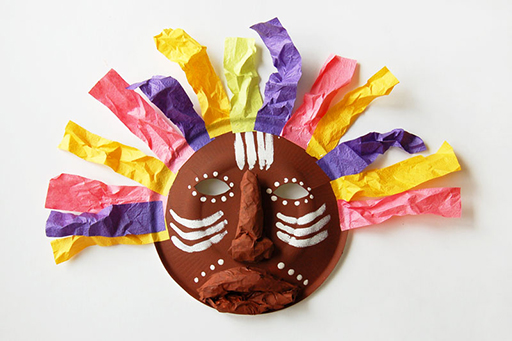
This image demonstrates one approach to incorporating cultural elements into classroom activities, though it would be worth considering whether such generic ‘tribal’ decorations respect the rich diversity and specificity of Indigenous cultures or inadvertently reduce hundreds of distinct cultural traditions to simplified visual stereotypes. Additionally, educators should reflect on whether these practices might perpetuate harmful ‘primitive’ or ‘exotic’ imagery and consider seeking authentic cultural education opportunities through community partnerships instead.
Discussion
This approach falls into Never do for the following reasons.
Why this causes harm
- Reduces hundreds of distinct Indigenous cultures to generic visual stereotypes.
- Treats sacred or ceremonially significant designs as costume props without permission or understanding.
- Perpetuates harmful ‘primitive’ imagery that portrays Indigenous peoples as relics of the past.
- Teaches children that cultural traditions exist primarily for others’ entertainment or educational use.
- Reinforces colonial attitudes that view Indigenous cultures as interchangeable rather than unique, living traditions.
The impact
- Causes real harm to Indigenous communities by trivialising their heritage.
- Misses opportunities for authentic cultural learning and relationship-building.
- Can make Indigenous children feel their cultures are seen as costumes rather than lived experiences.
- Normalises cultural appropriation and disrespectful use of cultural imagery.
Approach 3 Display a diversity bulletin board
Figure 9 A classroom bulletin board display titled "The Best Part About Me is..." - an example of well-intentioned diversity efforts that require careful consideration to ensure they genuinely celebrate children rather than tokenize differences
https://uk.pinterest.com/pin/468585536225644276/ A blue bulletin board with colourful border featuring the title “The Best Part About Me is…” with decorative elements and spaces for student contributions.
We couldn’t get permission to use this so will need an alternative.
This image demonstrates one approach to celebrating student identity and diversity in the classroom, though it would be worth considering whether such displays genuinely empower children to share what they value about themselves or inadvertently pressure them to highlight their differences. Additionally, educators should reflect on how they facilitate these activities – ensuring responses celebrate the whole child’s interests, talents and personality rather than reducing students to demographic categories or making them feel their primary value lies in how they differ from their peers.
Discussion
This type of display falls into Be mindful for the following reasons.
Potential positives
- Encourages self-reflection and self-celebration.
- Can help children articulate what makes them unique.
- Creates space for diverse voices and experiences.
Why it needs careful consideration
- Risk of children feeling pressured to highlight their differences or ‘diversity value’.
- Could inadvertently lead to tokenisation if responses focus solely on racial/ethnic identity.
- May make some children uncomfortable if they don’t want to share personal aspects of their identity.
- Success depends heavily on how it’s facilitated and what responses are encouraged/celebrated.
Approach 4 Making cultural crafts without context
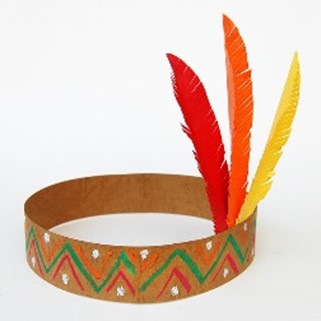
This image demonstrates one approach to incorporating cultural elements into learning activities, though it would be worth considering whether creating generic ‘Native American’ crafts respects the diversity and sacred nature of Indigenous cultural traditions or reduces hundreds of distinct cultures to simplified stereotypes. Additionally, educators should reflect on whether such activities might treat ceremonial or spiritually significant items as costume props and consider seeking authentic Indigenous education opportunities through community partnerships and age-appropriate learning about contemporary Indigenous peoples and their rich, living cultures.
Discussion
This approach falls into Never do for the following reasons.
Why this causes harm
- Reduces complex Indigenous cultures to simplified craft stereotypes like ‘feather headbands’.
- Treats sacred or ceremonially significant items as children’s costume pieces.
- Perpetuates harmful ‘cowboys and Indians’ imagery that portrays Indigenous peoples as historical figures rather than contemporary communities.
- Teaches children that cultural symbols can be freely borrowed and recreated without understanding or permission.
- Reinforces colonial attitudes that view Indigenous cultures as exotic.
The impact
- Causes real offence to Indigenous communities by trivialising sacred traditions.
- Misses opportunities for authentic cultural learning about actual Indigenous histories and contemporary lives.
- Can make Indigenous children feel their cultures are seen as costume props rather than lived traditions.
- Normalises cultural appropriation and teaches children it's acceptable to ‘play’ with other cultures’ symbols.
- Reinforces stereotypical imagery that Indigenous communities have worked hard to challenge.
Approach 5 Celebrating cultural events such as Black History month
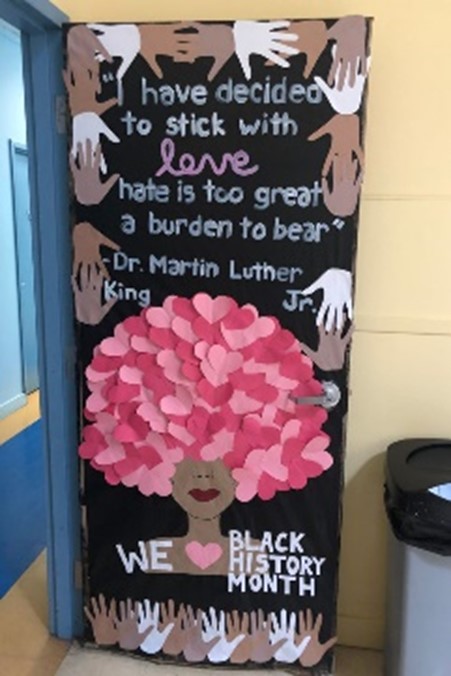
This image demonstrates one approach to celebrating Black History Month and honouring American civil rights leaders, though it would be worth considering whether the display connects to local and global contexts of racial justice rather than focusing solely on American figures. Additionally, educators should reflect on whether their approach balances learning about influential international leaders like Dr King with exploring racial justice histories relevant to their own communities and countries – ensuring children understand that the struggle for equality has taken many forms across different nations and that there are local heroes and contemporary activists whose stories also deserve recognition and study.
Discussion
This approach falls into Be mindful for the following reasons.
Potential positives
- Features authentic words from Dr Martin Luther King Jr, a significant historical figure.
- Creates a dedicated space to honour and learn about Black history and contributions.
- Shows intentional effort to move beyond tokenistic diversity approaches.
- Provides opportunity for meaningful discussion about civil rights and social justice.
- Demonstrates commitment to celebrating Black History Month with substance rather than superficial symbols.
- Uses direct quotes that can spark important conversations about love, unity and overcoming prejudice.
Why it needs careful consideration
- May focus primarily on American civil rights history while overlooking local or national racial justice leaders and movements.
- Risk of treating historical figures as distant artifacts rather than connecting their teachings to contemporary issues.
- Could inadvertently suggest that racial justice is primarily an American or historical concern.
- Risks reducing Black history and contributions to just one month rather than integrating them throughout the year.
- Success depends on facilitating meaningful discussions that help children understand ongoing struggles for equality.
- Needs to be balanced with learning about racial justice heroes relevant to children’s own communities and countries.
- Requires careful consideration of how to make historical lessons relevant and actionable for young learners today.
Approach 6 Role-playing slavery and historical violence
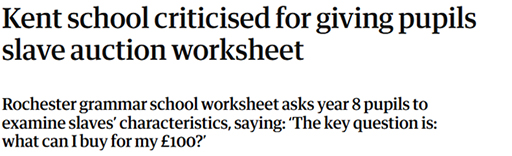
This image demonstrates one approach to teaching about historical slavery through experiential learning activities, though it would be worth considering whether asking students to simulate slave auctions respects the trauma and humanity of enslaved people or inadvertently normalises their dehumanisation. Additionally, educators should reflect on whether such role-playing exercises cause harm to students, and consider alternative methods for teaching about slavery that centre the experiences, resistance, and the attitudes and policies that led to the creation of the systems of oppression that caused immense suffering.
Discussion
This approach falls into Never do for the following reasons.
Why this causes harm
- Forces students to adopt the perspective of slave owners and make calculations about human worth.
- Traumatises students, particularly those from African diaspora backgrounds, by recreating the dehumanising logic of slavery.
- Reduces the systematic brutality and trauma of enslavement to a classroom budgeting exercise.
- Normalises viewing human beings as commodities to be evaluated and purchased.
- Trivialises one of history’s most devastating systems of racial oppression and violence.
- Creates hostile and unsafe learning environments for Black students and their families.
The impact
- Can cause lasting psychological harm to students who are descendants of enslaved people.
- Perpetuates racist ideologies by having students literally practice the mindset that enabled slavery.
- Demonstrates profound disrespect for the millions who suffered, resisted and died under these systems.
- Misses opportunities for authentic education about resistance, resilience, and the lived experiences of enslaved people.
- Shows how seemingly ‘educational’ activities can cross clear ethical boundaries.
- Reinforces dehumanisation of certain groups.
Approach 7 Cultural holiday decorations without context
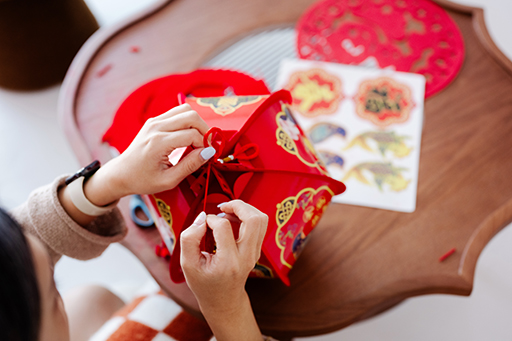
This image demonstrates one approach to celebrating cultural holidays through craft activities, though it would be worth considering whether creating decorative items without proper cultural context respects the significance and meaning of these celebrations or reduces rich traditions to superficial visual elements. Additionally, educators should reflect on whether such activities provide authentic learning about the cultural and spiritual significance of holidays like Chinese New Year or Diwali and consider partnering with community members who can share the genuine meaning, history and contemporary relevance of these important celebrations.
Discussion
This approach falls into Be mindful for the following reasons.
Potential positives
- Shows effort to acknowledge and celebrate different cultural holidays.
- Provides hands-on creative activities that children often enjoy.
- Creates visual reminders that diverse celebrations are valued in the classroom.
- Can spark initial interest and curiosity about different cultural traditions.
- Demonstrates intention to move beyond single-culture holiday celebrations.
Why it needs careful consideration
- Risk of reducing meaningful cultural and religious celebrations to craft projects.
- May strip away the spiritual, historical or family significance of important holidays.
- Could perpetuate stereotypes if decorations don’t reflect authentic cultural practices.
- Success depends entirely on whether proper cultural context and education accompany the activity.
- Needs input from community members to ensure respectful and accurate representation.
- Could become tokenistic if not connected to genuine learning about the cultures being celebrated.
Approach 8 Creating a class or family world map
This is really small and we can’t obtain a bigger version. Is there something we could use as an alternative? https://www.istockphoto.com/photo/where-is-gm157480217-9351010; https://www.istockphoto.com/photo/young-teacher-at-geography-lesson-gm186661473-28492072
This image demonstrates one approach to creating globally-aware classroom environments through world map displays, though it would be worth considering whether such maps genuinely reflect the diversity and experiences of children in the setting or remain as decorative background elements. Additionally, educators should reflect on how they use these visual tools, ensuring they facilitate meaningful conversations about global connections, cultural exchange and contemporary world issues rather than reinforcing outdated geographical or political perspectives and connecting map-based learning to children’s own family histories and global relationships.
Discussion
This approach falls into Be mindful for the following reasons.
Potential positives
- Creates visual reminder that the world extends beyond local community.
- Can spark curiosity about different countries and global connections.
- Provides reference point for discussing current events and global issues.
- Shows intention to develop children’s global awareness and perspective.
- Offers opportunities to connect learning to children’s family origins and travel experiences.
Why it needs careful consideration
- Risk of remaining purely decorative without meaningful educational engagement.
- May present outdated political boundaries or geographical representations.
- Could reinforce Western-centric perspectives if not used thoughtfully.
- Success depends on how actively teachers use the map for learning opportunities.
- Needs regular updates to reflect contemporary global realities.
- Should connect to children’s actual experiences rather than abstract geography lessons.
Approach 9 Having cultural dress-up days
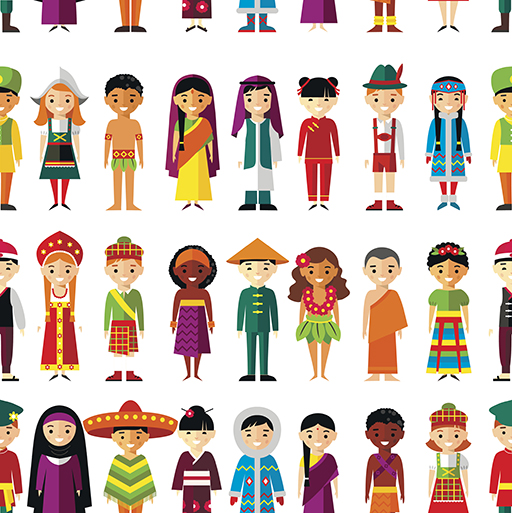
This image demonstrates one approach to celebrating cultural diversity through dress-up activities, though it would be worth considering whether such events genuinely honour cultural traditions or risk turning meaningful clothing and cultural practices into costumes for entertainment. Additionally, educators should reflect on whether these activities provide authentic cultural education and community partnership, ensure voluntary participation without pressure on children to represent their cultures, and avoid reducing rich cultural heritage to visual displays that may perpetuate stereotypes or misrepresent sacred or ceremonial clothing.
Discussion
This approach falls into Be mindful for the following reasons.
Potential positives
- Shows effort to celebrate and acknowledge cultural diversity in the classroom.
- Can create opportunities for children to share their heritage with pride.
- May encourage curiosity and interest in learning about different cultures.
- Provides visual celebration of the multicultural nature of the school community.
- Can foster discussions about cultural traditions and their significance.
Why it needs careful consideration
- Risk of turning meaningful cultural clothing into costumes for entertainment.
- May pressure children to represent their entire culture or feel tokenised.
- Could perpetuate stereotypes if cultural dress is misrepresented or oversimplified.
- Success depends heavily on authentic cultural input and proper context being provided.
- Needs careful attention to sacred or ceremonial clothing that shouldn’t be worn casually.
- Requires consideration of children who may not want to participate or don’t have cultural dress to share.
- Could reduce complex cultural identities to visual costume elements.
| Go ahead | Be mindful | Never do |
| Creating a cultural and racially diverse book corner | Ask your learners to make ‘Tribal’ themed class portraits | |
| Display a diversity bulletin board | Role-playing slavery and historical violence: | |
| Celebrating cultural events such as Black History month | Making cultural crafts without context | |
| Cultural holiday decorations without context | ||
| Creating a class or family world map | ||
| Having cultural dress-up days |
You may be confused as to why there was a column for ‘Go ahead’ if none of the examples would be put into it. By starting with three categories including ‘Go ahead’ (Authentic, respectful practices), this activity helped uncover something important about working with children from diverse backgrounds: even our best practices need thoughtful consideration.
You might have noticed that approaches like multicultural reading corners, celebrating festivals with community families, or displaying diverse role models all seem like solid ideas. And they can be! But they still work best when you think carefully about:
- how you’re implementing them in a specific setting or home
- whether you’re building genuine relationships with families and communities
- if you’re considering the particular children you’re working with or caring for
- whether you’re regularly checking that our impact matches our intentions.
The ‘Go ahead’ category was included to highlight that there really aren’t any ‘set it and forget it’ approaches to inclusive practice. Even our most well-meaning efforts can miss the mark if you don’t stay thoughtful about how we’re doing them.
What this means for practice
Rather than looking for a list of ‘approved’ activities, the real skill is developing your ability to think critically about any approach you’re considering. The most useful framework is actually:
- Be mindful: Practices that can support children well when done thoughtfully, with proper context and community input.
- Never do: Approaches that cause harm no matter how they’re implemented.
This reflects how inclusive education actually works. Being a reflective practitioner who keeps learning and adjusting, rather than following a simple checklist, is what it means to be engaging in inclusive practice.
Reflection prompt for practitioners
After completing this activity, think about your current learning space. What changes could you make to ensure it is welcoming, inclusive and culturally respectful for all children?
Reflection prompt for parents and carers
Does your learning or home environment celebrate racial and cultural diversity? What could you add or change?
Inclusive education is complex work that requires continuous critical thinking. There are no practices so perfect that they can be implemented without thoughtful consideration of context, community and individual children’s needs. In the next section, you’ll round up your learning from this session by applying your knowledge to another case study supported by our course expert, Dr Mngaza.