
6 Case study and practical applications
In this section, you’ll explore the story of Kofi, a 15-year-old boy navigating the transition from school into the world of work. This case study highlights how Black boys are often misinterpreted in both educational and professional settings, and how unconscious bias and racialised expectations can shape feedback, opportunities, and a young person’s developing sense of identity.
Activity 4 Kofi’s story: learning from a real-life example
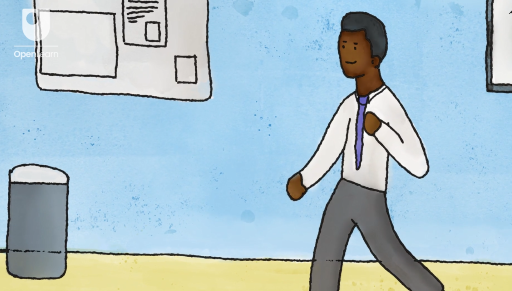
The following animation tells you the story of Kofi, whose experience highlights many of the issues you’ve been exploring in this session. As you watch, pay attention to how Kofi’s positive qualities are interpreted by others, and consider what this might mean for his sense of identity and belonging.
Transcript: Video 1 Kofi’s story
NARRATOR
Kofi, a 15-year-old boy from Ghana, is a student at a predominantly white school in the Midlands. He is a student with a strong academic record and a clear vision for his future. Ambitious and driven, he harbours dreams of a career in finance, motivated by a desire to contribute positively to his family and community.
At school, Kofi is known for his proactive approach to learning, often leading study groups and excelling in subjects like mathematics and economics. Recently, Kofi was selected for a coveted work experience placement at the head office of a very well-known bank. This was a rare opportunity that he saw as a stepping stone towards his professional aspirations.
This experience was intended to give him real-world insight into the banking sector, and allow him to apply his academic knowledge in a practical setting. However, the placement did not go as expected. Kofi was allowed to work within the Customer Service team in the bank’s service environment.
Kofi was eager to make the most of this opportunity, frequently offering ideas on how to improve efficiency and customer service, based on his observations and studies. His suggestions, though well intentioned and insightful, were not always well received. A particular incident involved Kofi proposing a new layout for the customer service area to reduce wait times, which he presented during a team meeting. His initiative was met with resistance from the bank staff, who interpreted his assertiveness as overstepping, leading to tensions within the team.
Back at school, the feedback from the bank was framed in ways that mirrored their earlier misinterpretations of Kofi’s behaviour, with terms like presumptuous and arrogant coming to the fore. This feedback was a blow to Kofi’s self-esteem, and his perception of his place in professional environments. His teachers, who had high hopes for his placement, were puzzled by the mixed report, leading them to sit Kofi down for a discussion about navigating workplace dynamics, and the fine line between showing initiative and perceived insubordination.
This experience at the bank, coupled with the discussion with his teachers, took a toll on Kofi. His once clear path to his future career started to look less appealing. And as he grappled with the realisations that the qualities he thought would make him successful, leadership, initiative and a drive for improvement were being misconstrued in both his educational and professional settings.
Kofi’s parents became concerned about the impact of these experiences on his aspirations and wellbeing, so arranged meetings with his teachers and the school’s placement coordinator. They sought to understand the context of the feedback, and to advocate for a more positive interpretation of Kofi’s actions, emphasising his potential, and the positive intentions behind his assertiveness.
Briefly note how you feel after watching the animation.
- What qualities did Kofi demonstrate?
- How were those qualities interpreted by others?
- How might these same behaviours have been interpreted if Kofi were white?
- What impact might these experiences have had on his confidence and future aspirations?
Discussion
While watching Kofi’s story, you may have noted how the same qualities, confidence, initiative and leadership can be interpreted completely differently depending on who displays them.
What you might have noticed:
- Kofi demonstrated: Leadership, analytical thinking, problem-solving skills, confidence, initiative and genuine care for improving systems.
- Others saw: ‘Presumptuous’, ‘arrogant’, ‘overstepping’, someone who needed to learn about ‘workplace dynamics’.
- The impact: Kofi began questioning whether his natural strengths were actually problems, potentially derailing his career aspirations.
Task 2 Expert analysis
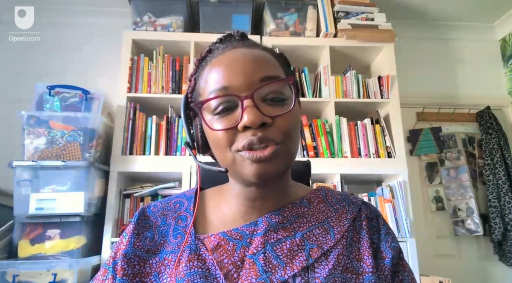
You’ll now hear from Frances Akinde, our expert in secondary education, inclusion and SEND, as she helps us understand what was really happening in Kofi’s experience and why it matters for young people’s development and experiences.
Transcript: Video 2 Analysing Kofi’s story
FRANCES AKINDE
Hi. My name is Frances Akinde. I am an inclusion consultant specialising in intersectionality, race, and SEND. I am also a local authority inspector and advisor, looking after special schools for a large local authority and generally giving advice around inclusion.
So when it comes to intersectionality, we start off with these race, gender, sexuality, class, and then it gets bigger and bigger. I’ve kind of changed my thinking around intersectionality and the language that we use because I’m very passionate that when we’re talking about intersectionality, we have to come first from a race-based starting point. And I think the term intersectionality has been made into something much, much broader by different people. And there’s lots of arguments around, well, you can’t claim that word. And I’m like, well, you’re using it from Kimberle Crenshaw’s work.
So she’s talking about race. She’s talking about gender. She’s talking about sexuality. So those are starting points. But now, I start thinking about privilege. And in my book, I’ve kind of got a diagram called privilege pie. And it’s talking about intersectionality on a wider basis of where you live that has a massive impact on whether you even get looked at for a diagnosis. And it was something I was talking to someone about in terms of autism.
There were lots of children that actually have auditory processing disorders, their first presentation. But if you’re in an area that doesn't diagnose APD, then you get diagnosed with autism as a communication difficulty.
And I really like Scotland’s approach. So they’re looking at becoming the first trauma-informed nation. And they take an approach called getting it right for every child. And that’s very much based on my favourite practitioner, which that’s such a long word to say. But Rotherham Brenner’s interactive factors framework, which is basically looking at the child first, what is going on for that child? And what are the interactive factors going around for them? And that, to me, links very closely to intersectionality, privilege, and all those other things. But it’s looking at the factors for that individual child.
It’s very easy for us as practitioners to think, OK, that child’s from that background. So this is the assumption that we’re going to make about them. So first and foremost, it’s getting back to the child as an individual. And it’s really taking some time. This is the problem. One of the issues in education is we’re not given the time to build those relationships and get to know the child as an individual. And if there was anything I could do right now would be to give people more time so that they could take an individual-first approach. And I mean, that’s what we’re saying in terms of disability, ableism, and everything else.
Black students, in particular, they do well in primary school. They leave primary school having done really well unless they’ve got unidentified SEN needs or identified SEN needs, to be honest, because then we have a lot of discrimination around that. So if children are not identified as having speech and language difficulties, they don’t get support for that. They typically do phonics screener. They fail that. And then, there isn’t any additional input into teaching them how to read through alternative methods. They’re not identified as having dyslexia or anything else like that.
So we go through primary education. We get to the end of primary school. And all of a sudden, their language difficulties have turned into SEMH, social, emotional, mental health difficulties. So that child is labeled as having a problem. They lose their confidence. Black boys do not have mental health difficulties in primary schools in the same way that they do in secondary schools. But it’s not identified as mental health difficulties that are underlying anxiety and depression from the way that they’ve been treated. It’s identified as aggressive behaviour, SEMH behaviours. And they’re misdiagnosed and mislabelled.
I always say to people, we can see it coming from when a child is in primary school. We know that the biggest area of need in primary is speech and language. We took away sure start centres. We took away support for mothers and parents in the home so that they didn’t get that support. Their needs weren’t recognised early. So then it became down to schools to recognise needs. Then, we don’t have enough speech and language therapists around. And schools aren’t investing in universal screening programmes.
So then, we have children that are going through primary school with their needs not being met. Speech and language turns into SEMH where people are looking at behaviour first rather than looking at the underlying language difficulties. You’ll get children that they’re not passing their phonics test. So they’re not passing it again. And then, nothing’s being done to look at dyslexia and other underlying difficulties.
As a child, your frustration builds. And the gap between yourself and your peers grows to the point where, OK, you’re showing expressive language difficulties. You’re not understanding. You’re not taking in receptive language. And you’re kind of showing these behaviours that people are saying, well, they’re showing these negative behaviour traits. Well, actually, that behaviour is a communication to say they’re not coping with school and with the demands that are being put on them.
With Black boys in particular, that’s my area of focus. They don’t have mental health difficulties in primary school. But then the highest rate for suicide is around Black men. So what’s happened? Why is it that in primary school Black children are doing well? And then, they get into secondary school and the gap between themselves and their peers is widening? And we have to think about the bias that goes along with that from teachers.
I wish they knew how hard it is to be a parent to racially minoritised children and how much time and effort goes into navigating them through the education system. I retrained or trained as a SENCO because of the issues I was seeing my children were facing and the bias they were facing from a young age, from the start. With one of my children needing speech and language support, going to speech and language, and them saying to me, it’s because of the way you play with your child, and him not getting his diagnosis of autism until 10 because parents were telling me that-- teachers were telling me that I was wrong and that I didn’t know my child.
And that delay where he was called arrogant and called all sorts of things, if I didn’t know the system and I didn’t know how to fight for my child, he wouldn’t have got his diagnosis. He wouldn’t have got the support that he needed. I wouldn’t have known how to fight for him. And that’s the case with all of our children. We don’t know the system. We don’t know what’s going on. We teach our children to be respectful of education and of teachers. And we’re not necessarily listening to what’s going on for them in the classroom.
I’d like to turn the question around a little bit and to say, I think the most important thing for me at the moment is parents being informed of what’s going on in education and learning what the system’s like so they can fight for their child. And then, they’re only going to get to that point when educators stop separating parents from schools. We’re supposed to be working together. I always say to people, I’ve lent you my child for the day. That’s still my child. So I’m expecting you to take care of my child and tell me when things are happening.
But unless we’re communicating with our children and finding out from them what their experience is like, taking the time to talk to them, we don’t know both sides of the story. So I would say to educators, take the time to listen to parents. Take the time to talk to them. Don’t always just say, make assumptions about things.
How have you reached out to communities and embraced them within your school? How have you invited them in and helped them feel included? Because we have a whole history of mistrust. We’re not just going to say, oh, you seem to be nice. So I’m going to believe what you’re saying. We’ve had a history of our children being taken away from us, higher rates of mortality in childbirth, and our children being put into supplement-- not supplementary schools, alternative--
Note the key words and concepts Frances uses. Are you familiar with all of them? If not, add them to your key words list at the end of this session.
Reflect on her perspective:
- Did anything Frances shared surprise you?
- What parallels can you draw between her insights and what happened to Kofi?
- How do her comments about bias and behaviour help explain Kofi’s experience?
Kofi’s story, alongside Frances Akinde’s insights, reminds us how secondary schools are racialised spaces where confidence, curiosity and initiative can be misread through the lens of race. It also highlights the emotional labour that parents take on when advocating for their children, and the systemic barriers many Black families face when trying to secure fair treatment and recognition.
Discussion
Frances’s key insights help us understand what happened:
- Frances explains how Black young people’s positive qualities are often reframed as problems, just as Kofi’s initiative was labelled as ‘arrogance’ rather than leadership potential.
- Frances notes how Black students often do well in primary school but face increasing challenges in secondary settings where bias becomes more pronounced. Kofi experienced this when moving into a professional environment.
- Frances emphasises the importance of seeing each child as an individual rather than making assumptions based on background. The bank staff failed to do this with Kofi.
- Frances speaks about how exhausting it is for parents of racially minoritised children to constantly advocate and navigate the education system, which is exactly what Kofi’s parents had to do.
- Frances directly addresses how bias from teachers and professionals affects outcomes. This bias shaped how Kofi’s behaviour was interpreted and reported.
When young people repeatedly receive messages that their natural qualities are ‘problems’, it fundamentally alters their self-concept and limits their aspirations. As Frances explains, this contributes to the widening gap between Black students and their peers as they progress through education.
As you move forward, consider the strategies discussed by Frances and how you might apply them in your own work with young people. In the final session, you will bring all your acquired knowledge from this course and put it to action.