
1 Bringing it all together
To begin, you are invited to listen to the opening of a panel conversation between the course author, Mel Green, and course experts, Dr Shaddai Tembo (early years specialist) and Dr Siya Mngaza (educational psychologist), who bring together some of the concepts you have been introduced to throughout the course so far.
Activity 1 Panel discussion between experts
As you watch the panel discussion, consider the following questions:
- What stands out to you about the emotional or relational aspects of this work?
- What do the panellists suggest about the need for long-term, ongoing commitment?
- How does this reflect your own experience, either as a parent, educator or caregiver?
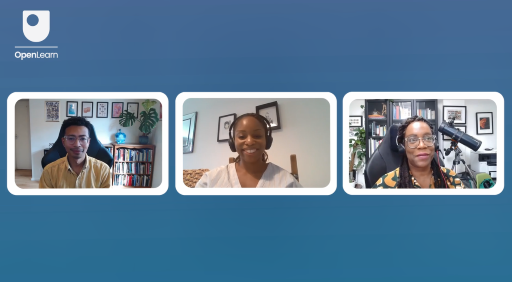
Transcript: Video 1 Panel discussion part 1
MEL GREEN
Hi everyone, and welcome to our panel discussion on understanding race and racism when working with children and young people. My name is Mel Green. And I am so excited to be chairing this important discussion today. This discussion is the concluding part of our course. And so we’re aiming to deepen your understanding of the complexities surrounding race and racism and how they impact the lives of children and young people.
So today, we have an amazing panel of experts who have joined us throughout the course and who bring a wealth of knowledge and experience from different aspects of education, inclusion, psychology, and much, much, much more. So I’m going to leave it to our panelists to introduce themselves.
SHADDAI TEMBO
Yeah. I’m Dr Shaddai Tembo. I am a lecturer in early childhood studies at Bath Spa University and The Open University. I’m also a trustee for the Fatherhood Institute and an independent writer and consultant for the critical early years.
SIYA MNGAZA
And I’m Dr Siya Mngaza. I’m an educational and child psychologist and I also work as a lecturer at the University of Birmingham.
MEL GREEN
Thank you both. And today, I will be speaking as well. And I want to introduce myself today as a former primary school teacher, a current lecturer in education studies, and a parent of children who have autism and sensory processing disorders. I think my insights can offer a parental and teaching perspective, especially concerning special educational needs and disabilities.
But today, our discussion is going to cover many areas of critical topics when working with children and young people. We’re going to begin by talking about the preferred language that we have when we’re discussing race and racism and ethnicity. We’re also going to be talking in more depth about intersectionality and how race intersects with special educational needs, gender, sexuality, and class.
And we’re going to be talking about the school to prison pipeline, and its implications for our children’s education and beyond. We’ll also be talking about educational policy, including strict educational policies that you may have seen in the news. And finally, we’ll be ending with some best practice for educators and practitioners, and what we wish that educators and practitioners knew about working with racially minoritised children and young people.
So we’re hoping to provide an engaging discussion that will enhance your understanding and also provide practical strategies for creating a more inclusive and supportive educational environment. I encourage you all to listen actively and to think about how the insights shared today can be applied to your own context.
So without further ado, let’s dive into our first topic. I’m going to start by asking our panel to share their thoughts on the importance of language that we use when discussing race, racism, and ethnicity. So Shaddai, what’s your feelings on phrases like BAME?
SHADDAI TEMBO
My feeling on phrases like BAME, BME and all those sorts of things, I guess my view is that language changes, and I think that’s OK. Often when I deliver training to educators and parents on what the best language is to use, they’re quite unsure and they’re often quite worried about getting it wrong. And that uncertainty can often prevent a number of educators from wanting to do the work.
I often say that because language changes and there is no universal set of agreed terms that people use to define themselves, it’s really important that we’re responsive and sensitive to the parents and carers and people within our community. The most important thing is that we ask and have those conversations. Often that anxiety about getting it wrong can prevent people from doing the work. But the risks of not doing the work far outweigh the personal anxieties that we have about saying or doing the wrong thing.
So we will get it wrong sometimes. I’ve got it wrong when referring to people and using language that people don’t like to refer to themselves. That’s OK. I’ve apologised and learned from that. I think the important thing is there that we model vulnerability and model a willingness to learn and make sure that we’re responsive to our parents’ requests around the language that they like to use to refer to themselves.
Certainly in the early years, we understand that language is really fundamental to how young children make sense of the world, understand others, and the kind of people around them. So having those sorts of conversations with young children, giving them that linguistic toolbox to say, it’s a really useful strategy in enabling young children to understand skin colour, facial features, who they are, how they can be proud of the skin that they’re in, developing a positive kind of racial identity.
So having those conversations is really important with young children. I guess there’s also a need to be responsive and sensitive. And just ask parents, what is your preferred racial identity? How do you like to refer to yourself? They’re two really easy things that you can do, at the start of your parents’ journey and your child’s journey in entering the nursery setting, to get those conversations right from the outset and really make sure that there’s a positive and proactive approach towards acknowledging cultural difference and being mindful of a more anti-racist approach.
MEL GREEN
I mean, that’s all really useful because I think my discomfort with phrases like BAME have been the umbrella that it puts communities under. And what you’re seemingly saying is that actually individualise your choices of language and then avoiding that umbrella.
SHADDAI TEMBO
I would say that yeah, I mean, we also have LGBT plus and that’s also an umbrella term that doesn’t seem to have received the same kind of criticism as BAME. These terms are useful to an extent and they do serve a purpose. But ultimately, we shouldn’t get too caught up on language because that’s not the only way in which racism occurs.
Of course, we need to be specific when we’re talking about particular groups who experience racism in different ways. But language is just one part of the anti-racist struggle and approach for me. So yes, it’s important, but let’s not get too hung up on language and be respectful and sensitive and really just have those conversations with parents to better understand how they themselves want to be referred to.
MEL GREEN
Thanks, Shaddai. And Siya, do you have similar thoughts to Shaddai?
SIYA MNGAZA
Absolutely. I think, specificity helps, and when I’m thinking about the use of words like BAME or phrases like BAME, acronyms, I’m thinking about erasure, I’m thinking about what that doesn’t say about somebody’s culture or community. So just like Shaddai, I’m asking when it’s possible to make sure that I’m calling somebody what they want to be called and using the phrases that somebody would want to use to refer to themselves.
I think what I’m also thinking through as you were talking, it was making me think about how closely I try to stay to the language that has been used by parents, by children, and by schools. And I suppose that kind of closeness or validity-- not necessarily validity, but that closeness to the phrases that a child may have used with me to describe their school experience, for example, or to describe how something feels.
I think that’s really important retaining those phrases when you’re thinking about what comes next for a child, what is the language that they’ve used. I think that that’s also a really important part of my practice. And so when I’m thinking about my teaching work at the university, I’m often thinking about this phrase that we use often, co-production. So creating documents together or creating reports together.
But actually, recently I’ve loosened that a little bit to think more about how do we co-produce an understanding, and I think language, having a shared language, and using phrases that we can all agree upon is a really nice part of the way that you can co-produce an understanding with the people that you’re trying to move from point A to point B with.
MEL GREEN
That’s really beautiful, isn’t it? And as you were talking, it reminded me of my son and his first beginnings of talking about ethnicity and talking about race. Because I am a Black woman and my husband is a white man, and when my son was talking about skin colour, he was very much-- as children do, kind of wrapped up in the-- but daddy’s skin isn’t white, and your skin isn’t black. So we have those conversations.
And then when it was deciding what colour his skin was, he decided to go with golden. He’s got golden skin. And so it’s a mixture of the black and white skin that he has. But it made me think about that shared language as you were talking, that’s his understanding of what it means to be what I would call mixed race. But for him, having golden skin is the language that he’s chosen to describe it. And I think it’s important to respect that.
What are your personal or professional hopes for this session? What do you find difficult or uncomfortable when trying to ‘apply’ anti-racist ideas?
Discussion
You may have made notes like:
- The vulnerability required to examine one’s own biases and assumptions.
- How this work involves relationships and trust-building, not just policy changes.
- The emotional labour involved for racially minoritised colleagues, parents and children who have been advocating for change.
Anti-racist practice is fundamentally relational work. It requires the engagement with your own emotions, discomfort, guilt and defensiveness, while remaining present and responsive to others’ experiences.
The panel reveals multiple layers to the discomfort practitioners experience. Dr Tembo identifies ‘language anxiety’, the fear of ‘getting it wrong’ when discussing race but emphasises that ‘the risks of not doing the work far outweigh the personal anxieties’. Rather than avoiding difficult conversations, he advocates for ‘courageous conversations’ and modelling ‘vulnerability and willingness to learn’ when mistakes happen. Dr Mngaza adds another dimension, emphasising that practitioners must become comfortable with ‘nuance and complexity’ rather than seeking simple solutions. Her concept of ‘co-producing understanding’ through shared language offers a practical approach to working authentically with children and families.
The panel makes clear this work ‘continues even when the attention wanes’ and that it’s not a trend but a sustained commitment. As Shaddai notes, effective anti-racist practice requires ‘whole staff team approaches’ rather than individual efforts. The panellists consistently emphasise that this work is never complete; it requires ongoing reflection, learning and adaptation as communities and contexts evolve.
Crucially, the panel shows that discomfort and uncertainty are normal aspects of engaging genuinely with questions of equity and inclusion. The key is learning to act despite discomfort, not waiting until you feel completely confident.
Reflection prompt
What are your personal or professional hopes for this session? What do you find difficult or uncomfortable when trying to ‘apply’ anti-racist ideas?
Dr Tembo emphasised that ‘the risks of not doing the work far outweigh the personal anxieties that we have about saying or knowing things to say’. What does this mean for you? How might your own anxiety about ‘getting it wrong’ be holding you back from taking action?
This question about moving beyond anxiety to action becomes particularly important as you turn to examine one of the most complex intersections in children’s experiences, where race meets special educational needs and disability (SEND). As you’ll hear Dr Tembo say later in the course, ‘We don’t live single lives … We all live lives in very intersectional ways’. For many racially minoritised children, especially those with SEND, this intersectionality creates what Dr Mngaza describes as ‘multiple layers of inequality’ that require us to move beyond simple explanations or single-lens approaches.