

3 Responding to maths anxiety: avoidance
You may avoid situations with maths, or choose to only answer questions that require specific maths. Avoidance is the act of not attending to a required task at all, regardless of whether the deadline is looming.
‘Avoidance behaviour’ is defined by the American Psychological Association as:
any act or series of actions that enables an individual to avoid or anticipate unpleasant or painful situations, stimuli, or events.
Figure 3 illustrates some common reasons for avoidance.
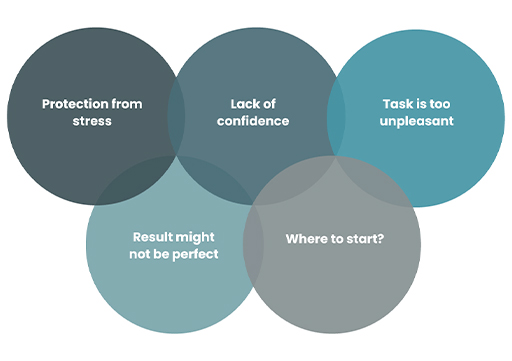
Avoidance behaviour and procrastination both stem from a wish to not put oneself in a situation of stress, but they are different – procrastination is not complete avoidance, instead it means putting something off until the last minute.
Both avoidance and procrastination are recognised ways of dealing with stress (avoidance coping) by simply not putting yourself in that situation. This response may provide immediate relief from the stress in the short term, but will increase anxiety in the long term, as it doesn’t address the root of the problem (Tan et al., 2008).
While procrastination and avoidance behaviour are definitionally different, the reasons behind them are similar, and similar strategies can be employed to address both of them.