

Green social prescribing is defined as the practice of supporting people to engage in nature-based interventions and activities to improve their mental and physical health. Some examples of this include local walking schemes, community gardening projects, conservation volunteering, green gyms, open water swimming or arts and cultural activities which take place outdoors. Many green social prescribing activities are led and supported by volunteers.
What is volunteering and why volunteer?
Volunteering is considered an act of social service whereby individuals or organisations provide services and support without expectation of compensation. The value of volunteers is much appreciated by society and also the UN, which recognises and celebrates volunteering through International Volunteer Day (5 December).
In the UK, volunteering is estimated to contribute significantly to the economy and society through the value of financial goods and services provided as well as the time. A recent report puts the value of volunteering in England and Wales alone at £324 billion per year, representing 14.5% of the UK’s GDP (Volunteering worth £324bn a year, research concludes Third Sector).
Volunteering also benefits the volunteers themselves: whether it is personal impact through gaining new or improving skills and confidence, increased wellbeing both mentally and physically, as well as socially by building a sense of purpose and belonging to the community. It often also enhances employability, as volunteering demonstrates responsibility and action.
Volunteers also have another key responsibility they can help address: inclusivity and inequality in the workforce.
Volunteering outdoors: an example from Milton Keynes Parks Trust
Volunteering outdoors combines the benefits of spending time outdoors, such as stimulating the brain and providing exercise (e.g. using green and blue spaces), and thus can help us to age well.
It should be remembered that volunteers should reflect the society they serve, thereby helping people to have better health outcomes and enabling local communities to thrive. Hence inclusion and diversity initiatives are essential to reducing health inequalities to all, which also applies to the volunteers themselves.
At The Parks Trust in Milton Keynes, a team of 244 volunteers helps care for 6,000 acres of parks. Everyone has their own motivations for volunteering, but lots of people turn to helping outdoors after they retire as a chance to give back, connect with others and learn new skills, which are some of the 5 Ways to Wellbeing. The Parks Trust has been supported by volunteers for many years, and were recently awarded with Investing in Volunteers accreditation.
Volunteers support in different ways. Many people choose to support by carrying out biodiversity conservation tasks such as vegetation management, creation of habitat and hedge-laying; and others support outdoor recreation activities such as leading guided walks or supporting parkland events. In 2024, volunteers contributed 11,352 hours of their time across 50 different parks and greenspaces! Some volunteers support on a more casual basis through Community Volunteering.
Volunteers also support the 5 Ways Café at St Andrew’s Church in Great Linford. Established as a dementia-friendly community café in 2019, the café has now gone from strength to strength and is supported twice monthly by an inspiring team of volunteers, each with their own motivations for wanting to help. Trudy Hutchings helped establish and now manages the 5 Ways Café and recently spoke with Dr Gráinne O’Connor about motivations for volunteering and the impact of the Café.
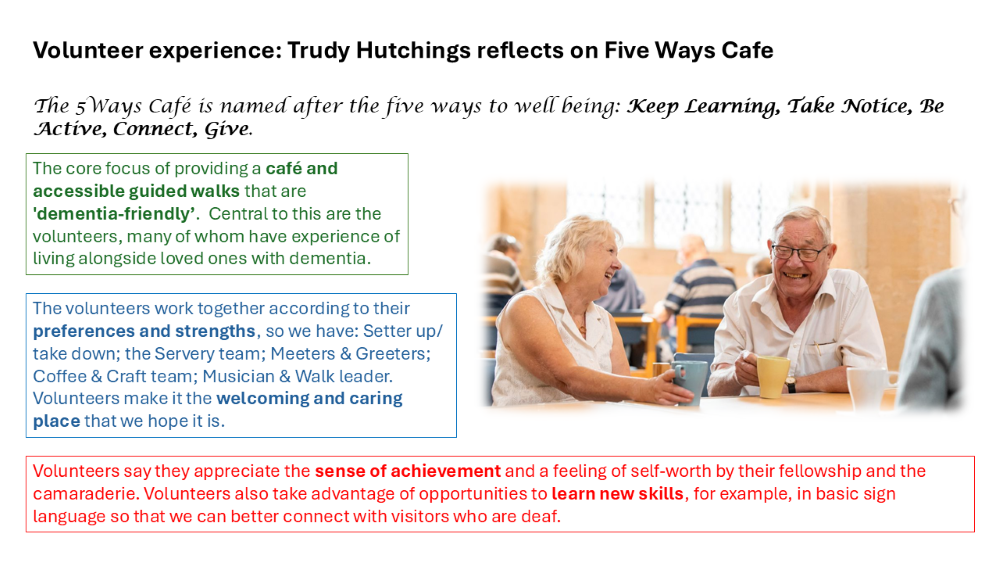
Volunteer experience graphic The 5 Ways Cafe is named after the five ways to well being: Keep Learning, Take Notice, Be Active, Connect, Give. The core focus of providing a cafe and accessible guided walks that are 'dementia-friendly'. Central to this are the volunteers, many of whome have experience of living alongside loved ones with dementia. The volunteers work together according to their preferences and strengths, so we have: Setter up/ take down; the Servery team; Meeters & Greeters; Coffee & Craft team, Musician & Walk Leader. Volunteers make it the welcoming and caring place that we hope it is. Volunteers say they appreciate the sense of achievement and a feeling of self-worth by their fellowship and the camaraderie. Volunteers also take advantage of opportunities to learn new skills, for example, in basic sign language so that we can better connect with visitors who are deaf.
We hope this article inspires you to get out and be a volunteer in nature if possible, or at least raise your awareness of the building blocks of health and local social prescribing schemes.
Further links
Like this? Try a free course
-
Neighbourhood nature
Learn more to access more details of Neighbourhood natureThere is a fascinating world of nature all around us which we can see if we know how to look for it. Wherever you live, be it in a city or the countryside, you will find areas that support a range of wildlife. This free course, Neighbourhood nature, will provide you with basic scientific and observational skills so that you can go into your ...

-
Work and mental health
Learn more to access more details of Work and mental healthAlthough being at work during periods of mental illness can be difficult for those with mental health problems, most people with these difficulties could take paid employment if it were not for numerous barriers in the workplace and the wider community (Centre for Mental Health, 2013). In this free course, Work and mental health, you will look ...

-
Introducing the voluntary sector
Learn more to access more details of Introducing the voluntary sectorThis free course, Introducing the voluntary sector, will guide you through some of the distinctive features and values of the voluntary sector, how organisations are funded and involve volunteers and other ‘stakeholders’ in their work. It will also provide you with knowledge and skills you can apply to your own work or volunteering as well as ...

Rate and Review
Rate this article
Review this article
Log into OpenLearn to leave reviews and join in the conversation.
Article reviews