

Watch these videos to find out more about what it is like to design the fastest boat in the world, what excites the members of the team and what mathematics they use. Would you like to be part of an exciting project like ThrustWSH?
What goes into designing the fastest boat in the world
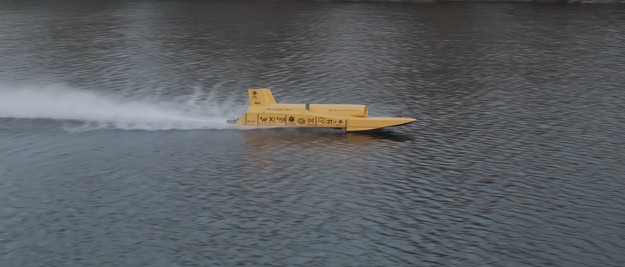
Where would you start if you were going to design the fastest boat in the world? In the video below you'll listen to Lorne Campell who designed the ThrustWSH boat. Lorne explains how ThrustWSH starts in the water, parting the wave in front of it and then rises up to skid over the water. He also explains why the project ended up considering super-cavitating hydrofoils as a solution to speed. You will hear more about hydrofoils in a later video.
What skills do we need to turn our dream into reality?
Would you have the skills to work on the ThrustWSH team? In the next video you'll hear from Dick Barton who explains what the RAF taught him and some of the practical skills that are needed to be part of the team. You'll also hear from Leonard Newton as he explains how learning what works is achieved through building and testing models of boats, as well as Butch Dalrymple-Smith who explains how, of course, not everything goes to plan. Finally, do you think if you were on the team you would spend a lot of time at a computer? Listen to Matthew Kear who works on the electronics to find out.
Why are we excited about super-cavitating hydrofoils?
Aeroplanes can fly at high speeds but they move through air. ThrustWSH has to reach high speeds by flying in (or on) the water! To turn this into a reality the team are exploring super-cavitating hydrofoils. Are you interested in what this technology is and why the team are so excited about it? Listen again to Butch who tells us why hydrofoils are so important for the success of this project and how they make the boat safer at high speeds. You also meet Colin Hales who is an aeronautical engineer. He explains the similarities between super-cavitating foils and supersonic aircraft wings, albeit that supercavitation in water comes in at speeds of 65-70 mph whilst supersonic speeds come in at over 700 mph. Dick and Matthew talk about their excitement of working on super-cavitating hydrofoils in this project. What excites you about a project you would like to work on?
What mathematics is needed for ThrustWSH?
Have you ever tried riding a bicycle holding a heavy shopping bag? Did you wobble? The team have to work out how to position components of different weights onto the boat structure so it balances, with its centre of gravity - CG - in the right place for safety and control. They need to calculate how much fuel will be needed, where to store it in the boat and what size pipes it should flow through. The next video features Andrew Bradley, the chief engineer for the project, and James Morton, a project engineer, as they talk about some of the mathematics they use to solve these problems. Often making practical use of very simple mathematics can be as important as solving complicated equations as Butch, Matthew and Dick explain.
What is it like to work as part of a team?
Of course a project like ThrustWSH needs a large team of people with different skills, but what does it mean to work as part of a team? Listen to Len and Dick explain what working on the ThrustWSH is like, and Lorne, Colin and Mike explain why teamwork is so important. What do you think makes a good team?
If you want to hear more from the team involved in ThrustWSH, then you can watch more videos here. You can also see more videos from Karl Schneidau, who filmed the content above here.
Visit the ThrustWSH water speed record hub
-
ThrustWSH water speed record hub
Learn more to access more details of ThrustWSH water speed record hubIn this hub you will find free learning resources related to the ThrustWSH (Water speed hydrofoil) water speed record project.
Discover our Engineering and Mathematics qualifications
-
Engineering courses
Learn more to access more details of Engineering coursesStart your journey towards becoming a professional engineer with an engineering course from The Open University. Recognised and accredited by professional engineering institutions, our courses cover various engineering topics, such as electronics, engineering design, mechanical engineering and more

-
Mathematics courses
Learn more to access more details of Mathematics coursesWhether you’re looking for a solid grounding in maths and statistics or want to specialise in aspects of pure or applied mathematics, an OU maths course will help you stand out from the crowd. Maths is an inspiring and enjoyable subject that will equip you with problem-solving and decision-making skills valued across employment sectors.

Study a free course
-
Introducing engineering
Learn more to access more details of Introducing engineeringEngineering encompasses a broad range of disciplines from design to manufacturing. This free course, Introducing engineering, introduces a number of key themes that explore how engineering is undertaken in our modern world. These themes include engineering design, rules that govern engineers, manufacturing for products and electricity ...

-
An introduction to design engineering
Learn more to access more details of An introduction to design engineeringThis free course, An introduction to design engineering, looks at the way in which engineers use ideas and approaches from the discipline of design thinking to inform their work. The complexity that people bring to design problems is introduced, along with some basic methods of dealing with such complexity.

-
Engineering: The nature of problems
Learn more to access more details of Engineering: The nature of problemsEngineering is about extending the horizons of society by solving technical problems, ranging from the meeting of basic human needs for food and shelter to the generation of wealth by trade. In this free course, Engineering: The nature of problems, we learn that engineers see the problems more as challenges and opportunities than as difficulties...

Rate and Review
Rate this video
Review this video
Log into OpenLearn to leave reviews and join in the conversation.
Video reviews