Present perfect or past simple?
Your goal
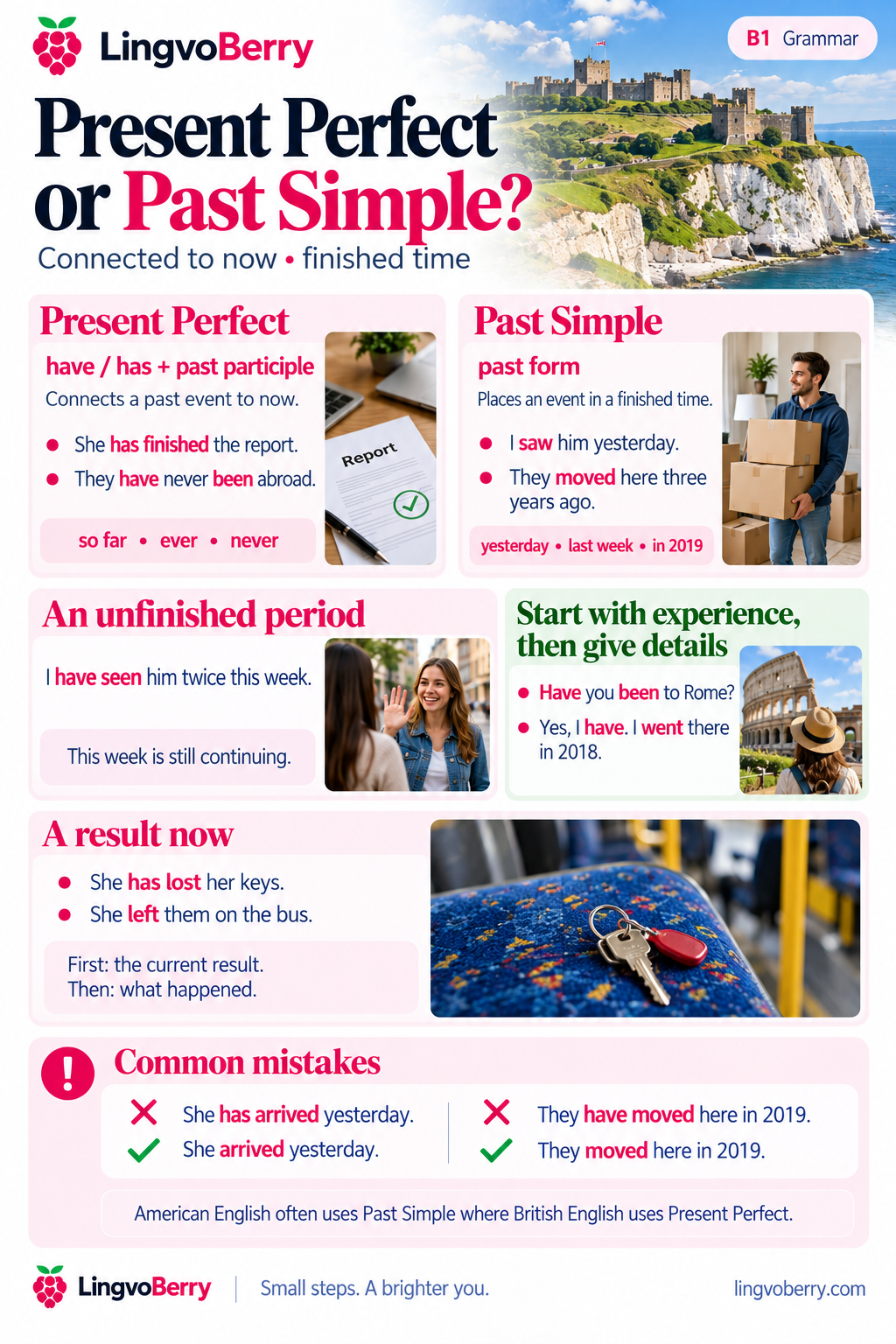
Connect a past event to now, then switch to a finished past time when you give the details.
One event, two ways to talk about it
How does the focus change between “I’ve lost my ticket” and “I lost my ticket on Monday”? Both sentences are grammatical: compare a present result with a finished past time.
I’ve lost my ticket. The speaker focuses on the present result: the ticket is missing now. The time of the loss is not specified.
I lost my ticket on Monday. The speaker says when the loss happened. Monday identifies a finished past time, so use the past simple. This sentence does not tell us whether the ticket is still missing.
Build the forms
Present perfect: have/has + past participle.
I have written. She has written. Have you written?
Past simple: a past form, such as wrote or worked.
I wrote. I didn’t write. Did you write?
Start with experience; add the details
Have you ever taken a night train?
Yes, I have. I took one in 2023.
The first question looks back over your experience up to now. The next sentence tells us when one trip happened.
Look at the meaning, not just a time word
I’ve read three chapters so far today. This is a total up to now.
I read a chapter at seven today. This is a completed event at a particular time.
Both tenses can occur with today. Present perfect does not mean that the action must be unfinished. American English also uses the past simple in some situations where British English favours the present perfect.
Try it in context
Use the forms requested. In tasks 1 and 4–6, choose between the two forms shown. Read the whole situation before answering.
- Yesterday, Oliver sent / has sent me the new timetable.
- Complete the present perfect: Lena __________ (never / eat) Korean food before.
- Choose the participle: Have you ever rode / ridden a horse?
- Maya has lived / lived in Bristol since 2022. She still lives there.
- Maya has lived / lived in Bristol from 2022 to 2024. Then she moved to York.
- Nina has finished the report. She finished / has finished it at 8.30 this morning.
- Correct the tense: “We have bought the tickets last Friday.”
- Correct the verb form: “Max has wrote three pages so far.”
- Both are grammatical. Explain the different focus:
“I’ve lost my ticket.” / “I lost my ticket on Monday.” - Write a three-line conversation about a life experience. Start with “Have you ever …?”, give a short answer and add a detail with a finished past time.
Make it yours
Write one sentence about something you have done so far this week, then add a sentence saying exactly when you did it. Underline the verb forms.
Answers and why
Reveal answers and explanations
- sent
Yesterday places the sending at a finished past time. - has never eaten
The requested form is has + past participle. Eat becomes eaten; never goes between them. - ridden
After have, use the past participle ridden. Rode is the past simple form. - has lived
The situation started in 2022 and continues now. Has been living would also fit if it were offered. - lived
This period ended in 2024. She no longer lives there. - finished
At 8.30 locates the event at a specific past time. This morning does not force the present perfect. - We bought the tickets last Friday.
Use the past simple with last Friday, a finished past time. - Max has written three pages so far.
The past participle of write is written. So far presents a total up to now. - A result now / an event at a finished past time
The first sentence highlights the missing ticket now. The second dates the loss. It does not tell us whether the ticket has since been found. - One possible conversation
“Have you ever slept in a tent?” “Yes, I have.” “I slept in one last summer.” Other conversations are correct if the forms and time references fit.
For teachers
Ask learners to explain the time frame, rather than circle signal words. Accept standard American English alternatives in open conversation. Do not teach a present result as proof that the past simple is impossible.
More practice
Read the matching English lesson on LingvoBerry
Lesson, activities and visual guide © LingvoBerry. CC BY 4.0.