
Building number confidence: Time
7. Greenwich Mean Time (GMT)
Until the introduction of standardised time, local time, which was determined by the position of the sun in the sky, and with the aid of a sundial, varied from town to town and region to region across the UK.
The need for a standard time across the nation quickly became apparent with the arrival of the railways, in order to accurately schedule services transporting goods, and passengers, over long distances.
First introduced in 1840 by the Great Western Railway, Railway time was gradually adopted by all UK railway companies, with schedules organised, and station clocks aligned to London time - Greenwich Mean Time (GMT) - which was set at the Royal Observatory in Greenwich.
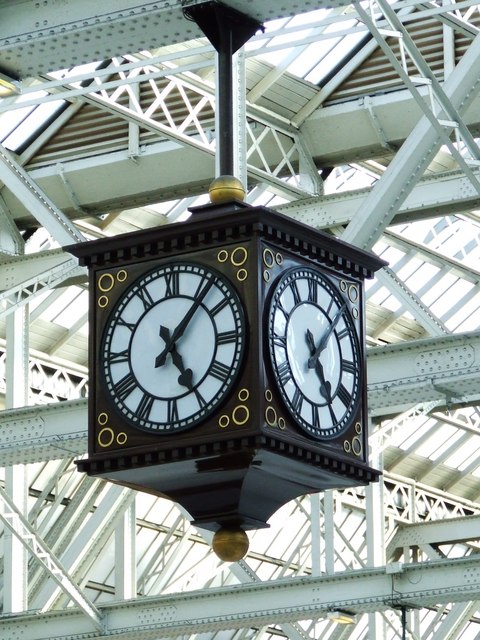
Glasgow Central Railway Station clock
Thomas Nugent @ Geograph / cc-by-sa/2.0
Forty years later, the Statutes (Definition of Time) Act 1880 formally defined GMT as the legal standard of time for Great Britain.
British Summer Time (BST) / Daylight Saving Time (DST)
In the UK, between the last Sunday in March and the last Sunday in October, clocks are set one hour ahead of Greenwich Mean Time (GMT) to provide an extra hour of daylight towards the end of each day.
Known as British Summer Time (BST), this practice is also in use in other countries around the world, where it is commonly referred to as Daylight Saving Time (DST).