Building number confidence: Time
1. Introduction
From the earliest of times, knowledge of the patterns of sunrise and sunset, and of the seasons, has enabled people to organise and plan their lives. For example, to gauge how much daylight is available in each new day, and when to plant and harvest crops.
Early civilisations began the development of calendars based around the:
- solar year, defined by changing seasons as the earth revolves around the sun;
- solar day, with its periods of light and darkness due to the earth rotating on its axis;
- lunar month, which follows the phases of the moon as it orbits the earth.
Various tools were also developed to aid time management, including:
- sun dials onto which shadows cast by the movement of the sun across the sky indicate the time of day;
- lunar calendars based on the monthly cycle of the Moon's phases;
- water clocks which capture the time taken for water to flow through;
- candle clocks and incense sticks which record time by the rate at which they burn.
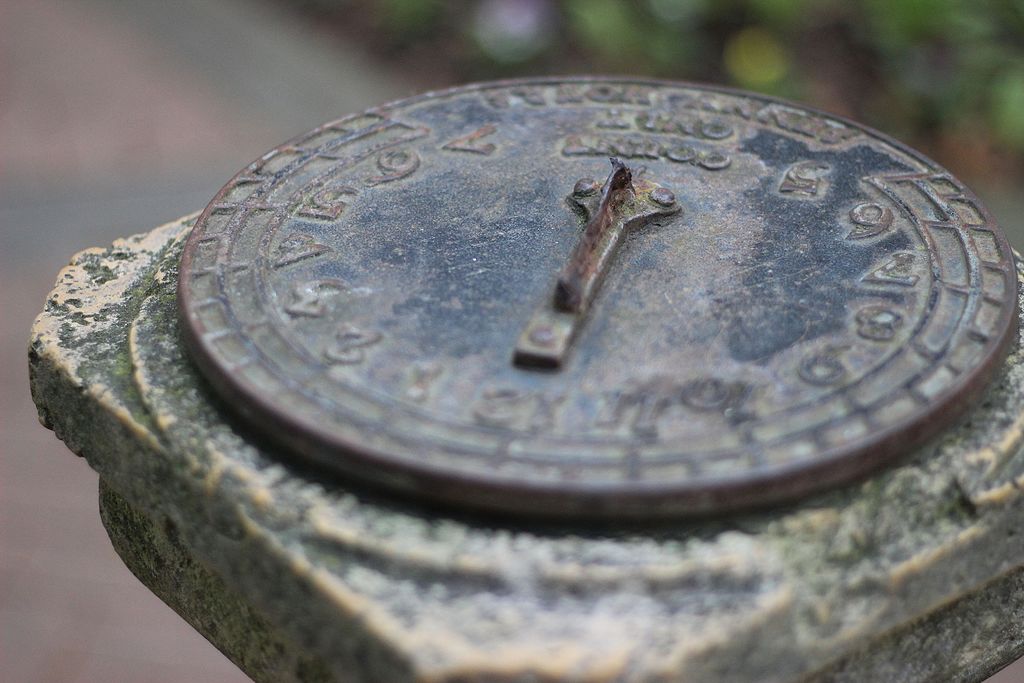
A sundial located in Shakespeare’s Garden, Stratford upon Avon
Wikimedia / CC BY-SA 4.0
Some of these methods were more reliable than others. Consider, for example, the ability to tell the time accurately using a sundial when the sun is hidden in poor weather!