The standard view of this forum does not always work well with assistive technology. We also provide a simpler view, which still contains all features. Switch to simple view.
Your user profile image

Kris Stutchbury Post 1

1 April 2021, 9:37 PM

Activity 1.5 Creating an inclusive ethos and culture

Provide two examples from your experience where an activity or policy contributed to creating an inclusive ethos

Your user profile image

Nicola jones Post 2 in reply to 1

12 April 2021, 3:30 AM Edited by the author on 12 April 2021, 3:32 AM

I can vividly, recall two activities that have contributed to creating, an inclusive ethos. My first experience happened when we invited a Resource Personnel to our school for a seminar.. The individual was not known to us but was highly recommended . On the day of the seminar the vehicle arrived  and we went outside to greet our speaker. To our surprise the individual was in a wheelchair and we had no ramps. It was one of the most awkward situation for us  though it was not an issue for our speaker who was probably accustomed to this happening. We apologize but made sure that it never happened again by having ramps constructed in designated areas.

Another, activity was after recently completing  the Inclusive Teaching  and Learning course, the staff at my school met and with the approval of the School Board adjusted the School's Mission and Vision Statements to reflect inclusion for example a line stated that " where students can learn in a safe, secure and inclusive environment "


Your user profile image

Florence Wanja Kamonjo Post 4 in reply to 2

12 April 2021, 8:49 AM

What an experience Nicole. Good that the experience yielded good fruits towards inclusive education. Good also to see that the study of the ITL has also yielded ethos of inclusivity in your institution. 

Your user profile image

Simone Campbell-Williams Post 10 in reply to 2

14 April 2021, 5:53 PM
Hello Nicola, in reading your post, I now know that is it indeed relevant with urgency to setup accommodation in facilitating structures to suit children and others who are invited to the school to feel safe and secure. No matter their challenges, race, ethnic background or otherwise.
Your user profile image

Sharon Seeraj Post 12 in reply to 2

14 April 2021, 8:44 PM

Hello Nicola, I can honestly say I quite understand that feeling. Many times policy makers don't do the necessary arrangements to accommodate the differently abled until it is an embarrassing situation. Honestly I can say through all the awkwardness some good came out of it.  

Your user profile image

Xiomara Bautista Post 19 in reply to 2

15 April 2021, 5:39 AM
Great news to hear that the mission and vision were revised to reflect inclusion. That is a leap forward towards having an inclusive ethos at the school.
Your user profile image

Roberto Torres Post 21 in reply to 2

15 April 2021, 6:39 AM

Great!, Our school adjusted our motto from "Providing Knowledge, Skills and Attitudes" to " Providing Knowledge, Skills and POSITIVE Attitudes !!

Your user profile image

Cathyann Martin Post 44 in reply to 21

16 April 2021, 4:21 PM

This sounds like your school is heading in the right direction.  

Your user profile image

Yuva Roopchansingh Post 65 in reply to 21

21 April 2021, 11:39 PM

Great attitude for your school to have !!!

Your user profile image

Savitri Emmanuel Post 27 in reply to 2

15 April 2021, 6:14 PM

Thank you so much for sharing this experience Nicole. I am glad that this experience yielded positive results.

Your user profile image

FLORENCE KISIRKOI Post 43 in reply to 2

16 April 2021, 1:56 PM

Oh Nicola.Your visitor was used to not being included and had grown to kind of accept it. Sad from now let all institutions remember there are people who are different but have great potential and have a lot to contribute. So sorry but many institutions have same story to tell if open enough to.

Your user profile image

Cecilia Castaneda Post 53 in reply to 2

16 April 2021, 9:18 PM

your experience as a staff made you realize how much you should do to cater for all needs. I am glad to know that afterwards it didn't happen again. IT is very good that your missions and vision also reflect on how effective you guys, when it come to catering for special needs. 

Your user profile image

Oluwaseyi Agunbiade Post 62 in reply to 2

19 April 2021, 12:34 PM

Hello Nicola.

Thanks for sharing your experience.

The school administrators are highly commended for being responsive. We are all learning and th ehallmark is the ability toadjust appropriately as issues arise.

The course teaches a lot of proactiveness that we need to emulate.

Thank you

Your user profile image

Jamila Lewis Post 63 in reply to 2

21 April 2021, 12:46 AM

Good experience! One that has contributed to improvements and knowledge of having an inclusive school to the meet the needs of all students.

Your user profile image

Renee Barkley-Dookie Post 75 in reply to 2

25 April 2021, 8:51 AM

Hello Nicola.

Your contribution was an enjoyable read. 

Noting your statements "having ramps constructed in designated areas" also "adjusting the School's Mission and Vision Statements to reflect inclusion for example a line stated that " where students can learn in a safe, secure and inclusive environment " are definitely two positive steps in the right direction. Thank you for sharing these events. 


Your user profile image

HAEMRAJI Persad Post 76 in reply to 2

29 April 2021, 6:24 AM

Nicola, thanks for sharing this experience. It truly reminds us that so much more resources have to be put in place in many schools to cater to the needs of all students and that many are left behind in the meantime.

Your user profile image

Ria Singh Post 81 in reply to 2

29 April 2021, 9:45 PM

Hi Nicola

Seems like a step in the right direction.

Your user profile image

Hugo Uh Post 82 in reply to 2

30 April 2021, 2:13 AM

Indeed an experience Nicola , makes us think about how important inclusion is, we need to make physical changes happen in our schools as a start.

Glad to know about the adjustments made in the Mission and Vision Statements at your school. 

Your user profile image

Paula Edwards Sealey Post 85 in reply to 2

30 April 2021, 6:42 PM

Great examples Nicola! Your story just highlights how specific and unique an attempt at inclusion can be for any educational setting. It also highlights that persons must value the needs of both the majority and the minority and be willing to make the changes necessary to help all persons have a sense of belonging. 

Your user profile image

Patricia Prescott Post 90 in reply to 2

2 May 2021, 12:17 PM

It is good that both parties were understanding of the situation at hand, resolved it as best as possible in the interim of a more long term solution. It was great that your staff and School Board took that opportunity to create a more inclusive environment. 

Your user profile image

Ruth Banfield-Joefield Post 92 in reply to 2

2 May 2021, 6:11 PM

Thanks for sharing Nicola. I remember a few years ago, the intake of Form 1 students had a student who was a wheelchair user. The school never before had a student with this type of disability. However, he was welcomed by the administration who took it as a challenge that must be embraced. The principal called a meeting with staff and laid out a plan as to what should be done in order to accommodate the student. During the vacation period renovation was done to make a washroom accessible for wheelchair users.

 At the beginning of the new term, students were sensitized about respecting each other. Eventually ramps were done so that the student could access the various rooms that the student had to use instead of always having to be on the ground floor.

Your user profile image

Florence Wanja Kamonjo Post 3 in reply to 1

12 April 2021, 8:45 AM

My experience was a few years ago when I was teaching in high school. When form one students reported and one of the students was on a wheelchair. This being the first of such student everyone in the school from the principal had to adjust and change attitude in order to accommodate the boy with special need. Facilities had to be modified to accommodate the student. His classmates were very kind and always ensured that he felt included in the classroom and school. This boy completed his studies and performed better than some of the normal students. 

My second experience is in a TVET institution where I am the chair of Board of Governors. We have a policy as required by the government to ensure that the institution becomes inclusive and we are looking for resources to ensure physical structures and environment conform to the policy. Already we have trained young women with special needs.


Your user profile image

Nicola jones Post 7 in reply to 3

14 April 2021, 2:16 PM

Great Florence inclusion is definitely the way forward.

Your user profile image

Xiomara Bautista Post 18 in reply to 3

15 April 2021, 5:35 AM

That's great to hear his fellow students had welcoming and supportive attitudes towards him. This further emphasizes the need for schools to adapt similar ideas for inclusion of those with special needs. They have so much potential. 

Your user profile image

Savitri Emmanuel Post 28 in reply to 3

15 April 2021, 6:15 PM

Thank you for sharing, Florence. I love reading posts where the classmates show such care and compassion for their differently abled peers. May God continue to bless the little ones.

Kim Noel

Kim Noel Post 57 in reply to 3

17 April 2021, 7:48 PM

Florence that is most definitely the way to accommodate student with different abilities.

Your user profile image

Joan Moses Post 60 in reply to 3

19 April 2021, 9:43 AM

I remember a time when one of our students was in a wheelchair too. The students would take turns helping her to move about. There was a comfortable learning environment where she felt as part of the class and not left out. Thanks for sharing this .

Your user profile image

Rachel Timothy-Springer Post 68 in reply to 60

22 April 2021, 10:41 AM
That's awesome Joan. Sensitizing students on the importance of being a buddy to all their peers is so important. It's also a reflection of the school's culture. All children will thrive better in a culture where they feel they are wanted and where they belong.
Your user profile image

Hugo Uh Post 83 in reply to 3

30 April 2021, 2:18 AM

It is great to know that your institution was willing to adapt to the new student and the students had a kind and positive attitude towards this learner . I am sure that this was a great encouragement to him/her that resulted in the good grades. 

Your user profile image

Stephanie Thomas Post 5 in reply to 1

13 April 2021, 3:48 PM
At this moment i am experiencing shame and disgrace for my school for inclusion is not a priority there. I am the Special needs coordinator for my school and it's not easy to get my principal and colleagues on board  to start creating an inclusive school because they complain a lot  about their lack of training, the lack of child centered and relevant curriculum, limited appropriate teaching learning materials, they lacking competence and will to modify methodology as per the need and the lack of proper in fracture to do so. This is sad but it's the reality of my school. 
Your user profile image

David Ngatia Post 6 in reply to 5

13 April 2021, 6:01 PM

Thank you Stephanie for your honest revelation about the sad experience in your school. I can imagine your frustration. The experience could be similar even in other schools. However, all is not lost. The behavior of your colleagues could be out of ignorance about inclusive education. Awareness campaigns need to be done to enlighten most teachers on the need for inclusive education. Is it possible to introduce your colleagues to this course  for them to learn of the benefits of inclusive education and how to create an inclusive school?  

Your user profile image

Nicola jones Post 8 in reply to 6

14 April 2021, 2:21 PM

Great suggestions to Stephanie ,David, and like they say inclusion is a process so with continued work Stephanie and her team will get there.

Your user profile image

Ariana Rampersadsingh Post 15 in reply to 6

14 April 2021, 9:38 PM

I agree with your suggestion David, to introduce the teachers to this course or even a similar one. Education is key and opens up an entirely different mindset that allows for positive change. As educators we need to be open minded and adapt to ensure that no child is left behind.

Your user profile image

Stephanie Thomas Post 36 in reply to 6

15 April 2021, 10:21 PM

I had already invited them presenting them with the link to sign up and join us but no-one showed interest.

Your user profile image

David Ngatia Post 42 in reply to 36

16 April 2021, 1:46 PM

Thank you Stephanie. We hope as teachers they will eventually realize the benefit of gaining knowledge about inclusive education. The good thing is that the two courses are still open and they can join any time.

Your user profile image

Sharon Seeraj Post 11 in reply to 5

14 April 2021, 8:38 PM

This is actually the reality at the schools that I interact with. I was filled with disdain when I found out the schools' soft skills was that of discrimination and the ethos of the school did not facilitate the progression of the Inclusion initiative . 

Your user profile image

Savitri Emmanuel Post 29 in reply to 5

15 April 2021, 6:16 PM

Thank you for your blatant honesty, Stephanie. It is sad when schools do not fully embrace the idea of inclusion.

Your user profile image

Florence Wanja Kamonjo Post 38 in reply to 5

16 April 2021, 11:36 AM

Thank you for sharing your experience Thomas. Yes it can be frustrating but do not give up championing inclusivity in your school. May be that is why you are there for  such a time like this.  Insist and persist until something happens especially now that you have more knowledge and motivation from these two courses. Do not give up. Best wishes!

Thomas is it possible to create awareness in your school concerning this two courses since they are free and available?

Your user profile image

Cathyann Martin Post 45 in reply to 5

16 April 2021, 4:24 PM

I am sorry that you are working under such conditions. Stay strong and hopefully they are enrolled in this course to adjust their thinking.

Your user profile image

Cecilia Castaneda Post 54 in reply to 5

16 April 2021, 9:22 PM

I can relate to your concern, my school is not prepared to cater for types of special needs. Teachers are not trained for it and all they do is complain too. In the preschool, people form the ministry visit the children with special needs but they do not make a follow up. It is pity and shameful when this things are not in place.

Your user profile image

HAEMRAJI Persad Post 77 in reply to 54

29 April 2021, 6:30 AM

There must be a real plan and policy from a ministerial level to address inclusivity in all schools so that it does not become a struggle at the school level to cater to the diverse needs of the learner, but an initiative that is embraced so that more students can fulfil their true potential.

Your user profile image

Raphael Cal Post 9 in reply to 1

14 April 2021, 5:39 PM

In Belize, policies as recent as 2012 (which is the latest policy book for teachers) ensured that all students are to be accepted in schools regardless of their religious, economic, or ability background. This is helpful because students with disabilities tend not to be accepted in school. Second, the Ministry of Education has mandated that all Standard 1 students take an assessment in the beginning of the school year so that students who are falling behind can be provided with additional assistance. 

Your user profile image

David Ngatia Post 13 in reply to 9

14 April 2021, 8:46 PM

Raphael, this a great stride towards inclusive education.

Your user profile image

Savitri Emmanuel Post 30 in reply to 9

15 April 2021, 6:17 PM

This is indeed wonderful. Thank you for sharing.

Your user profile image

Florence Wanja Kamonjo Post 39 in reply to 9

16 April 2021, 11:38 AM

Great! a step in the right direction.

Your user profile image

Hugo Uh Post 84 in reply to 9

30 April 2021, 2:24 AM

I believe this a start to promote inclusion in our country . We still have much more to do to achieve inclusive education for all levels of learning. 

Your user profile image

Sharon Seeraj Post 14 in reply to 1

14 April 2021, 8:56 PM
I have to share the same notion as one of my colleagues in saying that the Ethos in the schools in my country is one of discrimination of the differently abled child. Many educators, especially at the primary level are not trained in the skills needed to teach the diversity of children. I am also saddened to say that many of the primary schools in the country are not modern designs  and therefore they do not facilitate remodeling to include the differently abled child. 


However, the secondary school were all designed to accommodate remodeling or added features to accommodate the differently abled child. 

This now is very problematic as if the students are discriminated and not allowed proper primary school education, how then can they be equip to enter the higher level of secondary school.    

Your user profile image

Ariana Rampersadsingh Post 16 in reply to 14

14 April 2021, 9:41 PM

From my observation it is the same in my country, there is a lack of proper infrastructure in primary schools to facilitate inclusivity.


Your user profile image

David Ngatia Post 24 in reply to 14

15 April 2021, 8:40 AM

I can understand the predicament in your school Sharon. It's like climbing the tree from the top...! However with change in school  ethos  and having   pro-inclusion administration, I believe the challenge can eventually be surmounted by re-adapting the existing infrastructures to suit the needs of all learners.   

Your user profile image

Savitri Emmanuel Post 31 in reply to 14

15 April 2021, 6:20 PM

Thank you for sharing, Sharon. it is indeed a sad reality in many schools. But we must never give up. Let us continue to do the little that we can, in the role that we have, to contribute to creating and inclusive school.

Your user profile image

Florence Wanja Kamonjo Post 40 in reply to 14

16 April 2021, 11:45 AM

Thank you Sharon for sharing. Yes provisions for inclusivity should start from the lowest level of education to the highest level. The fact that there are provisions for inclusivity in secondary school is an indication that some effort have been applied toward inclusivity. Hope for the best Sharon as you advocate for inclusive provisions to be extended to all other levels.

Your user profile image

Joan Moses Post 61 in reply to 14

19 April 2021, 9:49 AM

This is indeed sad. Although my school is not totally challenge friendly, there are some ramps ,especially at the washrooms to accommodate wheelchair users. Everyone may not be on board and sharing the same inclusive spirit but I ensure that the students know that we are a family and we treat everyone with love and respect. So in the corner that you are , make an impact and let us continue to help change things one human at a time. Thanks for sharing!

Your user profile image

Savitri Emmanuel Post 17 in reply to 1

15 April 2021, 3:58 AM

Creating an Inclusive Ethos: Activity 1.5

School ethos can be defined as those values and beliefs which the school officially supports. On the other hand, according to Fullan (2007) school culture can be defined as the guiding beliefs and values evident in the way a school operates. 'School culture' can be used to encompass all the attitudes, expected behaviors and values that impact how the school operates.

One factor that is particularly effective in contributing to an inclusive ethos and culture is collective awareness of inclusion and action. Through collective awareness and action, culture can be used positively in order to enhance student learning and achievement, whether through small actions such as celebrating both student and teacher achievements in public assemblies, or to more large-scale projects such as developing democratic processes for teachers, students and other stakeholders. Relationships and interactions are characterized by openness, trust, respect, and appreciation.

Another factor that can contribute to an effective ethos and culture is teacher professional development. This is very important as it helps teachers to develop a positive attitude and by extension, contribute to an overall positive school culture. This in turn will promote effective pupil participation.

In conclusion, a school that promotes an inclusive and caring ethos is one where everyone is valued and made to feel welcome. There must be a very strong emphasis on celebrating differences and diversity through the curriculum. Teachers and support staff must also promote the respect of each individual associated with the school environment.

Your user profile image

Xiomara Bautista Post 20 in reply to 1

15 April 2021, 5:55 AM Edited by the author on 15 April 2021, 5:58 AM
From my experience, I have seen at one of the schools I taught, infrastructure changes to create a more inclusive environment for all the students. There were wheel chair ramps, special parking, and in the library there would be informative posters about those with special needs and how to be a welcoming individual. The school emphasized being supportive of one another which is actually similarly worded in its motto. There were buildings of 2 stories which would have stair cases as well as a manual elevator. It was the first time I had seen an elevator at a school; quite thoughtful.


Also, I am not sure if the question was worded differently in the activity sheet, but I would like to mention that two factors that are effective in contributing to an inclusive ethos and culture are:

1. To be aware of the specific needs of every child, especially those with special needs. Teachers can receive training on teaching children with different needs and learning styles. This way teachers will have a more positive attitude and patience when teaching children with and without disabilities.

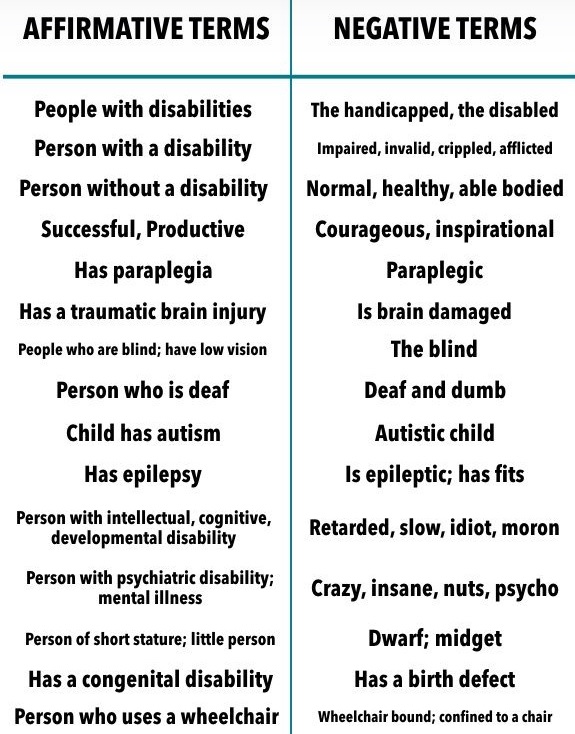
2. Teachers can celebrate student diversity by using diverse examples in lessons and use inclusive language. For example, referring to something or a group as ‘typical’ sounds more inclusive than using the word ‘normal’. Using the word ‘normal’ as a comparison may stigmatize others who are different and imply they are ‘abnormal’. By using inclusive language, they convey respect to all without sounding prejudiced towards a group of people. I found some very good examples to share of affirmative phrases which contrast the negative phrases to avoid when we speak inclusively. (Seiter, 2018) Affirmative vs. Negative Terms

Your user profile image

Roberto Torres Post 22 in reply to 20

15 April 2021, 6:50 AM

Thanks for sharing the affirmative and negative terms, they are surely going to be useful in my language and will share with my colleagues. 

Your user profile image

David Ngatia Post 25 in reply to 20

15 April 2021, 8:48 AM

Wonderful!  

Thank you Xiomara for the great exposition about use of pro-inclusive language in creating inclusive ethos and culture. 

Quite educative..


Your user profile image

Savitri Emmanuel Post 32 in reply to 20

15 April 2021, 6:24 PM

This was very informative. Thank you for sharing the terminologies as well as the sterling contribution you made. I especially like this "in the library there would be informative posters about those with special needs and how to be a welcoming individual. The school emphasized being supportive of one another which is actually similarly worded in its motto". This is indeed wonderful.

Your user profile image

Kris Stutchbury Post 34 in reply to 20

15 April 2021, 10:06 PM

Thank you for sharing this resource. The language used to talk about inclusion is very important. Chapter 2 of the TESSA Inclusive Education Toolkit has some workshop activities on this topic that can be used with groups of teachers in a setting. 

Your user profile image

Cathyann Martin Post 46 in reply to 20

16 April 2021, 4:27 PM

Thank you for sharing.

Your user profile image

Benedicta Tabot Post 71 in reply to 20

22 April 2021, 12:17 PM

Thanks for this share. It is very important to speak inclusively.

Your user profile image

Roberto Torres Post 23 in reply to 1

15 April 2021, 6:56 AM

Working together as a school community is important. Coming together to celebrate the students' achievements in an assembly is crucial to our students, and recognizing those special children for their efforts despite their challenges they live with is a living example for the other able students.

What our schools does is that we also invite parents for that special awards assembly. parents and students celebrate their achievements together!

We also have a non-zero policy for our first years students of high school. we encourage them to first get adapted , feel included first and then adapt to high school life.

Your user profile image

David Ngatia Post 26 in reply to 23

15 April 2021, 8:52 AM

Thank you Roberto for your contribution.  The collaborative efforts on inclusivity will surely bear fruits.

Your user profile image

Michael Kemp Post 33 in reply to 1

15 April 2021, 9:54 PM

Before we return back to begin each new Academic Year we are provided with Professional Development Workshops and Retreats. In my first year of teaching during this Orientation I was able to garner a lot of use information and listen to many co-workers who had a wealth of experience to share.

Furthermore I have been able over the years to complete a Diploma in Educational Pedagogy. This contributed greatly to my view and philosophy of what Education is. I believe these two experiences helped and continue to mold me into the Teacher I am today. 

Your user profile image

Kris Stutchbury Post 35 in reply to 33

15 April 2021, 10:09 PM

Michael, Thank you for reminding us that professional development takes many forms! You can learn a lot for a course leading to a certificate or a diploma - but you can also learn a great deal by working closely with your colleagues and sharing experiences. 

Your user profile image

Avalon Ali Post 48 in reply to 35

16 April 2021, 8:39 PM

I agree. Corporate experiential knowledge forms best practice. 

Your user profile image

Ornella Audhan-Mathura Post 51 in reply to 33

16 April 2021, 9:07 PM

Professional Development Workshops and Retreats really allows us to learn from each other. Thank you for this insightful contribution.

Your user profile image

Sigrid Hamilton Post 37 in reply to 1

16 April 2021, 1:02 AM

Presently, there is more to be established within some schools as it relates to creating an inclusive ethos and culture. Despite not having examples of experiences, there is a special education unit where special education officers attend to students with special needs.  However, there is room for improvement with regards to teacher awareness and development as well as the sensitization of the student population. 

Additionally, laws and polices must be implemented to end discrimination and encourage equal rights for ALL students. One such policy should be geared towards infrastructure which is critically needed.

Your user profile image

David Ngatia Post 41 in reply to 37

16 April 2021, 12:26 PM

Thank you Sigrid  for your contribution. The main tenets of inclusive education is to have all learners learning in the same schools and same classrooms without segregation, and being supported despite their differences in ability.

Your user profile image

Avalon Ali Post 49 in reply to 37

16 April 2021, 8:40 PM

There must be equal rights for all students. Laws and policies need to be reworked to reflect this. 

Your user profile image

Ornella Audhan-Mathura Post 52 in reply to 37

16 April 2021, 9:10 PM

Hello Sigrid. I agree with your contribution for laws and polices to be implemented to end discrimination and encourage equal rights for ALL students. 

Your user profile image

Avalon Ali Post 47 in reply to 1

16 April 2021, 8:38 PM

The first was in the form of a Sports and Family Day that encouraged all stakeholders, learners etc to fellowship.

The second example took the form of an open day workshop where all students were involved in career day. 

Kim Noel

Kim Noel Post 56 in reply to 47

17 April 2021, 4:34 PM

I think workshops are an effective way of reaching stakeholders, families, and the community.

Your user profile image

Ornella Audhan-Mathura Post 50 in reply to 1

16 April 2021, 9:06 PM

To establish an ethos that works, teamwork lies at the core: the entire community working together and recognizing the role they each play and the strengths they bring. There is no place for hierarchy or ego – everyone involved must have their voice heard, everyone must be nurtured. 

Also, From observing centers within my cluster, the physical infrastructure caters for children with disabilities by providing ramps, toilets that are accommodating and a safe environment for all. This will contribute to inclusive ethos within the school environment.

Kim Noel

Kim Noel Post 55 in reply to 1

17 April 2021, 4:32 PM

Activity 1.5

One example activity that I observed that created inclusive ethos was the allowance of children with special needs in the classroom. Student were allowed to be apart of classes with there peers.

Another activity that I observed was the utilization of aids within the classroom setting. Aids assist students to breakdown barriers as it relates to learning.

Your user profile image

Benedicta Tabot Post 70 in reply to 55

22 April 2021, 12:11 PM

It is true Kim that providing an opportunity to interact with children with special needs eventually contributes to inclusive ethos.

Sarah Ramjattan

Sarah Ramjattan Post 58 in reply to 1

19 April 2021, 6:54 AM
Example 1: At my past Secondary School, students with disability attended and they were given the same opportunity just as everyone else to participate and take an active role in students body groups, become prefect and even participates in school competitions.


Example 2: Schools in our education system in Trinidad and Tobago makes it possible to accept students with special needs and disability in the system and not excluding these unique children by categorizing them into a different school environment for only special needs students.


Your user profile image

Joan Moses Post 59 in reply to 1

19 April 2021, 9:40 AM

Creating a inclusive ethos

Although the school does not have a special education teacher , a teacher is chosen to help those students who are struggling . A trained teacher comes in to assist and this boosts the confidence of those who struggle in the classroom.

Your user profile image

Yuva Roopchansingh Post 66 in reply to 59

21 April 2021, 11:40 PM

I hear you, sometimes that can be a strain on the teacher to balance if they have regular classes to attend to as well ...

Your user profile image

Yuva Roopchansingh Post 64 in reply to 1

21 April 2021, 11:36 PM

We had another student that attended our institution some time ago with a visual impairment, so it was difficult for him to take part in exams or even simple reading exercises.


Eventually the administration and teachers of the school came together to sponsor special texts and exam scripts for him so he would be able to take part in his course work as normal as the rest of his peers.

Your user profile image

Tracey Little Post 67 in reply to 1

22 April 2021, 6:53 AM

Prior to working with Student Support Services, I had my private learning centre. My school comprised both local and foreign students. I remember for one of activities, we created passports for each child and a school immigration stamp. Each week, we took a trip to a different country at school and at home and each child was asked to bring back an artefact/souvenir to share at Show & Tell, that was representative of the culture of the specific country. We would post up various aspects of the culture, dress, food, musical instruments and so on. This was to give the children and their parents an appreciation for diversity.

We also had a cultural day each month, for which one family would be responsible. 

One of our policies was no child would be left behind and was built on the global view. We had an inclusive school and all were treated equally and exposed to all activities. There were children on the autistic spectrum, one with petit-mal epilepsy, hearing and vision impairment, speech and language challenges and down syndrome. Where it was possible, parents would volunteer to come in to assist at various times during the day for purposes of supervision. Most of the children gravitated towards each other to play, while others were either afraid or unable to socialize with their peers.

Your user profile image

Rose Nyambura Post 87 in reply to 67

1 May 2021, 12:58 PM

A trip to a different country at school! This is an exciting concept Tracey.  Teachers can be truly creative. 

Your user profile image

Benedicta Tabot Post 69 in reply to 1

22 April 2021, 12:05 PM
A student with a physical disability was admitted in the institution where I  worked, the walkways were so rugged and it was very difficult for him to walk around by himself.  Fellow learners assisted him and finally the walkways and ramps were put in place.

This also applied to the students with visual impairment.  The spirit of everyone coming out to assist created an inclusive ethos.

Your user profile image

Lily Ramsarran Post 72 in reply to 1

23 April 2021, 3:33 AM Edited by the author on 23 April 2021, 3:34 AM

The first experience I would like to share, involves a three-year-old, who entered our school diagnosed with cataracts, asthma and atrial septal defect. Due to the cataracts, she experienced a degree of visual impairment. As such teachers would ensure that signs, words/ lettering, and pictures being used or displayed were of large print. She was closely monitored during physical activities which were broken up throughout the day.

The second experience, involved a four-year-old, whose first language was not English. While she was able to understand some spoken English, she was unable to express herself. Here, her teacher, researched and learnt some phrases in her native language. During transition times, rather than, moving individually from one activity to the next, children were paired. This ensured that she could be guided by one of her peers until she was able to and comfortable navigating transitions on her own.


Your user profile image

David Ngatia Post 74 in reply to 72

23 April 2021, 9:19 PM

This is good Lily!. The two cases underscores the role of the teacher in inculcating inclusive ethos.

Your user profile image

Maryssa Beckford-Thompson Post 73 in reply to 1

23 April 2021, 7:08 PM

A teacher's attitude is one factor which effectively contributes to an inclusive ethos and culture in a school. The teacher who can show kindness from the moment of arrival; parents, families, caregivers and children are greeted using their names and are warmly welcomed into the school. Teachers who can show care by being sensitive to families diversity and valuing each child's individual uniqueness.

Another factor which contributes to an inclusive ethos is respectful relationships between teacher and parents / families; teacher and child. Parents know their child best, and when teachers have regular conversations with them, the teacher gain valuable insights of who the child is and can plan activities to further the child's learning and development.


Your user profile image

Sefinat Omuya Post 79 in reply to 73

29 April 2021, 3:11 PM

I completely agree with you Maryssa. Also, when you communicate unconditional positive regard, it draws the child nearer and as a teacher it enables you to better understand their needs as they will open up.

Your user profile image

Sefinat Omuya Post 78 in reply to 1

29 April 2021, 3:06 PM

Activity 1.5 Creating an inclusive ethos and culture

Two examples from my experience of an activity that contributed to create an exclusive ethos was a case of a blind student who was given course materials in print. this visually impaired student could not use the materials but the University provided an audio version of the material as the student preferred it to braille.

The second experience was a deaf and dumb student who could not benefit from the face to face facilitation as he could not hear or contribute to the discussion. A specialist was brought in to communicate with him in sign language and was also peered with some of colleagues

Your user profile image

Rose Nyambura Post 80 in reply to 78

29 April 2021, 3:14 PM

That was very kind of all who were involved. When learner' needs are met, everyone in class becomes productive. 

Your user profile image

Paula Edwards Sealey Post 86 in reply to 1

30 April 2021, 6:54 PM

At my workplace, we register students with physical challenges to attend our school and have done so for many years. The school when it was built catered to this need and was fitted with an elevator. Unfortunately, the elevator stopped functioning and has become too costly to repair. So to accommodate to these students, an administrative decision was taken to always place the classes of students with physical challenges on the ground floor of the school building regardless of the class/grade level. Usually the lower classes/grades were placed on the lower floors of the building. Additionally, with the help of the parent body, adjustable tables were made to accommodate wheel chaired students. These tables are utilized throughout the child's stay with us and are then passed on to other students with similar challenges. Schools in our community usually refer students with physical challenges to our school because accommodations are made to address their needs. 

Your user profile image

Katherine Persad Post 89 in reply to 86

2 May 2021, 5:57 AM

I like how the tables are passed down. This will help students with disabilities recognize that they are not alone. Also the presence of adapted tables will help acclimate other students so that inclusivity becomes acceptable and a norm. Really will help in changing attitudes.

Your user profile image

Katherine Persad Post 88 in reply to 1

2 May 2021, 5:54 AM

For me personally one of our school's policies is to have additional support for students. We invite their parents and have meetings with subject teachers, the parents and a psychologist before students with disabilities enter the school. This helps students to be sensitized to their needs and helps them to understand how to support their peer. We also have the inclusion of ethic and Religious Knowledge as well as HFLE which helps to teach children about appreciating diversity 

Your user profile image

Rose Nyambura Post 91 in reply to 88

2 May 2021, 4:44 PM

Ethics and Religious Knowledge is a good idea. It makes students appreciate diversity hence embrace inclusivity.