1.2 Use of natural resources
We use many different types of natural resources in our daily lives. We depend on food and water for survival and we need energy for many different purposes, from domestic cooking through to major industrial processes. Our clothes, transport, buildings, tools and all other items we use require many different resources for their production. Let’s take a simple example. Think about the resources that have been used to produce a notebook of the type you may be using right now as you study this Module. Manufacturing the paper needed raw materials of wood and water as well as energy for the production process. The trees that supplied the wood required soil, water and land to grow on. There may be ink or metal staples or other components in your notebook that were made from other types of resources. Our need for resources is vast and it is growing as the population increases and consumption per person increases with socio-economic progress. Depletion of natural resources by extraction and exploitation is especially of concern for non-renewable resources (see Box 1.1).
Box 1.1 Renewable and non-renewable resources
The resources we use can be classified as renewable or non-renewable. The basic difference between the two is the rate at which they are regenerated back into a usable form, relative to the rate at which they are used by humans. Non-renewable resources cannot be replenished by natural means as quickly as the rate at which they are consumed. They include minerals and fossil fuels such as oil, coal and gas, which are formed over millions of years by natural processes from decayed plants and animals.
Renewable resources are constantly available or regenerated over short timescales by natural processes. Some renewable resources, such as solar energy, are not modified or used up by humans. Others, such as water, are altered when we use them and can be over-exploited or damaged such that the resource is no longer available for use.
Can you suggest some other renewable resources that are replenished naturally but need to be managed properly and not over-exploited?
You may have suggested examples such as wood, animals and plants. For example, trees are cut down to provide wood and they will regrow but they need time to regenerate.
Globally, both population and resource extraction increased by almost 50% in the 25 years from 1980 to 2005 (SERI et al., 2009). Over that time, the world population increased from 4.44 billion in 1980 to 6.49 billion. Figure 1.2 shows how the extraction of natural resources increased between 1980 and 2005 from 40 billion tonnes to 58 billion tonnes. The graph shows the extraction of four types of natural resource: fossil fuels, biomass, metals and minerals. Biomass means biological material derived from living organisms such as crops, livestock, fish, wood, etc. Metals are used in the manufacture of a wide range of goods – from cars to computers. Minerals are used in industrial processes and in construction to build our houses and roads. Both metals and minerals are obtained from rocks that have been mined and are then processed in various ways to extract the valuable resource.
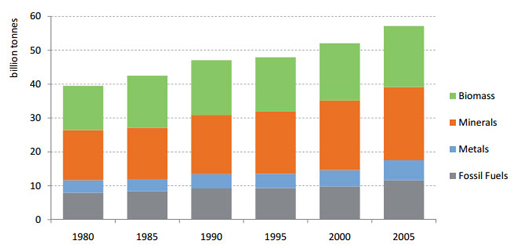
Look at Figure 1.2. What is the pattern of natural resource extraction from 1980 to 2005 and what do you think could be the reason?
Natural resource extraction shows a steady increase from 1980 to 2005, with the greatest amount extracted in the most recent year (2005). The most likely reason is the increase in the global population in this period; more people need more resources. It could also be the case that the amount used by individuals and by wider society is increasing due to changes in behaviour and levels of consumption.
Advances in technology have increased natural resource exploitation by enabling people to reach new resources and to exploit more resources per capita (per person). For example, fishermen who use traditional technologies such as small boats are limited in the number of fish they can catch. Modern industrial fishing fleets use very large ships that cover huge areas of ocean at greater depths to catch many more fish. This can lead to overfishing, which means catching fish at a faster rate than they can reproduce.
Are fish a renewable or non-renewable resource?
Fish are a renewable resource. However, if fishing is not managed properly and more fish are taken from the water than can be replaced naturally, the fishery will fail.
Overfishing and other examples of over-exploitation of natural resources can result in damage to or the loss of entire ecosystems.An ecosystem includes all the living organisms (humans, plants, animals, micro-organisms) and their physical environment (soil, water, air, land) and the interactions between them. If one component of the system is removed, this can have knock-on effects on the other parts of the system.
1.1 Relationships between human activity and the environment