
Find out more about The Open University's Law courses and qualifications.
This article is part of the Free to Bleed: Data Driven Advocacy and Art for Menstrual Justice project, an Open University and Vagina Museum collaboration funded by the Open Societal Challenges initiative. It relates to Open University law modules including W340: Law, Society, and Culture, and W350: Exploring Legal Boundaries.
What is the Free to Bleed project?
'Free to Bleed: Data Driven Advocacy and Art for Menstrual Justice' (hereafter Free to Bleed) brings together data, law and art to build the case for menstrual justice. Through national polling, creative expression and legal analysis, the project challenges stigma and highlights how menstrual inequity affects people across the UK.
The event at the Vagina Museum was designed to highlight the project, introduce Wee Nuls, the artist in residence, and showcase key findings from the YouGov poll on menstrual justice. Neelam Heera-Shergill from Cysters was invited to provide a keynote speech to open the event and to share her insights on menstrual justice. Importantly, the event was also a space for hearing about lived experiences of menstruation through craftivism, and to build networks with communities.
As an intern on the project, in the lead-up to the event, I worked on income-related findings, helped prepare slides, and created social media content to promote the event and create awareness. This helped me understand how research can be translated into accessible visuals and how rights around dignity, privacy and health appear in everyday experiences. As a law student, seeing these themes move from theory into practice was especially meaningful.
Free to Bleed at the Vagina Museum
Before the event started, guests were able to explore the museum’s exhibitions. The event then began with keynote speaker, Neelam Heera-Shergill from Cysters, delivering a powerful talk on the decolonisation of the health system and the inequalities that shape menstrual experiences. Her reflections grounded the event in a wider political and historical context and highlighted that menstrual equity is not only about access to products but also about whose pain is recognised and whose is overlooked.
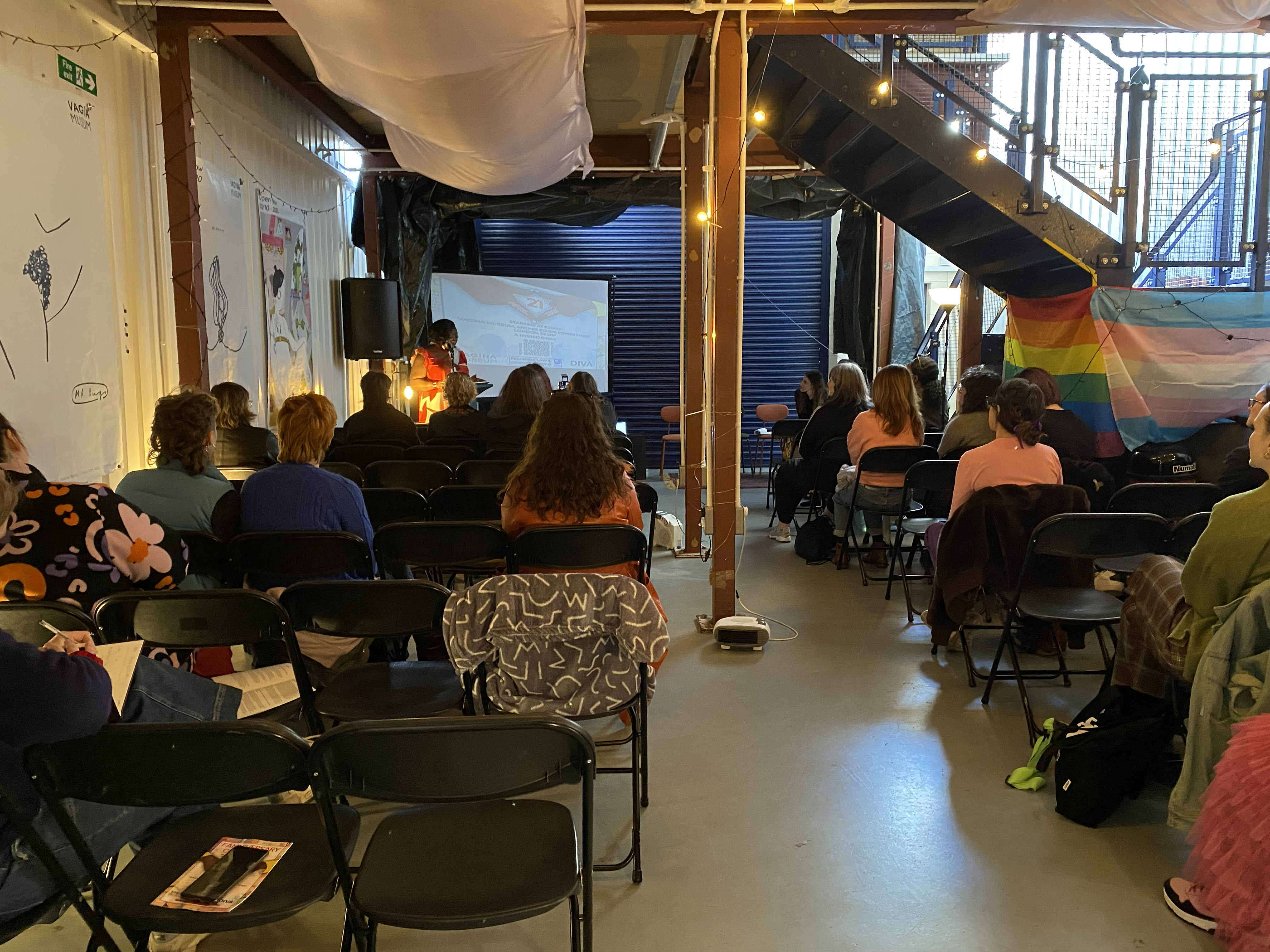
Artist in residence, Wee Nuls, then spoke about her work in Belfast and how public walls are a way for people to express what matters to them. She shared the story of a mural she created for the Menstruation Matters campaign, which was later censored. Listening to her reflect on that experience, and how it encouraged her to continue her work, showed how art does more than decorate a space. It can speak for issues that are often ignored, and it can bring conversations into public view in a way that data or policy alone cannot. Her story was a reminder that advocacy takes many forms and that creative work can open doors to understanding that people might otherwise avoid.
The ‘Bloody Beads’ workshop
The ‘Bloody Beads’ workshop followed panel talks and provided a space for creativity and connection. Instead of the usual 23 white and five red beads bracelet design for Menstrual Health Day, participants were asked to choose colours that matched their own personal experiences. It showed how creativity can make difficult topics easier to approach, and how shared activity can build understanding in a way that conversation alone sometimes cannot. People shared their own stories, from navigating chronic conditions to dealing with stigma in workplaces, schools and healthcare settings.
Events like this make menstrual experiences visible. They create space for people to speak openly, challenge stigma and connect with others who understand. Spaces like the Vagina Museum help normalise conversations that are often hidden. I learned how differently menstruation affects people and how wide the range of menstrual health conditions is. The lack of research and slow medical progress in women's health came up repeatedly. Hearing these experiences made the data we work with feel more human and urgent.
The feedback from attendees showed that the event was both engaging and informative. Many said they had learned more about menstrual issues and the Free to Bleed project, and that the key findings were valuable. The talk by Neelam Heera-Shergill and the lived experiences shared during the evening had a strong impact, and the creative aspects were particularly enjoyable. Attendees also expressed interest in future phases of the project and in continuing conversations around menstrual justice.
From a personal perspective, supporting the Free to Bleed event at the Vagina Museum was a meaningful experience. It brought together creativity, community and advocacy in a way that made menstrual justice feel both urgent and hopeful. I am grateful to everyone who attended and shared their stories. The event has strengthened my commitment to this work, and I am excited to continue contributing to the project in the weeks ahead.
If you are interested in the Free to Bleed project, please follow us @freetobleedproject or contact sophie.doherty@open.ac.uk.
Did you know that 28th May is Menstrual Health Day? This article raises, and answers, key questions around this event, providing five ways to mark this important day. Periods can affect most of the senses and the heightened hormonal changes can be particularly distressing for autistic people. This article considers the importance of their experiences of menstruation. When six women collapsed after the 800-metre race at the 1928 Amsterdam Olympics, The International Olympic Committee banned women from running any distance over 200m. It was thought that any greater distance ‘makes too great a call on feminine strength’. In 2019, Brigid Kosgei broke the long-standing women’s marathon world record by running 26....Discover more content like this
Five ways to mark Menstrual Health Day

Struggling in silence: Why we need to talk about autistic people’s experiences of menstruation

Leaving no stone unturned in the pursuit of female athletic performance

This free course will introduce social model approaches to health and wellbeing, which take as their starting point not the scientific context of the body, but the social context in which women live. The focus is on women and the impact of social and cultural factors on women's health. The course touches on various issues concerning women's ... Do you support women’s performance in sport or fitness as a coach or parent? Are you a female athlete who wants to optimise your performance using recent research insights? If so, then this free course is for you. It addresses the problem of sports science research traditionally being
male dominated and the assumption that if it works for men ... This free OpenLearn course is designed to help anyone whose life is affected by the menopause. No matter what gender you identify with, this transitional phase can affect people in all sorts of ways, so this course is open to all.
The objectives are to empower everyone, by increasing knowledge of what the menopause is and the effects it can ...Like this? Try a FREE course
Exploring issues in women's health

Supporting female performance in sport and fitness

Talking about the menopause: symptoms, support and the role of exercise

Rate and Review
Rate this article
Review this article
Log into OpenLearn to leave reviews and join in the conversation.
Article reviews