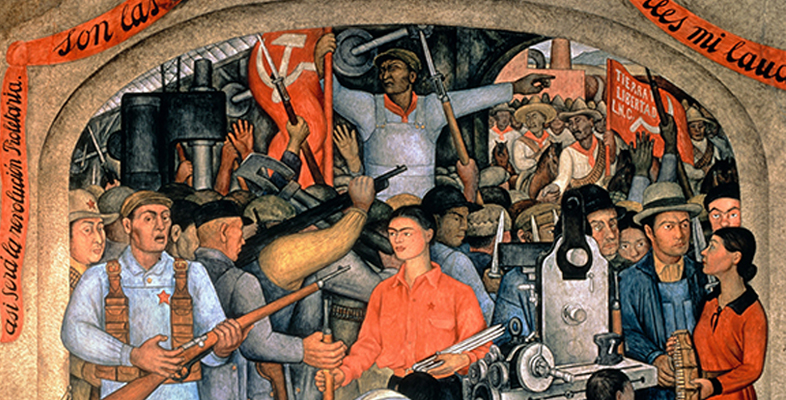
In this free course, Art and the Mexican Revolution, you will explore one of Diego Rivera’s key murals which was commissioned by the Mexican government in the period after the Mexican Revolution of 1910-1920. These monumental public artworks, designed to win over the Mexican peasantry and working-class to the new post-revolutionary state, brought Mexican mural artists international acclaim and Rivera was subsequently awarded important commissions in the United States. Yet, due to his commitment to a figurative form of propaganda, Rivera’s reputation suffered during the Cold War period and these Mexican murals are now largely left out of dominant accounts of twentieth-century United States art.
Course learning outcomes
After studying this course, you should be able to:
situate a key example of Mexican muralism within the post-revolutionary context in which it was made
explore recent debates around the interpretation of Mexican muralism
examine the concepts of 'realism' and 'modernism' in relation to Mexican muralism
address the relevance of social and cultural contexts for interpreting works of art
analyse works of art in terms of different ideas and approaches.
• The course most certainly delivered on the authors' objectives.
• Mexican muralism as a means to deliver propaganda to a population with an 85% illiteracy rate is an interesting concept; quite how many would actually have had access to these murals is another matter.
• The statement that Diego Rivera's artistic status was "rivalled only by Pablo Picasso and Matisse in Europe" caught me by surprise and is, in my opinion, greatly exaggerated. That said, he was indeed a respected participant in the Europe's Cubist avant‑garde.
• For a committed Maxist such as Rivera's, to accept a commission for $21k (c. half a million today) from a US corporation might have been construed as a potential sell-out; that is until he managed to satisfy both his sponsor and its multi-ethnic subjugated workforce, an impressive achievement!
• The coverage and indeed longer-term creative importance of Frida Kahlo over her husband Rivera was fascinating.
• In section 10 the 'Suprema Corte de Justicia' Murales link is broken. I merely inserted an authoritative link to the full bicentenary Spanish language text on the building’s murals. A non-Spanish speaker skimming a book on Rafael Cuaduro’s murals in the 2020s vs. illiterate Mexicans viewing Diego Rivera's murals in situ from the 1930s…
Interesting but quite frustrating. I hoped there would be more about Mexican history, and better pictures/film (though at least these are available elswhere on the internet). One of the films stopped working part-way. However, I did learn a fair bit about Rivera's murals and the odd choice of US industrialists to commission his work.
• Mexican muralism as a means to deliver propaganda to a population with an 85% illiteracy rate is an interesting concept; quite how many would actually have had access to these murals is another matter.
• The statement that Diego Rivera's artistic status was "rivalled only by Pablo Picasso and Matisse in Europe" caught me by surprise and is, in my opinion, greatly exaggerated. That said, he was indeed a respected participant in the Europe's Cubist avant‑garde.
• For a committed Maxist such as Rivera's, to accept a commission for $21k (c. half a million today) from a US corporation might have been construed as a potential sell-out; that is until he managed to satisfy both his sponsor and its multi-ethnic subjugated workforce, an impressive achievement!
• The coverage and indeed longer-term creative importance of Frida Kahlo over her husband Rivera was fascinating.
• In section 10 the 'Suprema Corte de Justicia' Murales link is broken. I merely inserted an authoritative link to the full bicentenary Spanish language text on the building’s murals. A non-Spanish speaker skimming a book on Rafael Cuaduro’s murals in the 2020s vs. illiterate Mexicans viewing Diego Rivera's murals in situ from the 1930s…