
This page will lead you through the initial steps towards embedding sustainability that we have found effective in our own practice:
- Be curious
- Reflection
- Sustainability competencies
- Learning outcomes and skills
- Student voice
- Reuse
- Connection
Be curious
Being curious is an important part of the journey towards embedding sustainability. It can be difficult trying to untangle what sustainability means in a learning design context and how to make that meaningful for students. The Open University’s (OU) Learning Design Team has created a set of resources to help prompt initial thoughts and discussions about embedding sustainability in course design. The aim is to encourage educators to reflect on whether sustainability can be included in the course design, and to flag that support is available.
The United Nations (UN) defines sustainability, specifically sustainable development, as development that:
The 17 Sustainable Development Goals (SDGs) were adopted by the UN in 2015 as a call for action by all countries to mobilise to end all forms of poverty, fight inequalities and tackle climate change, ensuring no-one is left behind.
Reflection
It is likely that your first step will be to reflect on what sustainability might mean to you in your context. This reflection is not only on environmental or social challenges, but is also about the personal, interpersonal and organisational capacities needed to respond meaningfully to those challenges. Focusing on identifying and developing your own skills and competencies can be a helpful first step towards taking meaningful action. Once you have done this you can turn your attention to the pedagogical design and needs of your teaching and learning.
Frameworks and tools that can help you consider the sustainability skills and capacities needed include:
- The Inner Development Goals. A framework that focuses on the inner skills and qualities people need to meet complex sustainability challenges. This framework complements the UNESCO sustainability competencies framework which is explored later on this page. A measurement tool for personal reflection is available to help you navigate the IDGs.
- Confidence circles. A tool developed by colleagues at the Open University for the Societal Challenges Project ‘Connecting Communities and Heritages against Climate Change’ which helps identify opportunities to develop confidence relating to sustainability actions and skills. By reflecting on prompt questions, it aims to support improving personal confidence by quantifying it, supporting you to increase your confidence through personal development actions. The questions ask: How confident do you feel in your knowledge and understanding of sustainability? How confident are you explaining sustainability to others? How confident are you in taking action for sustainability? How confident are you influencing others for sustainability?
The following video guides the viewer through a reflective activity to support consideration of the ‘How confident are you at taking action for sustainability?’ question.
Sustainability competencies
The United Nations Educational, Scientific and Cultural Organization (UNESCO) states that, for people to understand the complex world in which we live, we need to be able to collaborate, speak up, and act for positive change as 'sustainability citizens'. UNESCO has identified eight key sustainability competencies that allow us to engage constructively and responsibly.
The sustainability competencies are interrelated and key to achieving the SDGs. These are:
Learning outcomes and skills
Learning outcomes describe the skills and knowledge students are expected to have developed upon successfully completing their studies. Integrating sustainability into learning outcomes helps make education for sustainable development more visible, supports alignment between learning outcomes, activities and assessments, and provides a way to measure the development of sustainability skills and competencies.
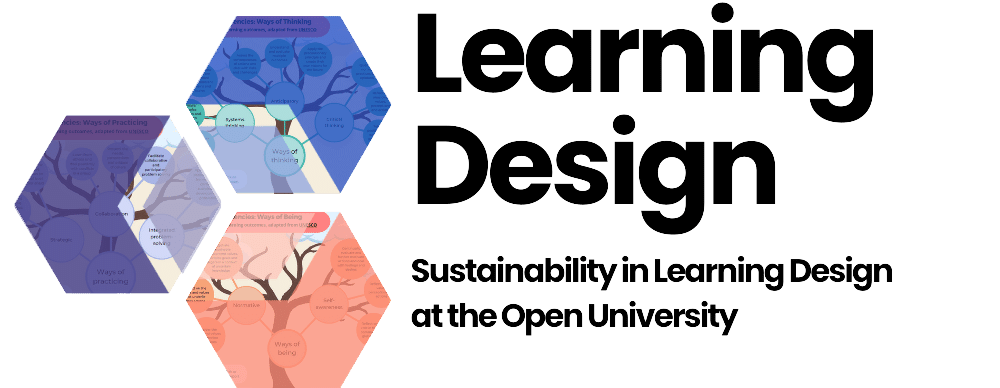
To support this process, the OU Learning Design Team has created a series of sustainability skills design cards. These cards translate UNESCO competencies into actionable ways of thinking, practising and being, and connect them with existing OU frameworks (employability, digital information literacy (DIL), and activity-type taxonomy) to support learning outcome and activity design.
The cards were created with the input of students from the OU’s Curriculum Design Student Panel. A key message from students is the importance of context in positioning sustainability away from feeling vague or ambiguous to being tangible and relatable.
Student voice
Student voices provide valuable insights and perspectives that can direct Higher Education Institutions (HEIs) towards sustainable futures in ways that are inclusive, accessible and engaging.
For example, national and institutional surveys tell us that students want HEIs to demonstrate stronger connections to sustainability in their courses (Carr-Shand, 2022; Kaplan, 2021; Unite Group, 2021). Students Organising for Sustainability (SOS) UK have collected yearly surveys since 2010 exploring students’ experiences of Sustainable Development of teaching and learning. Here are some highlights from the most recent results. These were collected in 2024 from almost 10,000 respondents:
- 86% felt their place of study should teach skills and understanding that positively impacts society and the environment.
- 77% indicated they would like to see sustainable development actively incorporated and promoted in all courses.
- 70% say that knowing their place of study limits its negative impact on the environment and society makes them proud to be a student there.
- 55% say they want to learn more about sustainability. (SOS-UK, 2025).
Engaging students aligns with the Relating and Collaborating dimensions of the IDGs and UNESCO’s emphasis on participation, communication and social responsibility. Working in ways that are informed by student voices or collaborate with students as partners also empowers students and staff to understand (and reflect on) each other’s perspectives, supports the transformation of thinking about teaching practices, and provides staff with a deeper understanding of student needs.
Reuse
The re-use of material is a practical and actionable way to save time and energy, for your benefit as well as the environment’s. Many existing sustainability resources already align with both UNESCO competencies and IDG dimensions. Using these as lenses to review materials through can help make sustainability more explicit without requiring major redesign.
Open Educational Resources (OERs) are one way to do this. They are ‘digitised materials offered freely and openly for educators, students and self-learners to use and re-use for teaching, learning and research’ (OECD). OpenLearn has guidance on how to find and evaluate OERs.
The OpenLearn sustainability hub contains free, expert-led OER content that can help you to turn knowledge into action. It covers a wealth of resources from climate change to the UN’s SDGs. It is also possible to filter resources by SDG if you want to focus in on a specific area.
Resources created by the OU Learning Design team are also available for re-use and adaptation under a creative commons licence. These include crib sheets which provide guidance on possible ways to use several of the resources. They can be downloaded from the Learning Design Blog.
Connection
Another way to develop sustainability practice is by connecting with the wider HE community. Learning from and collaborating with colleagues in the sector can provide opportunities to collectively move sustainability forward. Across the sector, there is a growing emphasis on capability-based and developmental approaches to sustainability education. The shared ground between UNESCO sustainability competencies and the IDGs helps situate local curriculum development within global educational priorities and sector-wide practice.
Like this? Try a FREE course
-
Am I ready to be a distance learner?
Learn more to access more details of Am I ready to be a distance learner?Distance learning can open up opportunities for study. You might have not studied for a while, you might be returning to education, or you might not have had the chance to study at a higher level before. This free course, Am I ready to be a distance learner?, will help to boost your confidence. You'll explore useful skills so you can discover ...

Level: 1 Introductory
-
Take your teaching online
Learn more to access more details of Take your teaching onlineIn this free course, Take your teaching online, you will gain knowledge fundamental to delivering effective teaching online. You will hear about the experiences of real educators, be introduced to cutting edge research, and understand the ideas and tools that shape how we teach and learn online. You will also learn useful methods that will ...

Level: 2 Intermediate
-
Teaching and learning tricky topics
Learn more to access more details of Teaching and learning tricky topicsThis free course is designed to provide a background and understanding of tricky topics, the practical application of threshold concepts, and their connection with learning design, digital innovation and learning analytics. The course, and the innovative teaching tricky topic process which it explores, will be useful for trainee or experienced ...

Level: 2 Intermediate
Rate and Review
Rate this article
Review this article
Log into OpenLearn to leave reviews and join in the conversation.
Article reviews