

A recent conversation between three colleagues from different professional backgrounds – education, social work, and academic development in Higher Education – explored the synergies and differences between how professional learning is framed in rhetoric and reality. What emerged was a rich tapestry of ideas, provocations, and shared tensions that challenge us to reimagine professional learning.
What is professional learning?
When thinking about professional learning, it is easy to default to formal programmes and structured training, but this obscures what we know about how people actually learn in their professional lives. There can be tension between regulated continuing professional development (CPD) requirements and authentic learning in professions such as health, social work and education. Ferguson (2022) highlights how we can reconceptualise professional learning for social work as a deeply personal embodied journey within daily practice.
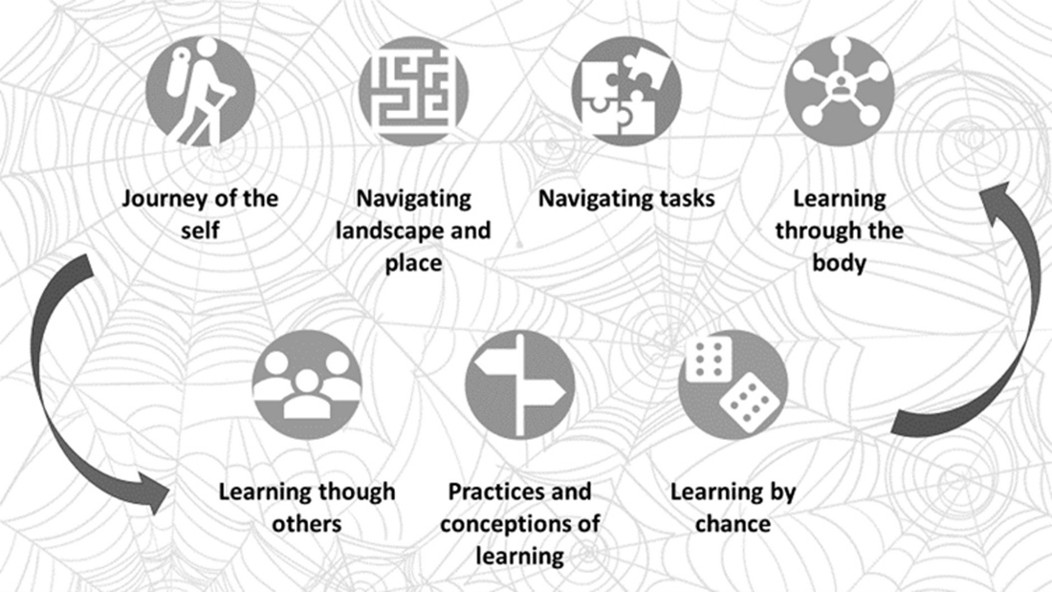 Figure 1 Learning in the workplace as a complex web (Ferguson, 2021, p. 124) The diagram shows 7 circles linked with black arrows on a background of a spider's web. The first circle shows an icon of a figure walking with a stick and backpack. The text Journey of the self is shown under the circle. The second circle shows a silhouette image of a maze. The words Navigating landscape and place are shown below the circle. The third circle shows 4 jigsaw pieces, three which are joined up with the fourth set apart. The words Navigating tasks is shown underneath. The fourth circle shows an icon of a person's upper body linked to 5 circle nodes. The words Learning through the body are shown underneath. The fifth circle shows 3 icon figures of people heads and shoulders. The words Learning through others is shown underneath. The sixth circle shows a blank signpost pointing in two different directions. The words Practices and conceptions of learning is shown underneath. The final circle shows dice underneath another dice, both faces showing six dots. The words Learning by chance are shown underneath.
An equally complex experience characterises learning for other professionals. Parkinson, McDonald and Quinlan (2020), working with academics in disrupted contexts, reconceptualise academic development as community development and suggest that this participant driven construct may also be applied to marginalised academic groups across a range of settings. In similar ways, early-career academics develop in liminal spaces through communities of practice, where identity, belonging and purpose are continually negotiated (Ndlovu, Mbatha & Msiza, 2024).
Appreciative understandings
Much professional learning is shaped around deficit modes of learning. We may be encouraged to attend a course to ‘fill a gap’ or to undertake professional enquiry to ‘solve’ an issue. In contrast, appreciative approaches (Cooke and Saunders, 2023) ask us to focus on what is working well, not just what needs fixing. In doing so, we explore what has powerful potential and imagine what could happen by changing aspects of our practice, opening us up to developing from our strengths rather than only learning from our weaknesses. Taking an appreciative stance aligns with diffractive, embodied, relational and serendipitous views of professional learning, where we are adopting a different kind of attention – towards appreciating and noticing what is and what could be.
Communities, landscapes and ecologies for learning
Communities of practice have long been recognised as a way of imagining networks for learning in the professional field; however, ideas have continued to evolve into thinking about whole landscapes for practice (Wenger Traynor & Wenger Traynor, 2015). It is within these landscapes that we learn to know. Spaces and places for connection are key within the landscape (Gravett et al., 2023). ‘Practicescapes’ (Costello et al. 2024) describe speculative approaches where practitioners explore possibilities through generative, poetic methods creating conditions for thinking differently by unsettling habitual patterns and opening space for possibility. Going further, imagining vibrant ecologies of professional learning (Jackson, 2019) invites a shift in how we support professional development, taking the unique needs and interests of professional groups into account (Ferguson, 2026).
Reflection or diffraction?
If professional learning is often serendipitous and informal, this reframes ‘what counts’ as processes of professional learning. Reflective practices are commonly discussed across professions, where we look backwards and towards ourselves as a stimulus for future action. Current literature asks whether diffraction, as an alternative concept, provides a more generative view of professional learning (Lambert, 2021; Hill, 2018). Here the emphasis is on a constant movement of pushing outwards. Like ripples in water, waves meeting can create amplifications, dilutions, interferences or prevent the original movement. Diffractive practices are about learning from the patterns of difference created (Barad, 2007) and from different relations interacting, represented visually by Cooke (2023) in Figure 2.
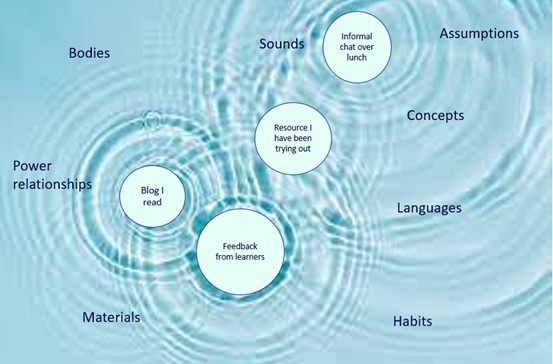 Figure 2 Illustrating the patterns created by bringing different elements of the praticescape together (Cooke, 2023) A blue background of intersecting ripples on water. On the surface are 4 circles with the following words within them: Informal chat over lunch; Resource I have been trying out; Blog I read; Feedback from learners. There are words also positioned on the surface of the water: Assumptions; Concepts; Languages; Habits; Materials; Power Relationships; Bodies. SoundsProfessional learning in the practicescape involves noticing what happens when different ideas, materials and acts interact with each other and deliberately experimenting with entangling different elements. This professional learning actively makes new professional worlds rather than reflecting on what already exists.
New conversations
The implication is clear: professional growth happens not primarily through formal interventions, but through the informal textures of professional practice. It is found in the conversations over coffee, the chance hallway encounters, the small kindnesses within communities where we feel, recalibrate and imagine otherwise. These moments are not peripheral to professional development; they constitute the embodied, relational and affective dimensions central to contemporary professionalism.
New worlds
This conversation scratches the surface of what constitutes professional learning and is just the beginning. We see these ideas as provocations—openings for further dialogue with professionals from different fields. We invite you to think about how we can create new professional learning worlds that create and value meaningful development, growth and transformation. How can we share ideas across professions and learn together?
Like this? Try a FREE course
-
Succeed with learning
Learn more to access more details of Succeed with learningThis course is for people who want to feel more confident about their learning skills. Informal in approach, the course builds on each person's own qualities, knowledge and skills to develop a deeper understanding of the nature of learning and of their own potential. It introduces some core ideas about learning and academic study, and some ...

-
Working in teams
Learn more to access more details of Working in teamsThis course will help you consider your experience of working in teams and the different roles you play in them. It will increase your confidence in marketing this key skill to employers as well improve your ability to perform well in teams you are currently part of.

-
Leadership and followership
Learn more to access more details of Leadership and followershipExplore what makes a good leader, recognise common leadership challenges, and identify the skills you need to develop if you want to enhance your own leadership experience.

Rate and Review
Rate this article
Review this article
Log into OpenLearn to leave reviews and join in the conversation.
Article reviews